 Join on WhatsApp
 Join on Telegram
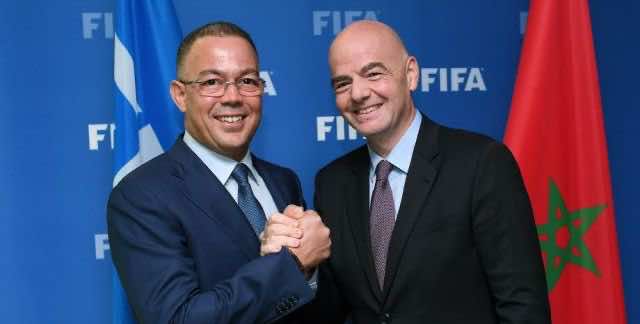
Rabat – Following the publication of the FIFA task force’s final evaluation of the preparedness of the two bids in competition to host the 2026 World Cup, FIFA president Gianni Infantino took upon himself the critical task of reassuring voters and the bids’ representatives of FIFA’s ethical standards throughout the whole voting process.
“FIFA will have no problems with a Moroccan World Cup,” Infantino said last week in an interview, despite reports that he had been trying to undermine Morocco’s bid.
But the undertone of Infantino’s remark suggested—unsurprisingly—something else altogether: fully aware that vitriolic comments have made the rounds in recent months about his alleged “dirty plot” to disqualify Morocco 2026, the FIFA president clearly wanted to take a final opportunity to distance himself from partisanship.
As the president of football’s supreme governing body, Infantino seemed to argue his only mandate is to enforce the game’s cardinal rule of fair play: inclusiveness, fairness, objectivity, neutrality, and honesty.
For all their importance for FIFA’s survival, money and big business interests do not and should not constitute the most essential components of football, to keep the game safe from the lure of hyper-capitalistic post-modern sports.
The North American trio is FIFA’s preference
But Infantino’s FIFA had already let Moroccan fans down. They did not understand the task force’s ambivalent theatre when it visited Morocco, changing its plans and making last minute readjustments without informing Moroccan authorities beforehand.
Moroccans never understood why Infantino urged Morocco 2026’s supporters to abstain from subjective public comments, and yet he himself kept saying in interviews that the United bid would bring higher financial returns than any other host before, and that FIFA’s coffers are in dire need of such funding.
They were outraged when FIFA singly bullied and lectured Morocco’s bid under the guise of “objectivity instructions,” explaining attitudes they must have during the entirety of the bidding, campaigning, and voting process. And how could anyone explain the fact that the FIFA 2026 television rights went to US-based media corporations without being put out to tender?
So for Moroccan fans, there already was a discernible Americanophile pattern in Infantino’s previous comments, which is why last week’s words were no music at all to the ears of Morocco 2026 supporters.
Morocco’s merits are underrated
“The cost of organizing the event of the World Cup is well supported by Moroccan government, and there is no question about that,” a source in the inner circle of the Morocco 2026 team, who requested anonymity, told Morocco World News by email.
Suggesting that Infantino’s claims that Morocco 2026 would be far more costly to FIFA is somewhat exaggerated. The source explained how Morocco has made considerable headway in its infrastructure, with a “high speed train that will connect three major host cities like Tangier, Rabat, and Casablanca in a very short time.”
“The FIFA president and his task force should know that Morocco is a welcoming country. Morocco has passed the task force’s examination. It is now up to voters to make their honest decision without any outside pressure,” the source concluded, hinting at a slight bias in Infantino’s appeal last week to national federations not to base their votes on “subjective criteria.”
Victory for Morocco 2026
Others just cannot understand why the US and Canada are intent on organizing an event which the majority of their populations have no interest in.
“They even annoyingly call the beautiful game ‘soccer,’ ” Hassan told Morocco World News this weekend as he nonchalantly sipped at his Moroccan tea in Campus Café in the Al Irfane neighborhood in Rabat, watching Brazil crush Austria 3-0 in their final pre-World Cup warm up. That was after Morocco hammered Estonia with an impressive 3-1 win.
“This summer, I will support Morocco, other African teams, and Brazil,” he added, pausing for emphasis with the theatrical look that football fans like to wear when discussing their favorite teams and players.
“These are the places that play and live football. These are places where football is a vibrant culture impacting and changing so many lives. Does FIFA really think that many Americans care about football? I wish people voting this summer could understand that we need and value the World Cup more than the US.
“They should for once give us the opportunity to show the world what we can offer. The excitement and love we can bring to this tournament will be magical and much more memorable than a match somewhere in Canada or in an NBA and NFA fans-packed stadium in America, no matter how huge the stadium or how impressive the infrastructure.”
Asked about Infantino’s neutrality and objectivity comments ahead of the Wednesday vote at the 68th FIFA Congress in Moscow, Hassan calmly replied: “He really said that? Well, that’s finally nice of him. But we really don’t need that now. The damage his previous comments and pro-America position inflicted on us is big enough already. That cannot just miraculously evaporate with a well-meaning statement that should have come much earlier. Infantino should have known better than this.”
Amine Messaoudi, a passionate Liverpool and Casablanca Wydad fan, is even more unapologetic about his love and support for a Moroccan World Cup.
“This is a national cause,” he says. “I’m well aware of the power and resources of the US. And I honestly think that it will be really hard to beat a bid that has the US with it. But this is Morocco. And does America really need to host a World Cup? First, we will win this 2018 World Cup, and then in 2026 we’ll organize one of the best tournaments ever.”
Sensing the disbelief and the shocking but friendly and supportive reaction that his 2018 World Cup comments caused, he said: “Why not? Are we not allowed to dream of triumph? What is the point of joining a contest if you do not think you can win it?”