 Join on WhatsApp
 Join on Telegram
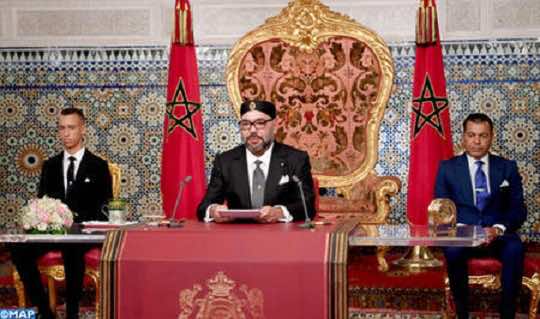
Rabat – In “Africa in 2019,” a special edition about what factors are likely to drive continental politics in the coming year, Jeune Afrique, arguably Francophone Africa’s most read and influential magazine, paid particular attention to King Mohammed VI of Morocco’s twenty years of reign.
On July 30 of next year, King Mohammed VI will celebrate the 20th anniversary of his ascension to the throne. How has the King fared in his two decades in charge? How has Morocco changed under his auspices and what awaits the North African country in 2019 as it seems to be looking to the future with regional aspirations?
There are still daily difficulties, especially a youth with fewer opportunities and seeking to leave the country at all costs, Jeune Afrique said of Morocco’s current social and political states.
But for all the persisting difficulties, the article hastened to add, Morocco is now “incomparably more accessible, free, and open.”
In what reads like a paean to the King’s policies, the newspaper discredited all the criticism that has come Mohammed VI’s way in recent years. According to Francois Soudan, the newspaper’s editor-in-chief who penned the editorial, the Morocco that critics often portray is starkly different from the Morocco that has emerged under Mohammed VI’s guidance.
“None of the catastrophic predictions about Morocco held true,” Soudan wrote. And as Morocco continues to thrive despite some “stubborn” issues, “one is tempted to wonder about what really bothers” the kingdom’s “alarmist critics.”
Maybe, the article answered its own wonder, “European commentators have a problem with how attached Moroccans are to the monarchy, as well as to a King who is seen as the commander of all believers.”
While “Moroccans feared Hassan II,” they seem to “love his son” as people never protested against his legitimacy or doubted his devotion to the country’s well-being, “even in the hottest moments of recent upheavals.”
“Of course there have been upheavals in the two decades. Terrorist strikes, the 20 February uprisings, the Hirak movement in the Rif. But every time, in complete rupture with his father’s style, Mohammed VI reacted at the right time.”
In addition to the “professionalism of security forces” in the case of Hirak, Mohammed VI showed that he sympathized with popular demands by “immediately re-launching development and employment-generating projects” for historically marginalized regions.
But the 20 years have been no bed of roses. Poor education quality and a deepening lack of employment prospects for young Moroccans are still some of the issues that Mohammed VI’s Morocco has not entirely come to terms with.
“The way forward for Morocco’s youth is still long,” the article noted, citing risks of radicalization and related dangers connected to youth issues. But it quickly added a corrective note, saying that the country’s current poor performance on the educational front should not downplay King Mohammed VI’s “passionate efforts” to find a solution to Morocco’s education and youth issues.
“One has to be either blind or ill-intentioned to pretend, as do some in Europe, that Morocco has not changed and the transition between the two reigns has not yet taken place. Morocco today is freer and more open than it ever was.”