 Join on WhatsApp
 Join on Telegram
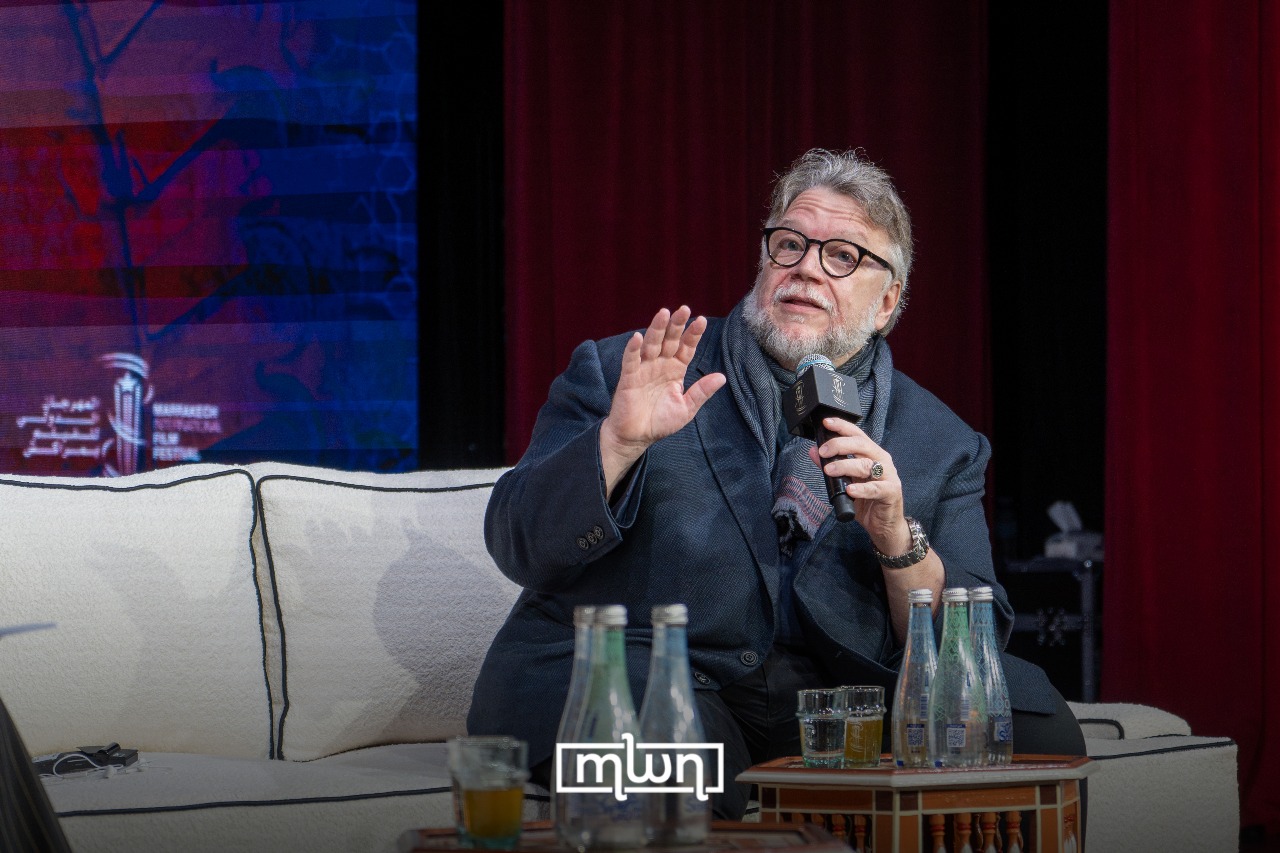
Marrakech – Mexican master filmmaker Guillermo del Toro delivered provocative declarations and startling revelations during his tribute conversation at the 22nd Marrakech International Film Festival on Friday. The three-time Oscar winner and acclaimed author stunned audiences with radical statements on mortality, artificial intelligence, and modern civilization’s spiritual decay.
“Why should you want to live longer?” del Toro asked the packed auditorium of festival attendees and film students. “I’m a big fan of death. I think death is really good. I’m certainly looking forward to it, because it’s the day you go, ‘Well, tomorrow I won’t have any problems.’”
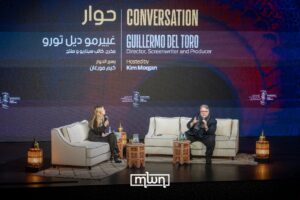
The director’s shocking philosophy emerged during a nearly two-hour conversation moderated by screenwriter Kim Morgan, his wife. Del Toro discussed his 50-year journey adapting Mary Shelley’s “Frankenstein,” which recently premiered at the Venice Film Festival starring Oscar Isaac and Jacob Elordi.
Del Toro revealed his deeply personal relationship with cinema, confessing he maintains minimal social existence outside filmmaking. “I have very little social life to speak of. This is my life,” he stated. “To me, this is not my filmography, it’s my biography. When I see these things, it’s like watching a family album.”
The filmmaker traced his monster obsession to age seven, encountering Boris Karloff’s Frankenstein creature. “That was religion. That was my church,” he explained. “I immediately felt that what my grandmother used to feel about Jesus, I now felt about Boris. And I saw myself in him.”
His Catholic grandmother attempted multiple exorcisms, horrified by his supernatural drawings. The religious persecution created lasting trauma that shaped his artistic vision. “I was a very strange child at age seven, and I felt that he didn’t belong in the world the same way I didn’t belong in the world,” del Toro shared about identifying with Karloff’s creature.
At eleven, del Toro discovered Shelley’s novel in a supermarket and consumed it entirely in one sitting. “I felt I had read the best book in the world ever,” he recalled. “At age 11, all those questions were in me, but I couldn’t name them. Little did I know that they had been written by somebody that was seven years older than me when I was 11.”
His grandmother taught him reading using his deceased mother’s gravestone, forging connections between literacy, death, and maternal absence that permeate his entire filmography. This traumatic education method influenced his recurring themes of birth anxiety and paternal relationships.
A brutal manifesto against modern illusions
Del Toro launched fierce attacks against artificial intelligence during the conversation. “Fuck AI,” he declared emphatically and without hesitation. “It’s not about artificial intelligence. Intelligence is not the matter. It’s stupidity. They want to foster stupidity. They want you to relinquish your spirit and your emotion to an algorithm that is gonna create art, but it’s not – it’s illustration.”

The director positioned his resistance within broader cultural movements. “The main fight of the romantic spirit was against the industrial revolution,” he offered. “And we should not relinquish everything to the machine. It’s the same spirit we’re in right now.”
Del Toro identified three destructive obsessions plaguing modern humanity. “There are three brutal means that I obsess about,” he explained. “Wealth. I obsess about why people live in a world where wealth makes no sense as a pursuit. The other one is romantic love and the seeking of perfection, which kills everything. And the last one is to live longer.”
His critique of contemporary emotional suppression revealed deep cultural concerns. “I’m Mexican, so emotion is big for me. I think emotion is very scarce right now. We have come to a point in civilization when emotion seems to be something you hide,” he stated.
“We are in a horrible moment where cynicism simulates intelligence. If you say, ‘I believe in love,’ you’re a fool. If you say, ‘I don’t believe in love,’ you’re a wise man. I don’t agree with any of that.”
The filmmaker advocated for operatic emotional expression through cinema. “I wanted the movie to feel like an opera, to feel really emotional,” he said of “Frankenstein,” adding: “The Romantics took a huge step toward the possibility of ridicule by the way they embraced spirituality, emotion, and sensation.”
Del Toro celebrated the sacred relationship between humanity and artistic creation. “Images are sacred, no matter what they tell us that can be done with them. They cannot be permutations. They have to feed from your spirit and your pain and your humanity,” he declared. “There is a tacit covenant between mankind and images that is sacred.”
The director revealed experiencing profound “postpartum depression” after completing his lifelong Frankenstein adaptation. “For 50 years, imagine that, for 50 years, you gather things, and you say, ‘I’m gonna do this when I do Frankenstein,’” he reflected. “And then finally, you do Frankenstein. And there’s no future. There’s no more horizon left, and the achievement felt unnatural.”
Del Toro’s extensive filmography includes “Cronos” (1993), “The Devil’s Backbone,” “Pan’s Labyrinth,” “Hellboy,” “Pacific Rim,” “Crimson Peak,” “The Shape of Water,” and “Pinocchio.” His gothic aesthetic emerged from childhood religious trauma and monster fascination, transforming personal darkness into celebrated cinematic art.
Del Toro revealed his unconventional understanding of romantic connection during the Marrakech conversation, rejecting traditional notions of attraction based on commonalities or beauty.
“To me, love is not identifying commonalities and things you like, or things that are beautiful,” he explained. “I think love happens when two people realize they’re hurt in a similar way. It’s the lackings that cause the attraction. We’re missing the same parts.”
The director illustrated this philosophy through his creature design in “Frankenstein,” which draws inspiration from the Japanese art of kintsugi – the practice of repairing broken porcelain with veins of gold. “Therefore, it becomes more precious than when it was intact,” del Toro noted, suggesting that emotional wounds and imperfections create deeper bonds than superficial attractions.
This perspective reflects his broader artistic vision that celebrates brokenness as a source of beauty and connection, positioning vulnerability and shared trauma as foundations for authentic human relationships rather than obstacles to overcome.
Mortality as natural rhythm rather than feared conclusion
The director champions imperfection through monstrous characters representing marginalized humanity. “The reason I love monsters is because they offer permission to be imperfect,” he explained. “We live in a world that tells us we have to be either the worst that ever lived, or the best that ever lived. Monsters tell you that you can be fucked up and a good person at the same goddamn time.”
His philosophical framework encompasses mortality as a natural rhythm rather than a feared conclusion. “As a Mexican, I know that the world is terrible and beautiful the same day, at the same moment,” he stated. “The day you are dancing your first dance, having your first child, somebody is being murdered, somebody’s losing something else.”
Del Toro belongs to the triumvirate of Mexican directors who revolutionized contemporary cinema alongside Alejandro González Iñárritu and Alfonso Cuarón. Their friendship represents artistic solidarity and creative collaboration within international filmmaking.
His adaptation methodology involves intertextual approaches combining source material with biographical elements. “I decided to do an intertextual adaptation. Not only the text, but the subjects, the context, and the biography of myself and Mary Shelley was gonna fuse,” he explained about “Frankenstein.”
Del Toro studied Romantic poets extensively, particularly Lord Byron and Percy Shelley, incorporating their philosophical sensibilities into his cinematic language. “I fused with the romantic sensibility, the pre-Victorian sensibility. I felt completely taken by the principles of romantic movement, both in music and in painting.”
His influence extends beyond horror genres into auteur cinema, combining literary sophistication with visual mastery developed through decades of practical effects work. Del Toro maintains unwavering artistic independence while achieving mainstream Hollywood success.
The Marrakech tribute celebrated del Toro’s contribution to contemporary cinema through his unique fusion of horror, fantasy, and humanistic storytelling. His work continues challenging audiences to find beauty within grotesque realities while maintaining authentic emotional connections in an increasingly cynical world.
The filmmaker advocates artistic vulnerability as an essential creative principle. “You have to be completely open to failure if you’re ever to experience success. You have to be ready to be ridiculous. So I’m ready to be ridiculous at all times,” he concluded.