 Join on WhatsApp
 Join on Telegram
Rabat – We would not automatically think of banjo tunes segueing into traditional Moroccan Gnaoua music, fused with blues and jazz. But this trajectory made all the sense in the world for Majid Bekkas, an internationally renowned pioneer of Gnaoua fusion music.
The native of Sale, Morocco, started playing the banjo at 15 years old. From picking the twangy instrument to working as a librarian for the Moroccan Ministry of Culture, Bekkas followed an unusual career route that lead to a unique genre.
Even after teaching classical guitar at Rabat’s National Conservatory of Music, Bekkas finally said, “Enough. I prefer to spend the rest of my life playing my music. That’s what I do.” Bekkas shared stories and opinions on his career, the spirit of Gnaoua music, and the genre’s international trajectory, in an interview with Morocco World News.
Bekkas accepted a fresh juice with this reporter along the Sale Marina, across the Bouregreg River from the capital city Rabat. Sunlight danced across the waves as the musician began to recall his musical journey.
An emerging musician
At 15, Bekkas picked a banjo to play popular “chaabi” music before he helped the recent Gnaoua renaissance. Gnaoua music is a traditional Moroccan genre with roots in slavery, a fame for its trance practices, and hypnotizingly beautiful rhythms.
Gnaoua was not popular during Bekkas’ banjo days. At the time, “when you said Gnaoua,” Bekkas remembers, “you said slave.”
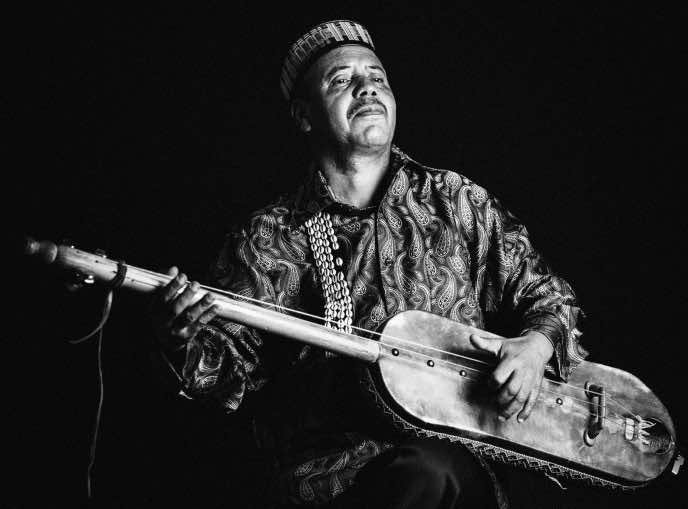
During his banjo days, Bekkas found inspiration in Casablanca’s Nass el Ghiwa, which he phrased as “the Beatles of Morocco.… The history of the groups, it starts with this group.” This band featured the guembri, a traditional Gnaoua two-string instrument. As soon as the guembri touched Bekkas, his banjo was doomed to take a back seat.
The Gnaoua master, or “maalem,” Ba Houmane was a popular figure in Sale. Bekkas watched the well-known community member drumming Gnaoua in the streets. He connected.
“One day I followed him. He was with the drum and I was following him until his house. And he told me, ‘What do you want?’ I was a very—I don’t know—something, something was in me, told me that I must follow him.” Thus began his menteeship on the camel-skin bass instrument.
A Gnaoua renaissance and African identity
Nestled in the Arab world and North Africa, Moroccan identity is sometimes conflicted. Gnaoua’s recent revival plays a part in connecting Moroccans to a pan-African identity. “I think Gnaoua music in itself, she’s African.… The mother is one—it’s Africa. Even with the blues, the blues or Gnaoua music—African music. The mother is one.”
Bekkas is enthused for the Gnaoua diaspora but has concerns about preserving its integrity.
“I still hope that this music [can] be more developed.… But what I am afraid of—I’m afraid that it becomes something that will lose the spirituality of this music. That’s the most important in this music—to stay spiritual. And so we have to be careful when [we] speak about fusion, we really have to be careful, and we have to be open to know about the other cultures before starting to make this fusion between Gnaoua and the other music.”
His work proves that Gnaoua’s essence can be preserved with open-minded cooperation and inspiration.
Gnaoua’s spreading popularity has a lot to do with coastal Essaouira’s annual Gnaoua World Music Festival. In June, an estimated half million+ music fans traveled to the 22nd annual celebration—a celebration both of Gnaoua music and its capacity to complement other genres from around the world. Music transcended borders under the stars on stages free for all visitors.
Read also: Focus on Music, Not Shopping at Annual Essaouira Gnaoua Festival
Long before the festival, legends like Jimi Hendrix visited the area to learn from Gnaoua music. This genre, at the roots of so much beloved music, is now up for a vote into UNESCO’s Intangible Cultural Heritage of Humanity list.
Preserving spirituality and authenticity
“Gnaoua music, it’s not only music … the master of Gnaoua, at the same time, he’s—how do you call it—guerisseur. Healer of the soul.… It’s the other function of the master. He organizes a Gnaoua night, we call it lila, when someone doesn’t feel good.… They play these colors—seven colors—we have seven colors in the lila. And they play these seven colors until the morning. And after that, people enter in trance, and they feel much better. It’s why they call the masters of Gnaoua also the healers of the soul.”
Bekkas believes these sacred trance roots will be key to preserving the genre in its integrity. “It’s because of the lila that this music will never disappear. You can never lose it, because in the Gnaoua night, we play the tradition—all the tradition, tradition repertoire. In the festival, it’s what we call secular. In the lila, we play the sacred. And in the festival, the secular. That’s the difference.”
This is starting to change. Gnaoua’s increasing popularity means recognition and new festivals in Europe. “It’s great – that means that it’s a big success. And now in Belgium, they’re gonna organize the first edition of a Gnaoua festival.”
Bekkas will perform in Belgium October 2 and performed in Berlin in August. The Berlin festival, in its second year, actually includes a lila trance night to share the music’s spirituality. “I hope in each European city, we will have a Gnaoua festival like this. The Gnaoua can tour all over the world,” he added.
Read also: Morocco Nominates Gnawa Music for UNESCO’s Cultural Heritage List
Cultural appropriation?
Essaouira’s emblematic festival faces concerns about cultural appropriation and a focus on foreign artists. As long as the music retains its integrity, Bekkas is not worried about cultural appropriation or fusion.
He acknowledged inequities within the group of artists but focused on the opportunities playing with big names provides to the Gnaoua community.
“I think that the organizers—they try to, of course, you know when you bring a big name, it’s—treatment is different, everywhere. Even in the United States.… But the Gnaoua musicians, the Moroccans, they cannot forget that, at least this festival, it gives them the opportunity to play and to share their music with thousands of people.”
Festivals in Morocco rarely invite Gnaoua musicians. “And then there are many specialists there, many professionals, they can choose some [Gnaoua] groups to play abroad,” he pointed out.
In addition to playing upcoming festivals in Europe, Bekkas is working on a record with the Afro Gnaoua Jazz Ensemble. Essaouira attendees in June got a sneak peak at their work during a high-energy show—fans should look forward to an electric guembri solo on the album.
Bekkas personally recommends anyone new to the genre listen to three different maalems, masters of the three schools of Gnaoua: Maalem Sam, Maalem Hamid Da Bouso, and Maalem Mahmoud Guinea. Looking into Gnaoua fusion, Bekkas’ classic “African Gnaoua Blues” is a must-listen.
Read also: In Pictures, the 1st Day of the Colorful Gnaoua Festival in Essaouira