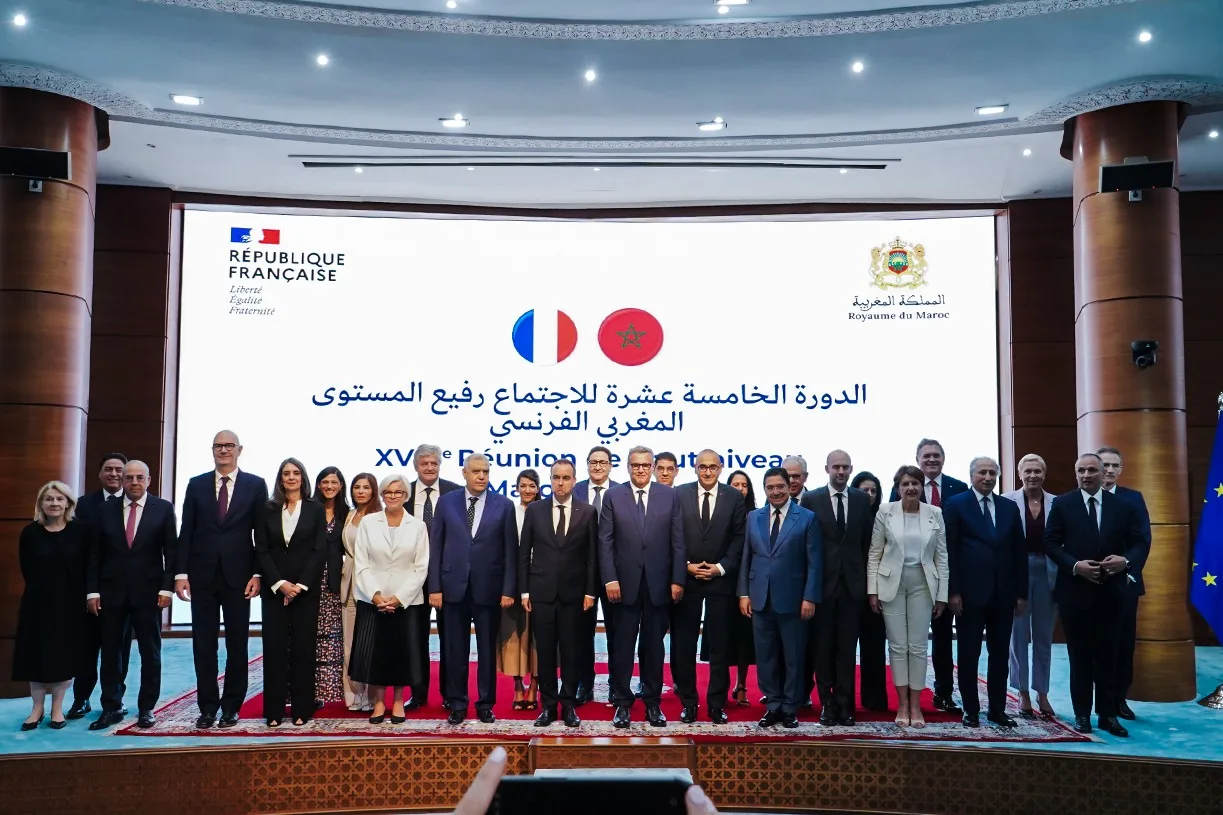
Marrakech – French Prime Minister Sébastien Lecornu announced the launch of an expression of interest for a direct electric interconnection between Morocco and France during the 15th High-Level Meeting (HLN) in Rabat on Thursday.
The project, dubbed “Pont de la Méditerranée,” would channel green electricity produced in northern Morocco directly to French and European markets.
The initiative envisions a subsea high-voltage cable running from Nador to Marseille, bypassing the Iberian Peninsula entirely. The route marks a departure from the historical logic of European electricity networks, where Spain served as the natural transit point for North African power flowing into the continent.
Lecornu cited the interconnection among “the major energy connectivity projects between Europe and North Africa,” framing it as one of the most ambitious economic undertakings between the two countries.
The investments, he noted, are creating “new synergies between our companies” while working to “continue integrating Morocco and France into the same value chains.” The project, in his view, fits a broader push to “organize the future” through large-scale infrastructure rather than conventional trade exchanges alone.
From failed UK cable to French pivot
The project had already been the subject of detailed public analysis months before Lecornu’s formal announcement. In February, French energy firm Selectra published an extensive breakdown of the initiative under the name Qantara Med, tracing its origins to the collapse of a far more ambitious plan.
British company Xlinks had initially proposed a 3,800-kilometer cable linking Morocco to the United Kingdom at an estimated cost of €29 billion. The UK government under Keir Starmer ultimately pulled back, opting to prioritize domestic energy capacity.
Rather than abandon the concept, Xlinks pivoted toward France, establishing a subsidiary called Elemental Power on French soil in 2024 to manage the administrative and technical groundwork for the Nador-Marseille connection.
Selectra’s analysis positioned Marseille as “the main entry point for African green energy into Western Europe.” The city would function not merely as a commercial port but as a strategic node in southern France’s electricity grid, “capable of absorbing several gigawatts” without transit through the Iberian Peninsula.
The proposed route, the study noted, “breaks with the historical logic of European electricity networks,” adding that the subsea option “frees the project from the geographical and political constraints of the Pyrenees.”
For Morocco, the project would reinforce the country’s ambition to become a regional energy platform. Investments in solar and wind have given the country renewable production costs that, as Selectra put it, defy European competition. The analysis described Morocco as “no longer a simple commercial partner, but a major new player in European decarbonization.”
For France, a direct link would reduce dependence on the pricing policies and infrastructure constraints of its Spanish neighbor – a move the study framed as a reflection of Paris’s intent to “directly control the valves” of tomorrow’s energy supply.
In Madrid, the announcement is likely to fuel concern. Spain has long pushed for stronger cross-border lines with France to export its own renewable surpluses – a struggle tied to what analysts describe as its “energy island” status. France’s decision to prioritize a direct Moroccan link adds pressure to that position.
A partnership ‘changing scale’
The technical groundwork is already underway. In April, Moroccan Minister of Energy Transition Leïla Benali held discussions with Gérard Mestrallet, special envoy of President Emmanuel Macron, and Xavier Piechaczyk, chairman of France’s national grid operator RTE.
Participants at the time stressed the need for “close cooperation and permanent coordination” to accelerate the project’s implementation.
The interconnection project was part of several agreements signed during the HLN, which Lecornu co-chaired with Moroccan Head of Government Aziz Akhannouch.
It marked the first session of its kind since 2019 and Lecornu’s first foreign trip since taking office. A delegation of 12 French ministers – including those overseeing foreign affairs, interior, and economy – accompanied him.
Lecornu described the follow-up on commitments made during Macron’s October 2024 state visit as “exceptionally positive” across industry, energy, security, defense, culture, education, and agriculture. Beyond the electric interconnection, the signed agreements covered cooperation in rail, maritime transport, road infrastructure, research, culture, and innovation.
The French premier also confirmed that the two countries are preparing a bilateral treaty – “the first that France will sign with a country outside the European Union.” A joint committee of qualified figures from both sides will draft the text, intended to provide “a unique, stable, ambitious framework adapted to the challenges of the coming decades.”
On the broader strategic front, Lecornu pointed to Morocco’s role in peace and security in the Sahel and across Africa. He called the Franco-Moroccan partnership one that “must now change scale,” citing the political conditions needed to build a more durable relationship.
Selectra’s analysis offered a broader takeaway on the project’s significance: tomorrow’s energy “will not necessarily follow the shortest routes, but those that guarantee the greatest geopolitical independence.”
Lecornu departed Morocco Thursday evening. Akhannouch saw him off at Rabat-Salé airport, where the French premier reviewed a detachment of the Royal Air Force before his departure.