
 Join on WhatsApp
 Join on Telegram
As Moroccan football enters a new era ahead of the 2030 World Cup, one question is increasingly echoing among Wydad fans: what should the future of the club look like?
The debate goes beyond results on the pitch. It touches ownership, identity, investment and the very structure of one of Morocco’s biggest football institutions.
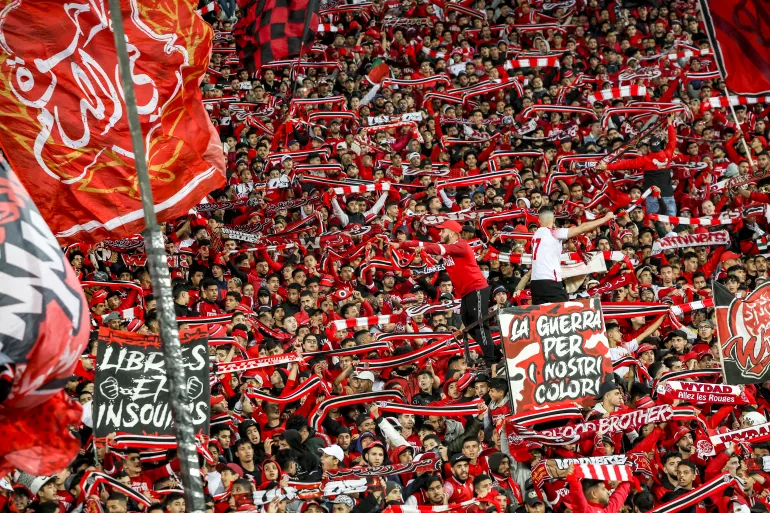
Lately, Wydad fans have been rallying around one big goal: keeping the club truly independent. Supporters are making it crystal clear that they want no part of any semi-public or institutionally controlled setups that threaten the club’s grassroots identity.
The conversation arrives at a particularly fragile moment in the club’s history. Wydad is currently navigating one of the deepest institutional and financial crises in recent years, a period many supporters view as a turning point that could shape the club’s long-term future.
Under mounting pressure from fans and club members, President Hicham Aït Menna and the entire executive board recently announced their collective resignation, paving the way for an Ordinary and Elective General Assembly scheduled for July 15.
Sporting struggles, fan pressure and a wider debate over Wydad’s identity
The institutional crisis did not emerge in isolation.
Discontent intensified after a difficult sporting period that saw Wydad go through a six-match winless run in the Botola Pro.
Although a recent Casablanca Derby win over Raja offered temporary relief and revived momentum on the pitch, deeper frustrations are still unresolved.
Frequent changes in technical leadership have also fueled concerns. The club has struggled to establish continuity in its sporting project after repeated managerial shifts, including the recent departure of Patrice Carteron.
At the same time, Wydad continues dealing with huge financial burdens inherited from previous administrations, including unresolved disputes involving former players and suppliers.
The pressure eventually evolved beyond footballing results.
Fans, particularly members of the Winners 2005 ultras group and club members, started asking for bigger structural reforms. Their calls include a fully independent financial audit, greater transparency surrounding club finances and debt obligations, and a more democratic institutional model.
Some fans have also opposed allowing the outgoing board to oversee daily operations until the July assembly. Calls for an independent transition committee have surfaced.
The transition calendar has already been outlined:
- May 5-June 5: Membership campaign for the 2026-27 season
- June 6-June 20: Official presidential candidacy period
- July 15: Ordinary and Elective General Assembly
In this context, more discussions about ownership and privatization have gained momentum.
For Hassan Samrhouni, a lifelong, passionate supporter and an influential figure within the club, this issue represents a bigger opportunity.
“In a world where football clubs are becoming global brands and economic powerhouses, Wydad stands at a crossroads,” he argued.
With Morocco stepping into the global spotlight for the 2030 World Cup, Samrhouni is convinced the club is at a turning point. He sees Wydad evolving into a professional sporting enterprise, making it a prime target for investors looking to get involved in Moroccan football.
“A privately held Wydad could attract foreign investment while also inviting Moroccan investors,” he told Morocco World News. He’s adamant that no matter how the club changes, its independence isn’t up for negotiation.
And many fans already know where they stand. “There is a big movement now from Wydadi fans. They’re against the idea of Wydad becoming semi-public,” Samrhouni said.
“It’s like Raja when they partnered with Marsa. It remained essentially semi-public because there is not as much freedom as we find in the Premier League, for example.”
He says supporters worry that such a model could prevent Wydad from maximizing its economic and sporting potential.
“So Wydadi fans did not like this policy. They want the team to stay independent and attract sponsors from both inside and outside Morocco, especially with many investors eager to buy shares in Wydad.”
Samrhouni also framed the discussion through the issue of valuation.
“Today, the club is worth 100 million dirhams and it’s the first of its kind in Moroccan football. So Wydad will not benefit from its true value, and its valuation could stay at around 15 million dirhams.”
Today, fans are actively driving the conversation about the club’s future. From street protests to public demands for accountability, they’ve shown that they won’t settle for anything less than real structural change.
For many of them, this isn’t just a technical debate about contracts or sponsors anymore. It has become a debate about who controls Wydad’s future and what kind of institution the Red Castle wants to become.