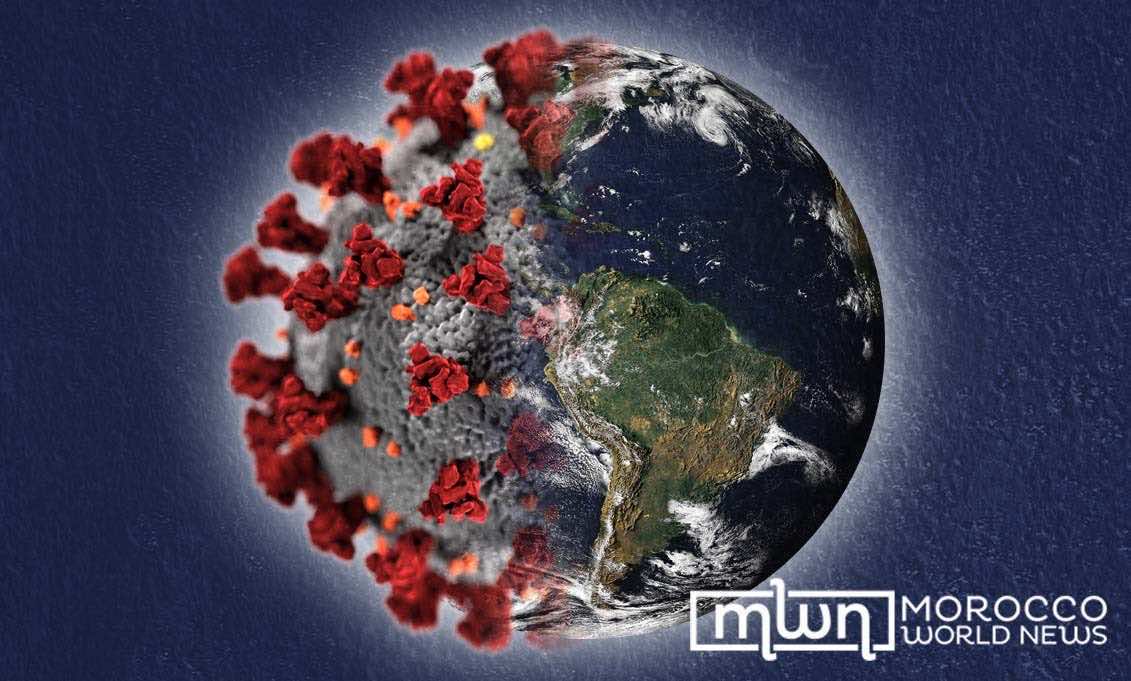
Rabat – The coronavirus crisis’ management, on national and international levels, will shift political priorities across the globe.
New priorities will emerge from the crisis response, both domestically and globally. These priorities may transform two critical variables to majorly impact the future of both the nation-state and the international system.
Internally, the question of the social contract will be posed in new terms and with new expectations. On the international level, many predict the crisis of multilateralism will deepen and open a path to redefine international leadership and its related institutions.
While some impact on the futures of the nation-state and the international system is inevitable, uncertainty regarding the coronavirus crisis’ full economic impact looms heavily. Major world powers are grounded in a zero sum game, reflecting already tense geopolitics and reaffirming an uncontested gap in international leadership.
Two factors will require leaders to profoundly revisit and review the nation state’s political agendas. The first relates to changes in the moral and contractual links between the nation-state, represented by political elites, and society as a whole, represented by civil society and economic actors.
The second relates to the international system’s ongoing path towards what Emeritus Professor of International Relations at the London School of Economics Barry Buzan calls “apolarity.” In other words, the surging coronavirus pandemic is highlighting a leadership vacuum in both the West and the East.
Challenging the social contract
In this time of crisis, the terms of the social contract are under unprecedented pressure. The virus appeared in a moment of history marked by widespread popular upheaval, occurring horizontally within many societies across the world. One common denominator of these crowds marching through the streets of France, Colombia, Iraq, Algeria, and others: A deep distrust in government ability to respond to people’s socio-economic needs.
Governments with declining legitimacy continue to use neoliberal laws to justify policy choices as rational. The last three decades have marked the rise of a virulent financial form of globalization. This will inevitably serve as the framework of a new world economic system.
Leaders facing the growing coronavirus pandemic are responding to the crisis in many different ways. All responses reveal how managing an asymmetric and invisible threat to human health could unveil new forms of vulnerability.
European countries provide an example of this, as they are unable to cover vital needs such as face masks, ventilators, and other medical equipment. In parallel, some developing countries, such as Morocco and Senegal, are demonstrating a reconfiguration of strength, ability, and resilience.
The crisis shows that western countries are overwhelmingly underprepared to cope with a transnational threat characterized by a sudden and rapid spread. The pandemic’s deadly impact proves that military means may become useless in fighting invisible threats. The impact also shows to what extent the most powerful intelligence services around the world may fail to foresee non-traditional threats such as pandemics, cyber attacks, and global financial crises.
Self interest compromises effective response
On the international stage, pandemic responses demonstrate fragmentation, a lack of coordination, and even a resurgence of warlike tactics. The US has tried to monopolize ownership of a vaccine, and some countries have attempted to seize medical supplies destined for other nations.
In a time when cooperation between major powers should rank at the top of the international agenda to tackle the pandemic’s propagation, the opposite scenario is unfolding. Individual responses unveil an existential crisis for the international scheme of peace and security, and demonstrate the failure of 21st century multilateralism.
China’s crisis management remains consistent to the nature of its political system. Still, many Western analysts and commentators, as well as American politicians, have criticized China’s lack of transparency regarding the origins and specifics of what US President Donald Trump calls “the Chinese virus.”
Chinese leaders adopted a “strategy of unanimity.” The political system successfully contained the spread of the virus thanks to a political culture of self-sacrifice for the collective interest, deeply embedded in Chinese society.
In contrast, European and American responses lack preparedness and are grounded in narrow, fragmented, and short-sighted policies. The crisis is revealing weaknesses in Europe’s health systems, excepting Germany and Nordic countries.
The pandemic spread rapidly and prompted a high death toll in Italy, Spain, France, and the UK because of confusion. Countries failed to take drastic measures at the right time. At first, leaders refused to impose lockdowns, prioritizing economic health over the health of their citizens.
If leaders of the so-called “developed world” can learn one lesson from their response, it is that they chose to designate the wrong enemy. Governments such as those of the US and UK downplayed the threat’s reality, putting faith in the theory of “herd immunity” as the most effective response from a rational, utilitarian standpoint.
International cooperation is failing
Nations states themselves conduct ongoing efforts to cope with the pandemic, and European leaders find themselves unable to trigger the EU’s solidarity mechanisms. Directives and harmonized policies issued by Brussels have been useless in containing the threat. Europeans are discovering that in times of crisis, Europe as a collaborative and supportive body is a mere chimera. This reinforces a growing sentiment of rejection towards the EU throughout European populations.
Major powers remain divided on whether or not this pandemic should be labeled a threat to international security, even though UN Secretary General Antonio Guterres has called the pandemic the greatest international threat in the history of the United Nations.
While the Security Council’s crisis is anything but new, one surrealist scenario is striking: States are weaponizing transnational threats to maintain geopolitical tensions and reinforce bargaining power in foreign policy. Informal groups such as the G20 and G7 are demonstrating inefficiency in a tense geopolitical and geoeconomic context, accentuating the Security Council’s inaction.
Nation state reactions to new external threats are pushing political leaders to regain oversight on economic and financial policies, and to opt for more populist and conservative policies including beggar-thy-neighbor policies, which tend to benefit one country’s economy at the expense of economic health in other countries.
From an internal perspective, gaps in crisis management will reinforce the trend of contestation, as well as calls for public policy reforms, especially in health, education, labor, and scientific research. This could trigger radical political positions, and may ultimately transform the structure of governing elites and replace Europe’s ruling classes.
The return of the nation state, and with that its drive to retrieve complete sovereignty, could likely mark the end of the European Union.
Challenging the international system
World powers’ nationalistic, uncoordinated, and ineffective pandemic responses reflect the nature of the new world order, following the end of a bipolar system with the Soviet Union’s 1991 collapse.
Globalization’s limits in providing an international public good at an international level–in this case, health security through preventive measures, medicines, and vaccines–are striking, given the current domination of a globalized economy and interdependence between nations.
Whether it is due to common goods, such as access to food and water, or due to the values of stability and peace, the current world system will likely witness a reconfiguration of the United Nations and the rise of a loose multilateralism “a la carte.” Ultimately, US and Chinese leaders may be willing to design a genuine partnership to rebuild a less Hobbesian–in other words, more civilized and collective interest-oriented–international society.
Edited by Perri Huggins
Reda El Fellah is a Moroccan professor of International Relations at Ibn Zohr University in Agadir.