 Join on WhatsApp
 Join on Telegram
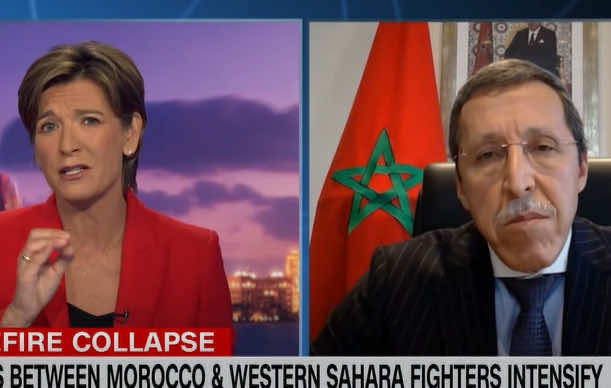
Rabat – Morocco’s Omar Hilale showed how to explain the Western Sahara conflict in a Friday interview with CNN. Hilale is Morocco’s Permanent Representative at the UN in New York and was invited on CNN’s “connect the world with Becky Anderson” program to make Morocco’s case for pragmatism in the Western Sahara dossier.
CNN had earlier provided coverage rife with factual mistakes and preconceived notions, yet Hilale provided a polite and fact-driven response. His calm and reasoned approach turned a hostile interview into a clear explanation of the conflict.
Accusations
CNN’s Becky Anderson had come prepared to “grill” Hilale over the conflict in Western Sahara.The program had prepared several statements by Hilale himself, Polisario and even King Mohammed VI to paint Morocco as the aggressor in the conflict.
The contentious interview started with Anderson highlighting a previous statement of Hilale’s that declared the independence referendum “dead and buried.” Anderson presented the statement as controversial, yet Hilale calmly explained how this position has been the expressed opinion of 21 UN resolutions over the last two decades.
An animated Anderson accused Morocco of undermining the 1991 ceasefire. Hilale in turn highlighted Polisario’s attempt to create a clash at Guerguerat, and Morocco’s repeated efforts to solve the issue diplomatically before lifting the blockade under UN supervision. “This operation was completely civil and it was in daylight and with the presence of the UN observers,” Hilale explained.
CNN’s Anderson played a statement by Polsiario’s Sidi Omar who claimed that the militant group’s declaration to end the 1991 ceasefire came because it had “been left with no other option.” Hilale emphasized Polisario’s continuous use of propaganda, noting that “Morocco is used to” Polisario’s usual distortion of history and facts. He drove home his point by quoting one of the US’ founding fathers, John Adams stating. “Facts are stubborn,” he said. He suggested that Polisario’s manufactured outrage failed this time because UN observers on the ground can attest that Morocco acted in self-defense after waiting for weeks for a diplomatic solution.
Calm analysis
“It is Polisario who declared officially they are breaking the ceasefire, it’s Polisario who is firing on the Moroccan army,” Hilale told Anderson. “You will not find a single declaration by Morocco that we withdraw from the ceasefire, or the political process.”
When asked about Morocco’s vision for peace in the region, Hilale calmly laid out Morocco’s autonomy plan and its backing from the UN Security Council. “Within this large autonomy, everything is possible, outside this large autonomy nothing is possible,” Hilale told CNN.
CNN’s Anderson continued her fierce questioning by highlighting King Mohammed VI’s statement that Morocco would respond to any aggression in Western Sahara with the “greatest severity.” Hilale simply explained the ongoing dialogue between the king and the UN Secretary General Antonio Guterres and Morocco’s commitment to the ceasefire.
“What Morocco will do if attacked, as his Majesty said, we will defend ourselves, and we will just use our self-defense,” Hilale stated. “That’s what happened during these last days, we are not going to war but we are ready to defend our civilians to defend our territory and our territorial integrity.”
Emphasizing international support
By now, Anderson’s tone had evolved from hostile to understanding. As Hilale’s calm display of factual information countered her sensationalist questioning, her cooling tone betrayed the uneasiness of her facial expression. She looked to be searching — in vain — for better rejoinders to corner Hilale, to get him to admit something, anything, damning about Morocco’s supposed misbehavior in the Guerguerat crisis .
By and large, however, Hilale showed CNN that Morocco’s intentions to lift the blockade on cross-border trade in Western Sahara are backed by the international community, with only Algeria and Namibia having expressed support for Polisario’s acts in Guerguerat.
He also explained to CNN how Morocco’s Guerguerat operation has been backed, or at least diplomatically welcomed, by countries around the world, including the EU, the GCC and twenty African countries. Referring to Polisario’s tactic of seeking international relevance and visibility by creating or escalating tensions, Hilale again employed a strong quote, this time by former UN chief Kofi Annan. “Never trust 100% armed groups or separatists because they have no international obligations,” he stated.
Hille concluded his remarks to CNN by emphasizing recent reports on another troubling Polisario tactic in Western Sahara. As the UN celebrates the International Day of Children, Polisario is “mobilizing armed children to war, they are just hijacking their youth and their lives.”
What had started as a combative interview concluded amicably. “Your perspective has been incredibly important,” Anderson stated as she thanked Hilale for sharing the Moroccan perspective on the Western Sahara tensions.