 Join on WhatsApp
 Join on Telegram
Rabat – Spain is under pressure after at least 6,000 people arrived in the Spanish enclave of Ceuta in the last 48 hours, including minors and women.
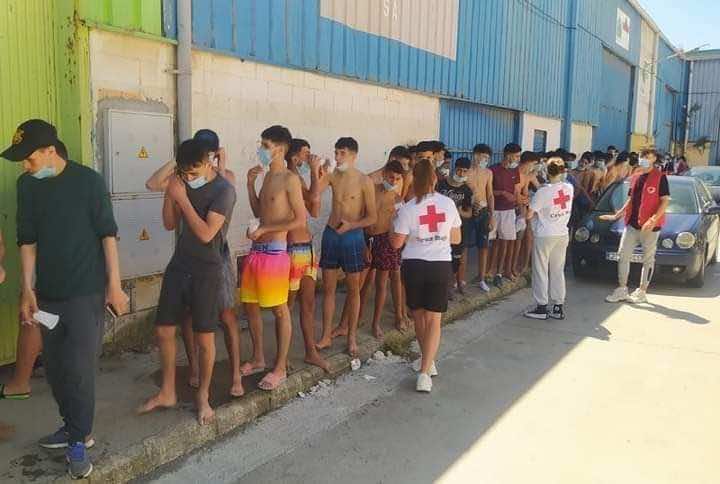
Viral online photos show people leaving Morocco’s shores with nothing but the clothes they are wearing.
Migrants left Morocco either by swimming or using other means, including risky inflatable boats.
Frustrated, Spain mobilized its army to intensify migratory management in the region amid the surge of migrants flowing from Morocco.

Spain’s Prime Minister Pedro Sanchez said his country’s priority is to restore “normalcy” to Ceuta.
“[Ceuta] Its citizens must know that they have the absolute support of the Government of Spain and the utmost firmness to ensure their safety and defend their integrity as part of the country in the face of any challenge,” Pedro Sanchez said on Twitter today.
The list of migrants does not only include Moroccans but also sub-Saharan migrants and other nationalities, sources said.
This is not the first time when migrants have stormed the Spanish enclaves. The number of irregular migrants who managed to cross into the Spanish enclave, however, is more than double of a normal migratory attempt, drawing the attention of international media.

Due to the situation, Pedro Sanchez canceled his trip to Paris due to the crisis.
Spain also launched a repatriation operation, with over 1,500 people sent back home so far.
Morocco’s government has not yet issued a statement regarding the situation.
International media attributed what they described as “lack of security” in Moroccan borders due to the rift both countries experience. Tension between both countries escalated when Madrid decided to host Polisario leader Brahim Ghali for hospitalization last month.
Ghali tested positive for COVID-19. Spain and Algeria arranged Ghali’s hospitalization.
The Moroccan Ministry of Foreign Affairs condemned the acts, describing it as against the spirit of cooperation between Spain and Morocco.
Morocco also asked Spain to provide answers on why Madrid’s government decided to receive Ghali despite the many legal procedures against him for several charges, including torture and rape.
The Spanish government responded to the statement, saying that the reception of Ghali for hospitalization is due to “humanitarian reasons.”
Laya told reporters recently that her country “was not aware” that Morocco relaxed migratory controls due to the rift.
In response to its clarifications, Morocco directly asked Spain if it is ready to sacrifice relations with Rabat for Brahim Ghali.
In an interview with Spanish news agency EFE, Moroccan Minister of Foreign Affairs Nasser Bourita reaffirmed Morocco’s position regarding Spain’s decision.
He also questioned Spain’s reluctance and refusal to provide answers regarding Rabat’s concerns. He said the situation is a test of “reliability” for Spain-Morocco relations.
Bourita also discussed Morocco’s position regarding irregular migration issues, saying that the situation requires “shared responsibility.”
Rather than financial support, genuine cooperation at all levels of the decision making process is the “best way” to manage migratory issues, he said.
“We must be partners in the vision, in the formulation of strategies, not only in their implementation in exchange for a sum of money,” he argued.