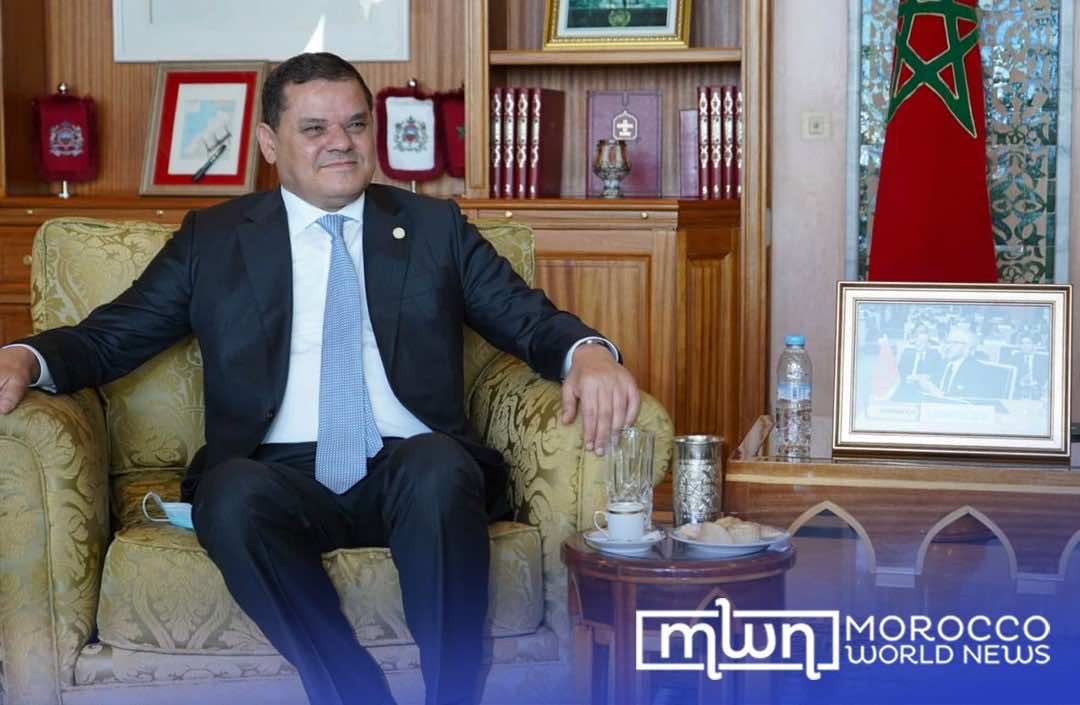
Rabat – Libya’s Prime minister Abdelhamid Dbeibah expressed today his country’s gratitude towards Morocco for its efforts to encourage inter-Libyan talks and dialogue.
Dbeibah, who was visiting Rabat to cement bilateral ties, held talks with several Moroccan officials today.
Following his meeting with Morocco’s Head of Government Saad Eddine El Othmani, Dbeibah told the press that Libyans have suffered from their county’s profound political divisions in the past decade and are now looking to settle their differences and end their national plight.
He said that the Morocco-brokered Skhirat Agreement was crucial in bringing together the different components of Libya’s diverse political forces.
“We are grateful to Morocco, King [Mohammed VI], the government and the people for bringing the Libyans together in Bouznika, Skhirat, and Tangier,” he said.
Morocco has held several roundtable discussions on Libya, convening members of the rival Libyan fractions for dialogue.
Dbeibah emphasized Morocco’s pioneering role in supporting Libya’s cause and the organization of elections.
He also expressed his country’s determination to develop economic relations and promote tourism with Morocco.
For his part, Morocco’s Head of Government renewed the country’s commitment to restoring peace and stability in Libya, emphasizing historical, social, and political ties uniting Morocco and Libya.
The Moroccan head of government also stressed the country’s readiness to strengthen relations with Libya, renewing support for the organization of the Libyan elections.
“Morocco can only support any consensual solution in Libya,” El Othmani said.
Dbeibah also met with the speakers of Morocco’s House of Representatives and House of Councillors today.
During his meeting with the speaker of House Representatives, Habib El Malki, the Libyan official said that Morocco has always been a friendly country for Libyans.
He stressed Morocco’s mediation efforts in the Libyan crisis, saying that the meeting in Bouznika was “crowned by the formation of the national unity government which represents all Libyans.”
Dbeibah also met with the speaker of the House of Councillors, Hakim Benchamach, who renewed Morocco’s commitment to resolving the Libyan conflict.
Benchamach also reiterated Morocco’s principle of non-interference in the domestic affairs of other countries, citing Rabat’s constant support in providing Libyan parties with the appropriate conditions for the success of the ongoing inter-Libyan dialogue.