 Join on WhatsApp
 Join on Telegram
Rabat – With Morocco’s call for expression of interest in research and development of the 1,300-year-old Sijilmassa archeological site, it is time to discover the monumental and historically-important national pride. What exactly was Sijilmasa?
Sijilmasa is a Moroccan historic site that served as the focal point of the Trans-Saharan gold trade, established in 757 A.D. and ultimately, abandoned 600 years later in 1393 A.D. It was located near the northern edge of the Sahara in Morocco, near what is known today as Errachidia in Draa-Tafilalet.
Dale R. Lightfoot, and James A. Miller, who published “Sijilmassa: The Rise and Fall of a Walled Oasis in Medieval Morocco,” note in their research that many Arab geographers and historians considered it as one of the wealthiest cities in the whole of Maghrib. They also stressed that “prior to abandonment in 1393, Sijilmassa constituted a global place in the premodern era.”

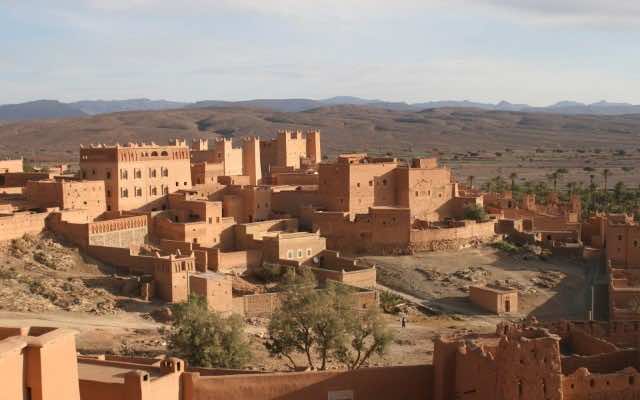
Tafilalt oasis’ vegetable fields, grain, and date palms. The heart of the historic city lies on a small rise at the Oued Ziz perennial stream. Amidst the stunning landscape, one can find pottery shards and ruined adobe walls scattered in the area.
The ancient city grew wealthy due to its strategic position resting on the banks of Oued Ziz, a river crossing a part of the Sahara desert. A second factor that contributed to its success was its proximity to the Trans-Saharan caravan trade route, situated between Morocco’s most northern-point of Tangier to the Niger River down South in the Sudan region of Central and Western Africa.
Archeological evidence suggests that Sijilmassa was minting most of the gold arriving from the southward region of Sudan, with numerous researchers suggesting that the city also acted as an organizer of the trans-Saharan gold trade.
Historically speaking, this placed Sijilmassa in a position to secure the trans-Saharan gold trade with the Medieval kingdoms of Ghana. In exchange for gold, the people of Sijilmassa traded copper and brass from North Africa, as well as salt from the Sahara desert.
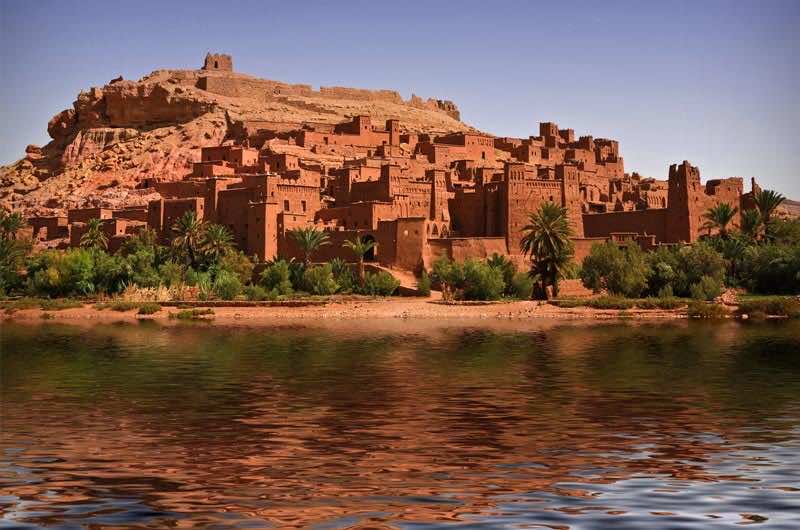
One of the primary reasons for the establishment of the city was to help capture the African gold trade. But, the renowned 11th century historian Al-Bakri noted, as cited by Hopkins and Levtzion, that many histories show the city’s origins as spiritual in their nature, a sort of spiritual refuge in the African desert. The city’s history is deeply intertwined with Islam, considering that it was the second Islamic city founded in the Magrib, following Kairouan in Tunisia in A.D. 670.
Ultimately, the city fell in 1393 A.D., coinciding with the fall of Morocco’s central authority in the 1400s. As a result, Sijilmassa devolved into a landscape of adobe villages. In turn, gold trade in Morocco also sharply declined, both due to the collapse of Sijilmassa as well as external influences such as the encroachment of the Iberian forces.
Some researchers estimate that the city of Sijilmassa, at its peak, held a population of up to 40,000 people, less than half of Tafilalt’s modern population. Historically, while the city itself was not walled, the surrounding oasis was, with some walls reaching up to four meters in height. The city had four main gates, namely Bab Fez, leading northwards to the old royal capital of Morocco, Bab Sharq (Eastern Gate), Bab Sahel (The Sahel Gate) facing southwest, and Bab Gharb (Western Gate). Each gate indicated the direction of trade.
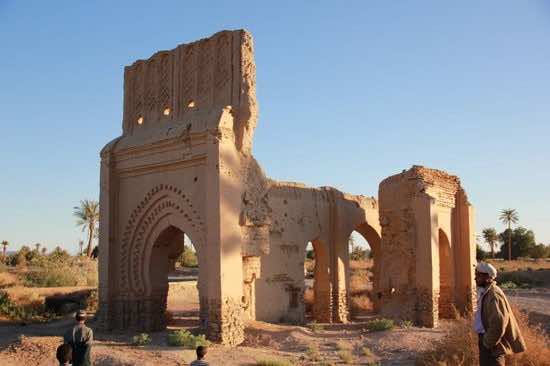
The city also held the Ben Akla market which served as a trading outpost, tax collection point, as well as a caravan terminus. Archeologists have uncovered stone date-pit pounders, which were used to turn date pits into animal fodder, grinding stones, and a variety of other tools from the time period. Similarly, the researchers found ruins of mud-brick walls, building foundations made of stone, and even pillar foundations that suggest the existence of a mosque.
Ultimately, after its collapse, the city was eventually rebuilt by Sultan Moulay Isma’il, one of the early rulers of the Alaouite dynasty that still governs Morocco today. Sijilmassa fell once again in 1818 at the hands of the Ait Atta nomads.