 Join on WhatsApp
 Join on Telegram
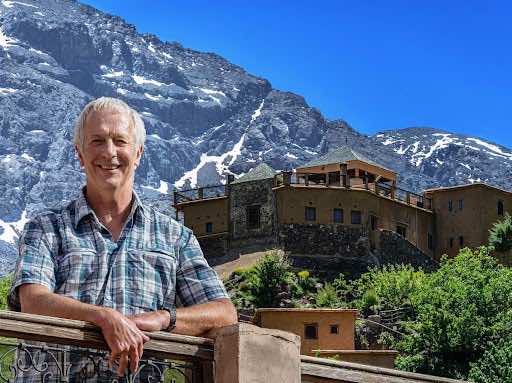
Sustainable tourism has become a buzzword in today’s increasingly climate-conscious discussions among friends and policy debates on the world stage. In the 1970s, not so much. Here’s the story of a man, who acted as a catalyst for this transformation; here’s the story of Mike McHugo, who brought sustainable tourism to life, on the slopes of Morocco’s High Atlas Mountains.
“He does not always get everything right, but his heart has always ruled his head, which is why, after forty-two years he is one of the only three close friends I have,” says Trevor Rowell who, together with Mike, established Hobo Travel, the company that is now Discover Ltd., back in 1979. With £1000 each, the two young men with big dreams and an even bigger appetite for adventure, bought and rebuilt an old Land Rover aiming to offer tours of Morocco from it, once it had been refurbished.
Many muddy miles and countless memories later, Mike and Trevor’s Morocco tours has evolved from being purely adventurous, to include education and leisure. As Trevor went back into full time teaching, Mike, alongside family and friends, purchased the ruins of an old mansion, the country home of a once-feudal lord, overlooking Imlil in the foothills of Jbel Toubkal, the highest peak in North Africa. The idea was to turn it into an eco-lodge and share it with the world. Mike’s older brother Chris loved the idea, jumped on board, and quickly became an integral player in the project.
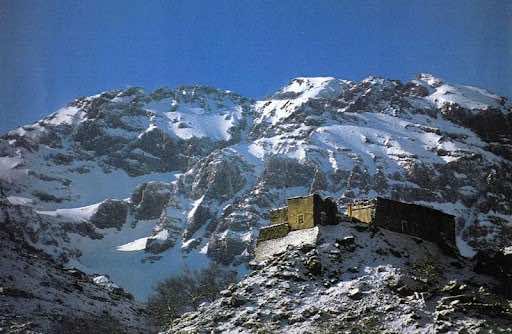
The old ruins of the Kasbah. Credit: Hamish Brown M.B.E.
‘Kasbah du Toubkal’ soon came to act as a cultural-exchange between visitors and the Berber people of Imlil, attracting large crowds of visitors seeking stunning mountain views. Although Mike did not set out to create a sustainable haven, the Kasbah gained increasing attention for its ‘green’ practices.
“We won plenty of awards regarding sustainable tourism in the early days – before they became about ticking a few boxes, acting as green washing,” recalls Mike. A hand-picked member of National Geographic’s Unique Lodges, the Kasbah’s practices were even praised by Prince Charles as exemplary in an essay he wrote on responsible tourism for Conde Nast Traveller in 2005.
“Once, on a long-distance bike-trip along the dusty roads of rural Morocco, I saw Mike hopping off his bike in what was a horribly steep hill, just to rescue a turtle laying in the middle of the road – that’s the kind of person he is,” says Derek Workman, who wrote Reasonable Plans, the story of Kasbah du Toubkal, and produces a quarterly magazine and newsletter for the Berber Hospitality Center, as the Kasbah is known.
Due to Mike’s trust in his abilities during their first encounter, Workman transitioned from producing travel material to designing magazines and websites for top-end hotels.
“I didn’t have a lot of work at the time because of the virtual collapse of the industry, due to the financial crash in 2008… Meeting Mike opened up Morocco for me and a new avenue for work,” says Workman.
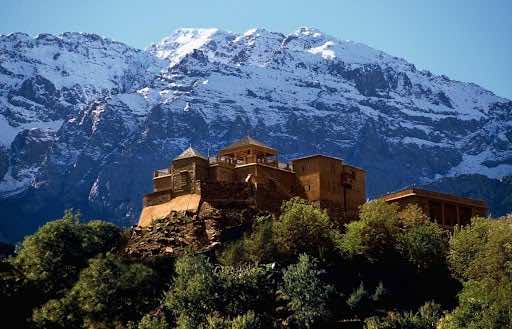
Kasbah du Toubkal today, well-kept and grand. Credit: Alan Keohane
Mike’s original motivation was to avoid office-work, which initially led him on his journey. Opting for a life-philosophy adopted from the Dalai Lama, Mike tries to be “good selfish, rather than bad selfish.”
Applying this simple approach to the complexity of life has allowed for fortunes to flourish. Fortunes, not in monetary terms, but in terms of an organic development of the Kasbah and the rural villages around Imlil. Fortunes, not kept for the few but shared amongst the many.
Trevor and Mike come from very different backgrounds but their appreciation for the simple things in life is mutual – such as enjoying a packed meal by the side of the road following a long day of cycling: “Mike still makes PB & jam sandwiches when we go for a bike ride. Old habits die slowly and if I forget my sandwiches he shares half of his with me. And that simple action sums Mike up,” says Trevor.
However, Trevor is careful to stress that Mike, “like the rest of us, is no saint.” Although their lifetime of amazing memories has not occurred at the expense of anyone else, “The environment has not been so fortunate,” says Trevor. Referring to their innumerable drives between Europe and Morocco, Trevor’s point carries truth.
Seemingly, even someone who’s received awards for his sustainable achievements; including an MBE (Member of the Most Excellent Order of the British Empire) which he accepted on behalf of everyone involved, from Prince Harry in place of the Queen herself – leads a life of double-standards.
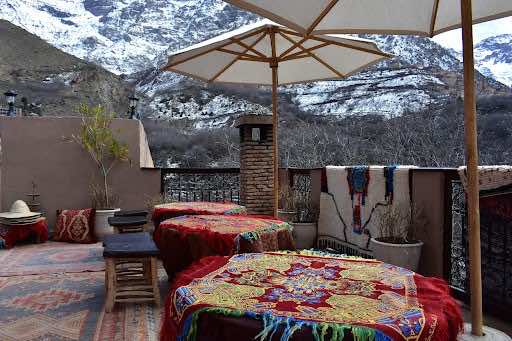
The terrace where guests get to enjoy the organic, locally grown food offer spectacular views.
“In Imlil, just like in the rest of Morocco, there is a huge problem of pollution. When Mike a long while back decided to set up an incinerator to get rid of all the rubbish in the area, his well-intended actions came with hidden consequences of polluting the air,” recalls Allen Hogan, a childhood friend of Mikes.
Having gone through life by his side, Allen describes Mike as an unusual, committed, and loyal control-freak, with strong and pure intentions but somewhat lacking the executive powers to follow them through.
“One thing to know about Mike, is that he can talk the hind legs of a donkey,” says Allen with a laugh, going on to point out that his chatty friend has helped the protection of all such creatures used to carry guests and their accompanying luggage up the steep hills of the Kasbah.
Local residents often earn a substantial amount of money renting out mules. Recognizing the importance it carries for the hirers, the Kasbah du Toubkal only owns one mule and hires mules on a rotational system from the local community, encouraging economic trickle down into the community.
“This rota system is unheard of elsewhere, and doesn’t gain Mike anything – but it guarantees a fair distribution of employment – so according to him, it’s the only sound way to do it,” says Allen.
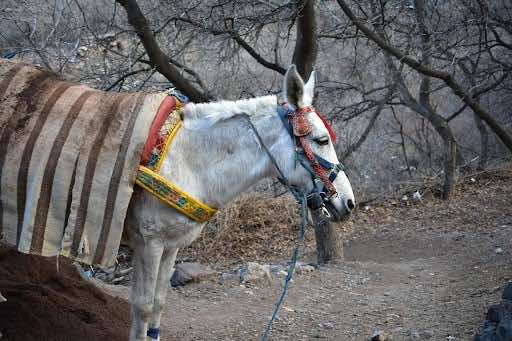
Mules and donkeys, jokingly referred to as the ‘Moroccan 4by4’s, are often forced to carry weights too heavy for their build – hence why Mike was happy to help the work with SPANA and vet Glen Cousquer.
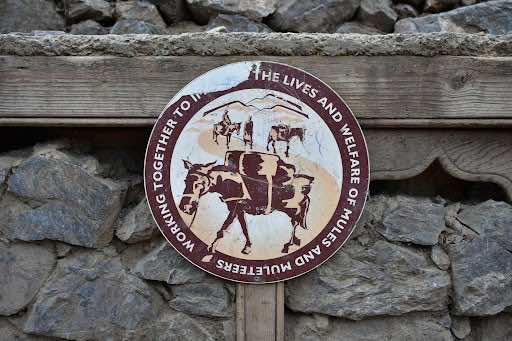
For tourism to bring about real change in small communities like the Imlil Basin, there needs to be a catalyst, a vision, a mechanism, and a co-operation between relevant local parties. In the case of the mule rental, this occurred when Mike was joined by a veterinarian called Glen Cousquer, the international animal charity SPANA, and Hajj Maurice from the Kasbah, who brought invaluable local knowledge. Together, they work for better mule welfare – benefitting both tourists and locals.
This idea was a spin off from the Association Bassin D’Imlil, formed originally by Discover Ltd and Hajj Maurice to distribute and utilize the money received from the filming of Kundun in a fair manner. Discover decided to maintain the fund by introducing a 5% levy on all clients at the Kasbah. This has enabled the building of a Hammam in Imlil, an important meeting place for the local women in particular; a 4×4 ambulance service which has helped reduce both infant and maternal mortality rates in the area, and the implementation of a rubbish collection and disposal service.
Mike’s eldest daughter, Dominique Beltran, was only a few weeks old when the Kasbah had its official opening in 1995. The lodge, which two years later starred in Martin Scorsese’s Kundun, is today known beyond the country’s borders. That was not the case from the start, however, says Dominique growing up. She was mortified by her dad’s relentless promotion of his passion project – which included slapping big advertisement stickers on their camper van.
“Although the Kasbah has come a long way since, our dad hasn’t changed much,” she says, explaining that even his wardrobe choices, consisting of “Rohan clothes paired with sandals and a very cheap Casio watch,” remain unaltered. This unassuming attitude to life is reflected in the set-up of the Kasbah.
Because in Mike’s eyes, sustainability is not about perfection, nor about winning awards or showing off flashy innovations – it’s about using your common sense and being a good neighbour.
“It’s about improving the lives of future generations, enjoying yourself along the way and trying to mitigate the harm taken from your actions to the best of your abilities,” says Mike.
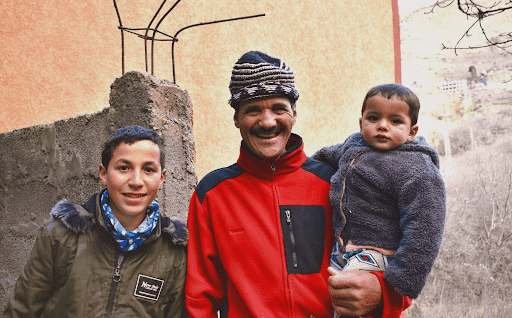
Employing some 40 full-time staff, alongside providing part-time jobs, the Kasbah brings plenty of capital to the local economy. Here’s the amazing in-house chef Omar with his son, and grand-son.
Mike has led a life of joy, lacking the rigid structure of a grand life-plan. By treating the world around him with respect and dignity, he has built long-lasting relationships. By trying to do more good than harm, he’s been part of improving life for people and the planet. By focusing on his relationships with loved ones and nature, he’s ensured their health and wellbeing – and as a result, his own.
“Our future, if there is to be one, has to lie within Agenda 21 ‘Think local, act local’,” says Trevor – a slogan which supports the branch of tourism created by Mike and his team when the Kasbah first opened its doors. And so far, it has been sustained with the ease only a sustainable-business model could enable – the Kasbah remains a model to take after, half a century down the line.
And so does Mike – a man who has done it all; from hosting village parties drawing crowds in their thousands, to setting up a successful charity, providing girls from rural areas in Morocco access to higher education – on top of running a successful, sustainable business, generating positive outcomes to those involved.
Humble to these achievements, Mike jokes them away by explaining that his well-balanced attitude to life does not reflect his physical one, which is why he’s never picked up yoga. In life, “you’re supposed to have the three S’s I believe: Strength, stamina and subtleness – I only ever had two, the latter was never one of them,” Mike says with a laugh.
It turns out that to become a sustainability-champion, you don’t need to be superhuman, but rather just super at being human, with all the perfect imperfections that entail.