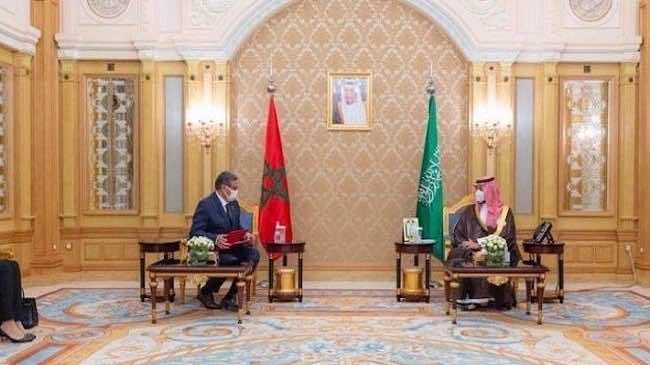
Rabat – Morocco’s Head of Government, Aziz Akhannouch, called on Riyadh to strengthen the Morocco-Saudi Arabia cooperation to address the challenges associated with climate change. Speaking at the Middle East Green Initiative (MGI) Summit, Akhannouch endorsed Saudi Arabia’s ambitious goal to achieve carbon neutrality by 2060.
The summit came after Saudi Arabia reiterated its unwavering support for Morocco’s territorial integrity and sovereignty over Western Sahara on October 19.
Morocco’s head of government led the Moroccan delegation in the MGI Summit including the Minister of Energy Transition and Sustainable Development, Leila Benali, and the Moroccan Ambassador to Saudi Arabia, Mustapha Mansouri.
Several international government officials, executive presidents, stakeholders, policy makers, and activists attended the summit to bring to light several aspects of environmental conservation, particularly in light of the ongoing global fight against climate change.
During the summit, Akhannouch underlined the need for an effective and integrated strategy between policy makers and stakeholders of the international community to unify visions and remove hurdles to accessing climate finance.
“The Kingdom of Morocco has adopted an integrated policy based on a responsible, inclusive and participatory approach to climate change, in line with the objectives of the National Strategy for Sustainable Development which aims to ensure transition to a green economy, with the reports of the Intergovernmental Panel on Climate Change and the Sustainable Development Goals (SDGs),” he noted.
In this regard, Akhannouch recalled the challenges and impact of climate change on the process of sustainable development, the vitality of ecosystems, the security of environments and natural resources, and on public health.
Morocco has undertaken significant efforts to curb the damaging effects of climate change. In 2018, the Climate Action Tracker (CAT) said that Morocco is among the countries that have made significant progress in limiting the effects of global warming.
Akhannouch said that Morocco’s initiative to develop the National Climate Plan 2020-2030 aims to strengthen the ability to adapt and accelerate the transformation towards a low-emission economy, the implementation of national climate policies at the local level and the encouragement of innovation and awareness to better respond to the challenges of climate change.
“The plan, which also includes the use of nature-based solutions, the production of clean energy and the development of green industry, is based on strengthening governance and mobilizing resources to combat climate change,” he added.
Morocco has established the National Program for the supply of drinking water and irrigation for the period 2020-2027, with an overall cost of about $11 billion (MAD 99 billion).
Akhannouch stressed that the program’s mission is to preserve water resources, particularly, in the agricultural sector, through the reuse of wastewater and desalination of seawater.
Additionally, Akhannouch praised the Middle East Green Initiative, which reflects Saudi Arabia’s willingness to develop an ambitious roadmap aimed at enhancing nature protection in the region, and contributes effectively to international efforts by laying the foundations for sustainable development and safeguards future generations.
The Paris Climate Agreement and the 2030 Agenda for Sustainable Development, he said, are pivotal elements in promoting global climate action and transitioning to carbon-neutral development and that through enhancing environmental awareness and introducing sustainability into various economic sectors.
In 2019, Morocco ranked second-best performing country in the Climate Change Performance Index (CCPI).
In the summit, Akhannouch conveyed King Mohammed VI’s greetings to King Salman bin Abdul Aziz al-Saud, and the Crown Prince Mohammed bin Salman bin Abdul Aziz al-Saud. He also conveyed King Mohammed VI’s wishes to deepen awareness of contemporary environmental issues and promote sustainable development in the Middle East region.