
 Join on WhatsApp
 Join on Telegram
Time and again in the past fifteen years, the UN Security Council’s resolutions and the UN Secretariat General’s reports on the Western Sahara conflict have espoused the unmistakable view that a self-determination referendum is illusive and unworkable. In the latest UNSC resolution, for example, it is hard to miss the gist of what now constitutes the UN consensus on how best to find a political solution: abandoning an impossible self-determination referendum for a negotiated, compromise-based political solution.
Despite such a clear disqualification of the self-determination route, some of the most vocal pro-Polisario Sahara watchers – analysts, government officials, lobbyists, and journalist – have continued to defy both the diplomatic consensus and historical objectivity to push for the same tired story of “Sahrawi decolonization.”
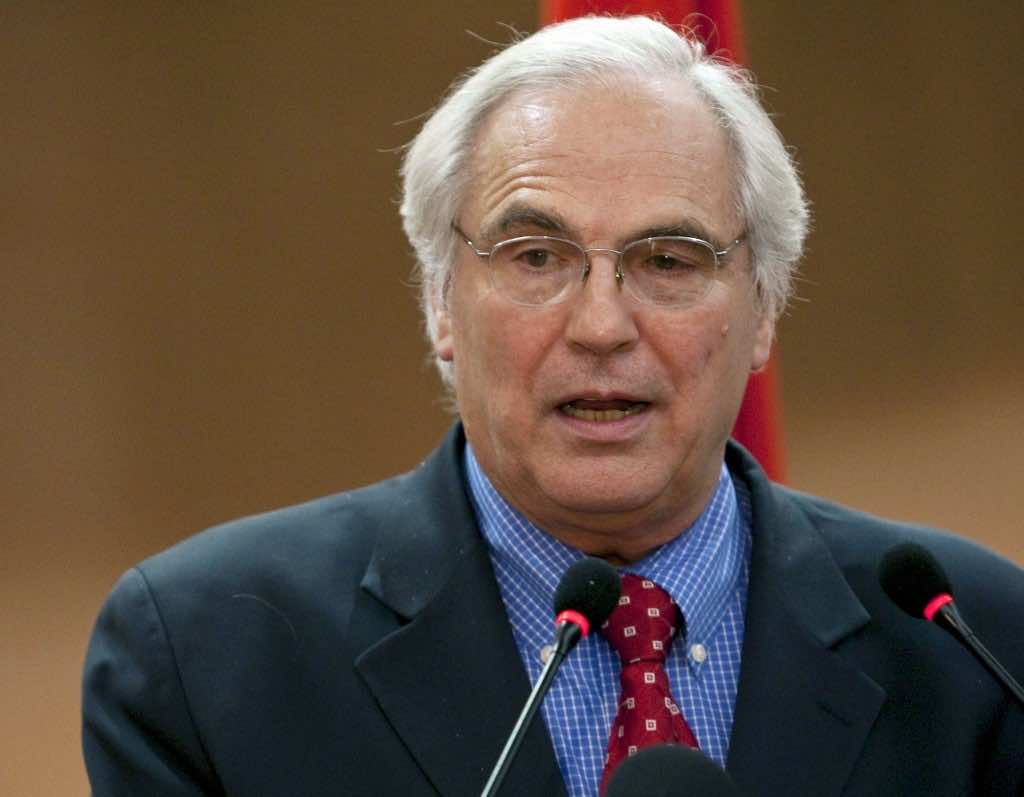
Christopher Ross, the former UN envoy in Western Sahara, is a prominent voice in this camp of pro-Polisario commentators and lobbyists who pay little heed to developments on the ground – notably the decisively pro-Morocco diplomatic consensus – and are trapped in their own distorted, make-believe reality about the Sahara conflict.
Less than a week before the UNSC adopted Resolution 2602, its latest on Western Sahara, Ross posted a comment in reaction to a PassBlue article on human rights monitoring in Western Sahara. If anything, the comment provided a useful window into Ross’s contorted thinking about Western Sahara.
“Why would adding human rights [to the mandate of MINURSO] be un-implementable? Because Morocco would find a way to block it on the ground, as it did in 2000 with MINURSO’s preparations for a referendum,” Ross claimed. “And why would Morocco block a human rights mandate? Because such a mandate would give resident Western Saharan opponents of the Moroccan presence a transparent way to inform the outside world of their views, which Morocco has done everything possible to prevent lest its claim to the territory be weakened.”
He went on to accuse Morocco, more tellingly, of having “short-circuited these negotiations by trying to impose its autonomy proposal as the only item on the agenda to the exclusion of the Polisario’s proposal for a referendum.”
Such claims are uncharacteristic and unbecoming for a seasoned diplomat who should make sure to tell the whole truth and not be selective about the facts surrounding the conflict. As Mark Crispin Miller says in his introduction to Edward Bernays’ 1928 book Propaganda, it is the “preeminent consensus” surrounding any topic that “determines what is true.”
It is precisely this preeminent consensus surrounding what are viewed as the legitimate claims of the Polisario and Morocco’s status as a “villain” that pushes people such as Ross to repeat their misleading reading of the conflict. And in so doing, they believe – and do their best to make sure – that their truth is the only truth that everyone should take at face value.
Yet what Ross has done time and again is overlook so many key facts without which we can never get a perfect, or at least clearer, understanding of the intricacies, nuances, and complexities of the Sahara conflict.
During a meeting of the African Union in Nairobi in 1981, a decade before the UN established MINURSO, King Hassan II called for holding a referendum on self-determination based on the 1974 census.
Taken by surprise, the Polisario, who was hoping to secure more recognition for its self-styled Sahrawi Arab Democratic Republic (SADR) from more African states, rejected the proposal and lashed out at members of the then Organization of African Unity for “selling out” what the separatist called the Sahrawi decolonization struggle. Six years earlier, Algeria, then the darling of the global decolonization movement, helped establish SADR and mobilized its ideological capital and diplomatic firepower to set the stage for the realization of Polisario’s dream of Sahrawi self-determination.
But even Algeria’s undivided and multifaceted – financial, logistical, diplomatic, etc. – support could hardly, if ever, make up for the plain reality that most of Polisario’s “Sahrawis” had no connections whatsoever to Western Sahara. As a result, Polisario was more interested at the time in drumming up support for its statehood status within the OAU, than in pushing for a self-determination referendum in Western Sahara.
Both the Algerian and Polisario leaderships knew what many pro-Polisario commentators now appear to conveniently sideline: The holding of a referendum would not have only thwarted their goals but would have also exposed the existence within the Tindouf camps in Algeria of inauthentic “Saharawis” that had come from neighboring Sahel countries. According to French newspaper Le Monde, the Spanish government knew as early as 1979 that half of the Saharawis in the Polisario-run camps in Algeria were natives of Niger, Mali, Mauritania, and Algeria.
Ross’s misleading omissions about the referendum debate
Fast forward to the 1990’s as the UN made several attempts to implement the Settlement Plan by getting Morocco and Polisario to agree on all the provisions of the plan, especially voter eligibility, it came to the realization that both parties tended to have fundamentally different interpretations of these provisions.
In his report to the Security Council on February 17, 2000 (S/2000/131), then-Secretary General Kofi Annan made the sobering assessment that the referendum was unworkable. Seeing both parties’ dogged refusal to cooperate fully with MINURSO based on eligibility criteria and the composition of the electoral body, Secretary Annan concluded that any attempt at a self-determination referendum was doomed to fail.
A visibly frustrated Annan could not have expressed this any clearer when he said: “Despite repeated calls upon the parties by the Security Council and my predecessor to permit the process to advance more rapidly, the positions of the parties frustrated all such efforts, as both sides were reluctant to compromise on any issue that they believed would weaken their own position.”
Contrary to Ross’ claims, at no time in his report did Annan single out Morocco for not cooperating with MINURSO or hindering its work. More still, Annan said that in late 1995, the Polisario suspended its participation in the identification process of three tribal groupings in the 1974 census identified as H41, H61 and J51/52.
For the sake of fairness and intellectual honesty, I ought to point out that Annan was also clear about the fact that Morocco was not receptive to the UN’s request to vet 100,000 applications from people residing outside of the territory to “ensure the timely completion of the identification process.”
As plainly laid out in Secretary Annan’s report, the UN simply failed in its efforts to rally the two sides around how to conduct the referendum and who was eligible to vote. The two parties clung to their respective strategies to shape the outcome of the referendum, making it literally impossible for the UN to discharge its mission.
Annan’s assessment was corroborated by the testimony of former MINURSO chief Erik Jensen. According to Jensen, the hasty way in which the UN concluded the ceasefire agreement, as well as the disagreement between the parties on Sahrawis eligible to vote, are the main reasons why the referendum of self-determination was unworkable. In other words: the referendum was stillborn.
From referendum to compromise-based political solution
After almost a decade of unfruitful UN attempts to hold a referendum, Kofi Annan concluded that even if a referendum did eventually take place, there was simply no means of implementing the outcome. For him, it was time to consider other ways. He consequently asked James Baker to seek “to explore ways and means to achieve an early, lasting and agreed resolution.”
Between 2001 and 2003, Baker submitted two proposals. Morocco accepted the first, but the Polisario and Algeria rejected it. Morocco rejected the second proposal, while Algeria and the Polisario accepted it.
All of this matters for anyone interested in accurately telling the convoluted and nuanced story of Western Sahara. But in his cherry-picked, self-servingly simplified story of the conflict, Ross has no qualms about overlooking or even mischaracterizing whatever doesn’t serve his make-believe version of the diplomatic stagnation in Western Sahara.
Left unmentioned in Ross’s presentation of Morocco as the villain of the story is Algeria’s well-documented role in the origins and perpetuation of the conflict. He elides, for instance, the November 2001 meeting when then-Algerian President Abdelaziz Bouteflika informed Ambassador Baker of Algeria’s rejection of the Baker Plan. “Algeria and the Frente POLISARIO,” Bouteflika said, “would be prepared to discuss or negotiate a division of the Territory as a political solution to the dispute over Western Sahara.”
Equally important is Ross’s omission of the fact that Algeria made a similar request in 1978. During a meeting with US Secretary of State Cyrus Vance in June 1978, Bouteflika, who was then Algeria’s Foreign Minister, said that his country and Polisario would not oppose Morocco’s plans to keep part of the territory, including the phosphates mines and part of seacoast, if the Polisario could take control of the remainder.
This begs the question: if Algeria and Polisario believed strongly that Western Sahara was not a Moroccan territory and were serious about enabling the Saharawis to exercise their right to self-determination, why were they open to the idea of Morocco keeping the biggest chunk of the territory?
After Baker’s subsequent proposals failed to satisfy the different sides, the Security Council asked the parties to submit proposals to reach a political solution. In 2007, Morocco presented its Autonomy Plan, which the UNSC has consistently described as “serious and credible.”
Since the adoption of Resolution 1754 in 2007, the UN Security Council has completely ruled out the winner-take-all approach to the resolution of the Sahara dispute. Instead, the council has repeatedly called on the parties to reach a mutually acceptable political solution.
Despite these developments, some Western observers of the Sahara conflict – and Ross is foremost among them – consider any attempt to reach a political solution as a violation of the right of the “Sahrawi people” to self-determination. But this reading ignores a key fact from the International Court of Justice’s 1975 ruling.
In its verdict, the court stated clearly that it would leave to the UN General Assembly a measure of “discretion with respect to the forms and procedures through which the right to self-determination can be carried out.” This passage is routinely left out by all those Polisario supporters who claim that ICJ’s advisory opinion once and for all enshrined the right of the Saharawis to independence.
Western Sahara is not a case of occupation
Ross also says that for any negotiations to be truly genuine, three facts must be taken into consideration. Of these facts, I will only focus on one – the question of occupation – which I find very questionable, the other two being of less importance.
First, Ross says that Western Sahara is a non-self-governing territory separate from Morocco, “as attested by the World Court, the highest European courts, the Secretariat and agencies of the UN, and most countries around the world.” Second, that the indigenous Sahrawi population should not be confused with other ethnic Saharawis who have ties to Morocco, Algeria, and Mauritania.
By stressing that Western Sahara is a non-self-governing territory separate from Morocco, Ross seems to imply that it is under Morocco’s occupation. This is a recurrent claim among pundits and Sahara watchers.
Yet except for two General Assembly resolutions adopted in 1979 and 1980, which referred to Morocco as “occupying” the territory, no UN organ has ever since referred to Morocco as an occupier in Western Sahara. Had the UN been of the view that Morocco’s presence in the territory amounts to occupation, it would have continuously said so in all its official documents and meetings over the past four decades.
This has clearly not been the case, however. And as a former UN envoy for Western Sahara, Ross should know better. He should know, for instance, that every single comma or word in any given UN document or resolution carries political weight and can produce legal effects. He should also know that even in the UNSG report, the UN Secretariat never refers to Morocco as an occupying power nor does it ever use the word occupation. More still, it does not even refer to the Western Sahara as “disputed territory;” rather, it describes it as “The Territory.”
If the UN regarded Morocco as an occupying power, it would have simply said as much in all its reports and resolutions about the Sahara conflict. Take for example the Palestinian-Israeli conflict and the Syrian Golan Height crisis. Despite the copious support Israel enjoys from different major international players, the UN always refers to Israel as occupying both the Palestinian territory and the Golan Height. The terms “occupation” and “occupying country” were used interchangeably over 100 times in the latest report that the UNSG submitted to the UNSC on the Israel-Palestine conflict.
So, it is not because of some hidden agenda or outsized Moroccan power or influence that the UN does not refer to Morocco as an occupying power. Rather, it is simply because the UN does not consider the Western Sahara conflict to be a classic case of occupation by a foreign power.
It is, therefore, obvious that Ross’s claim that the Western Sahara’s status as a separate territory from Morocco is supported by the UN Secretariat and its agencies does not stand scrutiny. Nor does the claim that this status is supported by the World Court (International Court of Justice) and the European Union Court.
For starters, how could the ICJ have claimed that the territory is separate from Morocco while its verdict clearly mentioned the existence of ties of allegiance between Morocco and some Saharan tribes? What the ICJ said is that the existence of those ties does not trump the Saharawi’s right to self-determination.
Secondly, though the EU courts have since 2015 attempted to mingle in the conflict by handing some feel-good “legal victories” to the Polisario, these courts do not have the legitimacy to rule on cases that involve the EU and a third party (Morocco), and this is especially the case when what is at stake is the third country’s sovereignty over what it regards as part of this territory.
Only the ICJ is competent to deliberate over such cases. But even the ICJ cannot rule on such cases without receiving the explicit approval of all the parties concerned. By pushing the argument further, we can even disprove Ross’s claim that Western Sahara is a classical non-self-governing territory.
Without denying that the UN General Assembly still treats the territory as such, some precisions are needed. One question that Ross should answer is: Why has the UN never asked Morocco to provide regularly to the Secretariat statistical and other information of technical nature about Western Sahara, in line with article 73 (Chapter VI) of the UN Charter?
The reason is simple: first there is a need to establish that Morocco’s presence in the territory does have a colonial nature, which was not the case. According to Principle I of UNGA Resolution 1541, “The authors of the Charter of the United Nations had in mind that Chapter XI should be applicable to territories which were then known to be of the colonial type.”
Second, according to Principle IV, “Prima facie there is an obligation to transmit information in respect of a territory which is geographically separate and is distinct ethnically and/or culturally from the country administering it.” What this shows is the lack of compelling evidence – legal, historical, or even sociological – to corroborate the mainstream notions of a cultural or social distinction between Morocco and the Saharawis, and of geographical discontinuity between Morocco and Western Sahara.
By tirelessly rehashing a selective interpretation that aligns more with their personal convictions and worldviews than with the reality, the champions of “Sharawi independence” overlook the political significance and legal weight of all UN official documents that have largely settled the theoretical debate that these champions are bent on continuing.
Rather than helping the Sahrawi population in the Tindouf camps close this chapter of endless suffering, rather than encouraging the Polisario to forego its horizonless independence claims, they persistently invest false hopes and misleading – albeit charming – narrative that only sustains the suffering and despair of ordinary Sahrawis.
Samir Bennis is the co-founder of Morocco World News. You can follow him on Twitter @SamirBennis.