

 Join on WhatsApp
 Join on Telegram
Fez – Morocco’s Higher Council of Education, Training, and Scientific Research released on November 30 a report on students’ learnings as part of the National Program for Assessing Students’ Learnings (PENA).
The study was conducted in 2019 and compared learning outcomes among students from different gender and in rural, urban public, and private schools.
The survey took the 6th grade of primary school and 3rd grade of middle school as its sample, both in public and private schools Sample were set to meet the required representativeness and precision.
It evaluated the learnings of 18,025 students of the 6th grade in 600 primary schools and 18,883 students in the 3rd year of secondary school distributed over 550 middle schools, one class per middle school for each level.
For the primary school level, the evaluation tackled four subjects, namely Arabic, French, mathematics, and nature and life sciences. For the 3rd year of middle school, it covered five subjects: Arabic, French, mathematics, nature and life sciences, and physics-chemistry.
The study found an overwhelming gap between public and private schools.
Students with satisfactory level received between 80% and 100%, and are described in the following table:
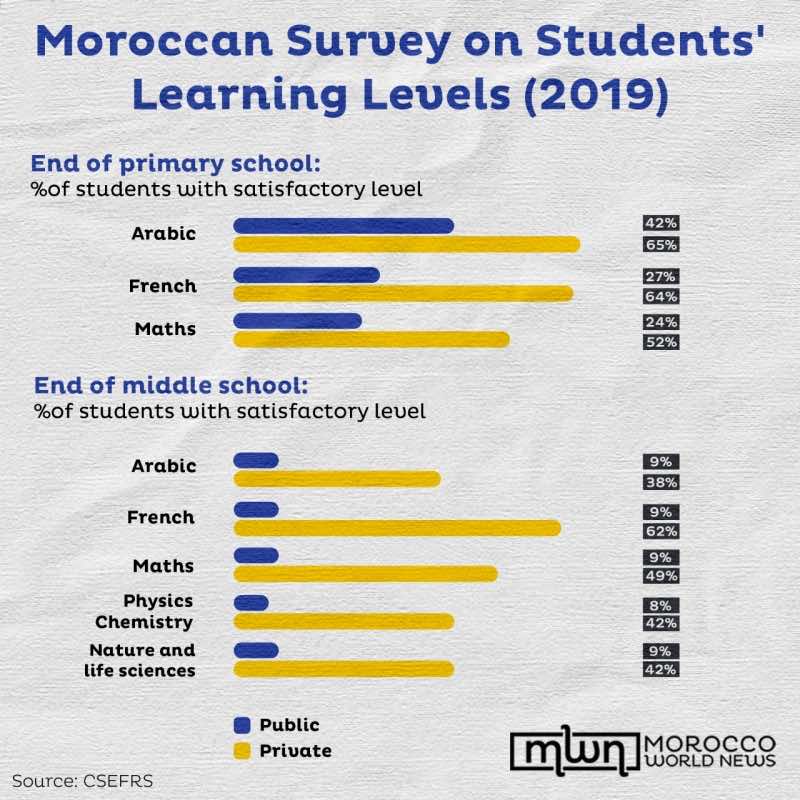
The survey classified students in public schools below the level of satisfactory learning, in contrast to good levels in the private sector. This shows a large quality gulf between private and public learning institutions in Morocco.
Such gaps are very high in elementary school and widen further in middle school. At the end of primary school, only 42% of students in public middle schools have a satisfactory level in Arabic, compared to 65% in private schools, the study found.
Read also: Government Spokesperson: Education Sector Requires Reforms in Morocco
Comparing middle school students’ performance in both public and private sectors, only 8 to 9% of public school students have a sufficient level in their core subjects, compared to an average of 50% in private schools.
This gap shows there is still a lot of work to do to remedy the outcome of the educational process in Moroccan public schools.
The rural-urban disparity is minimal compared to the public-private gap, especially in French skills. In the overall evaluation, the hiatus between the learned skills are practically the same in both urban and rural areas.
“Only 14% and 17% of students in rural and urban areas, respectively, mastered 81% of the prescribed [French] program, while only 6% and 10%, respectively, mastered all of it,” according to the study.
The PNEA survey also found that, in terms of gender, girls still outperform boys in virtually all subjects.
The report not only highlights the extremely low level in Moroccan public schools, but it also points out the factors that maintain a status quo that doesn’t benefit students in terms of learning quality.
It stresses the importance of preschool learning, assistance programs for poorly performing or low-income students, and teachers’ pedagogical skills in transferring knowledge to students.
“PNEA results suggest that in-service teacher training does not have much impact on student achievement,” the report noted, adding that this is due to the “weakness, inadequacy” of training programs, which are seldom organized. Teacher training programs are a must and have always been demonstrated in “international reports as important.”
The PNEA report identifies some areas that should be improved when it comes to enhancing teaching outcomes, including infrastructure and working circumstances, social environment, school environment, and schooling facilities.
Read also: Morocco Approves Paris Declaration Calling for Investing in Education’s Future