Rabat — While the roots of child marriage vary across regions and cultures, structural constraints such as the lack of educational and economic opportunities, limited access to health care, political instability, unfavourable legal frameworks, and the lack of robust data on the practice put children at risk of marrying under age 18. Presently, climate change disasters, increased irregular migratory movements, and the COVID-19 pandemic are quickly exacerbating such fragilizing factors.
In Morocco, despite a number of overall positive political and economic improvements as well as few measures directly aiming at eradicating child marriage, the phenomenon still persists due to determining factors. In 2020, Moroccan courts registered almost 20,000 requests to get married with a minor. Of these, 13,335 legal marriage authorisations were granted — casting doubt on the utility of Morocco’s legal prohibition of child marriage in 2004. In the North African kingdom, as in other countries where the practice is common, girls are more at risk of marrying under 18.
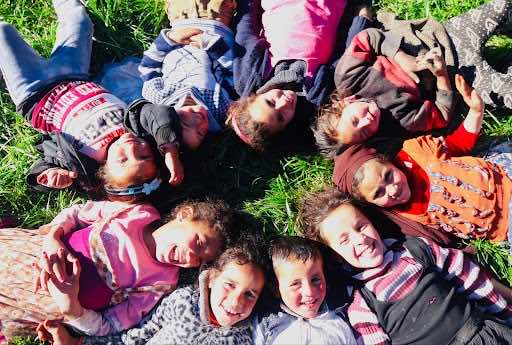
The attitudes of families are the major driver of child marriage in Morocco according to a recent UNICEF study. Above, children of a remote village in the High Atlas mountains play in the fields. © Saâdia Dinia 2018.
Social and gender norms
Generally, change in a social system occurs as a result of change in the consciousness of its members — a “new awareness” which people develop and which forces them to re-think the norms of their society. Simply defined, norms are those “social expectations and prescriptions reflected in the informal rules, beliefs, and attitudes of a society.” A number of studies on child marriage in Morocco appear to argue that such a change in consciousness pertaining to this specific issue has not yet occurred among the majority of Moroccans.
A recent study by UNICEF pointed to the attitudes of families as being the major driver of child marriage. The study portrayed a number of behaviors and beliefs as problematic. For instance, families’ authority over girls’ decisions in terms of marriage was reported to limit a girl’s ability to express her voice and exercise her choices at the risk of being perceived as “defying a father’s authority.”
Obsession about daughters losing their “virginity” and families their “honour” was also raised as an incentive to marry girls early. This points at the close connection between marriage, sex, and childbirth in Moroccan society both in social and legal contexts (Article 490 of the Criminal code).
Another taxing belief highlighted in the study is families’ perception of child marriage as a source of social security for their daughters who move from parental/guardian care to being under their husbands’ responsibility.
These convictions, the study found, are the result of deeply entrenched patriarchal traditions and unequal gender norms. The report also scrutinized the close connection between religion and child marriage in Morocco. A further look into the question indeed shows that a girl’s “readiness” to marry in Islam may be evaluated in some cases based on her first menstrual signs, however early they appear.
Looking back on the tragic suicide of Amina El Filali and how, until very recently in Morocco, marriage was offered as a legal settlement to rapists, also calls attention to the necessity of revisiting marriage symbolism in the country.
Nadia Sonneveld, a social scientist who set in 2015 to find out wether child marriage reforms in Morocco were vain, concluded that constitutional reforms in the kingdom will remain largely inefficient if they are not accompanied by reforms of customary laws and traditional knowledge pervading society at large, including among judges.

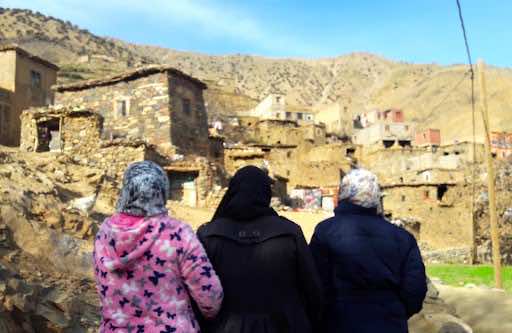
In Morocco, customary law marriages are accepted retroactively as legal proof of marriage. The fact that both child marriages and customary law marriages occur most in marginalized areas might explain the yearly high number of judicial permissions for unerage marriage. Above, a remote village in the High Atlas mountains. © Saâdia Dinia 2018.
Legal loopholes
Morocco raised the legal age for marriage from 15 to 18 years-old (Article 19 of the Family code) in 2004. It was in the context of a larger reform which introduced unprecedented rights for Moroccan women. As far as child marriage is concerned, the reform proved generally ineffective.
The rate of child marriage has been gradually increasing in Morocco. Data from Morocco’s Ministry of Justice and Liberties show that the proportion of marriages conducted in family courts that involve a minor has increased from 7% in 2004 to 11.5% in 2013 (not counting undeclared marriages). In this context, most studies and surveys have denounced a number of inconsistencies in the country’s legal framework.
The number one ambiguity about Morocco’s strategy vis-à-vis child marriage is found in Article 20 of the Family code, which leaves discretionary power to judges to grant an exception to the rule. The judge has to substantiate her/his decision explaining the interest and reasons justifying the marriage.
This settlement must be reached after hearing the parents/legal tutors of the child, with the assistance of either a medical expertise or a social enquiry. While a refusal to permit an underrage marriage can be appealed, its authorisation cannot be. Article 21, for its part, requires the consent of a child’s legal guardian, yet allows judges to disregard a guardian’s refusal to consent.
Another legal hindrance to ending child marriage in Morocco was reported to be related to Article 16 of the Family code, which stipulates that customary law marriages are accepted as legal proof of marriage as long as they are judicially declared within five years of the marriage date.
Given the interlinkage between child marriages and customary law marriages in Morocco (both most common among rural and marginalized communities), this might explain the yearly high number of underage marriage judicial permissions in the country.
Indeed, Article 16 allows judges to approve customary law marriages retroactively, even if one of the spouses or both of them were underage at the time of marriage. Particularly instructive in this regard is Sonneveld’s recounting of the case of a female judge she interviewed in 2015.
The judge recalled having to “choose between two evils”: either to legally register the marriage of a 14 years-old pregnant girl or to reject her request for proof of marriage in a society where a child born out of wedlock is considered “a bastard” and not allowed to school. “Had I declined her request, I would have given the mother and the baby the worst possible start in life,” Sonneveld quoted the judge as saying, pointing at the legal and social ambiguities many Moroccan judges have to deal with when faced with underage marriage requests.
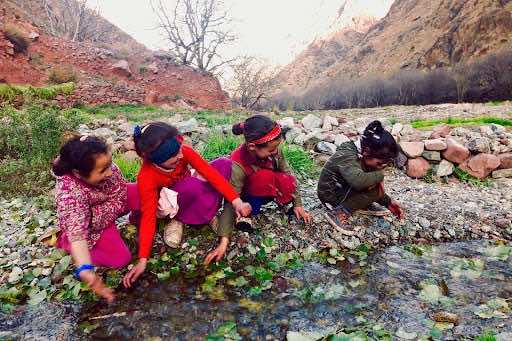
The net enrolment rate in lower secondary education is almost 80% for boys in urban areas but less than 30% for girls in rural areas, reports the World Bank. Above, girls from a remote village in the High Atlas mountains play with a water stream. None of these girls is likely to go past primary education. © Saâdia Dinia 2018.
Restricted access to education and health information
A causal relationship between child marriage and the lack of educational opportunities is today widely established in all countries where the practice prevails. Low levels of schooling appear to be both a cause and a result of child marriage.
According to a study by the International Center for Research on Women, the education a girl receives is the strongest predictor of the age at which she will marry. Compared to girls who have little or no education, girls with secondary schooling are globally up to six times less likely to marry as children.
In Morocco, a 2012 study by the Ministry of Health also showed evidence of a positive relationship between educational attainment and median age at first marriage. The median age at first marriage proved to be more than six years higher for women who completed secondary or greater education compared to those who completed none (30.8 years versus 24.6).
More recently, former Minister of National Education, Said Amzazi, reiterated the two-way causal link between child marriage and school dropout rates in Morocco. He described the lack of educational facilities in rural areas as Morocco’s biggest challenge to end underage marriages.
Certainly, girls from rural areas of Morocco remain at a disadvantage. According to a World Bank report, “the net enrolment rate is 79% for boys in urban areas but only 26% for girls in rural areas in lower secondary education.”
The lack of schooling facilities and their inadequacy (often due to the unavailability of functional toilets) is exacerbated by two factors: 1) the lack of teaching and learning quality in rural school systems; 2) the prevalence of disadvantageous gender norms in rural areas, where it is often not acceptable for adolescent girls to walk to school alone and where the need for women’s education is not well established.
In this context of school dropout in rural settings, the Ministry of National Education and Vocational Training (MENFP) has instigated a few successful measures such as the Tayssir program, a Conditional Cash Transfer program which benefited both rural girls and boys, reducing secondary school dropout and re-enrolling former dropouts.
The MENFP has also operated successful boarding schools for girls from impoverished households in rural areas. But the fact remains that access to education must be accompanied by access to health information. UNICEF has listed unawareness about the negative effects of child marriage on girls’ health as a major determining factor in the perpetuation of the practice in Morocco.
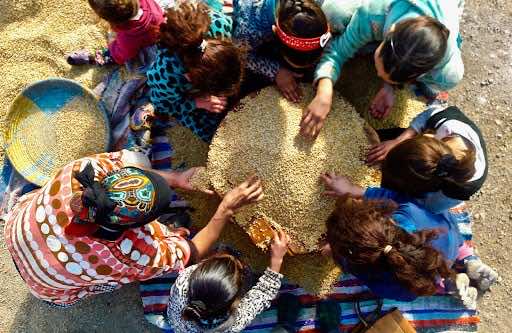
“Girls who marry young are more likely to be poor and remain poor,” reports the International Center for Research on Women. Above, women and girls filtering wheat grains for their personal use in a remote village in the High Atlas mountains. © Saâdia Dinia 2018
Restricted access to economic opportunities
One recurrent point in most studies and reports is that education alone is not enough to end child marriage. The practice is reported to be most common in the world’s poorest countries and among the poorest households within those countries.
Worldwide, parents are giving their daughters off to marry early in order to relieve the family’s economic burden. In Morocco, the dowry system is presented as an additional incentive for families facing economic distress to wed their daughters earlier. The Dowry payment or Mahr in Islam, being an obligation on the groom, is paid in the form of money or possessions to the bride at the time of marriage.
Besides, in families with limited resources, child marriage is often seen as a way to provide for daughters’ future. This situation is aggravated by gender inequalities in the job market, where the unavailability of employment opportunities for women and girls, especially in rural areas, make early marriage the safest option for a decent living.
The aforementioned 2012 study by the Ministry of Health found that there was in Morocco too a positive association between median age at first marriage and wealth quintile, ranging from 25.3 years in the poorest wealth quintile to 28.4 in the wealthiest.
While poverty and the lack of economic opportunities for girls and women enable child marriage, they are also a result of it. “Girls who marry young are more likely to be poor and remain poor,” according to studies carried out by the International Center for Research on Women.
Being married in Morocco invariably reduces the probability of economic participation for women, according to estimates from the World Bank. These figures confirm that if marriage determines a woman’s participation in economic life, then being married before the age of 18 decreases a girl’s access to economic participation.
The way forward
As Moroccan authorities continue to pledge their commitment to promoting female empowerment and eradicating gender inequality, the fight against child marriage should be among their priority. As such, the way forward for the North African country essentially entails addressing the interlinkages between poverty and child marriage.
This includes empowering girls economically through education and legal rights. It also means investing in the building of schools or classrooms that are closer to communities, as well as involving local communities and parents in the schools and training more female teachers.
Such actions need to also consider offering cash incentives and support for transportation and school supplies to families in order to alleviate financial barriers to education. Furthermore, there is a need to provide alternate opportunities for girls to independently support themselves through locally adapted vocational training for instance.
The point is that creating the necessary opportunities and environment for girls to achieve financial independence will reduce their parents’ economic burden. This will in turn help in getting families to change their perception or notion of early marriage as the sole and surest way of ensuring decent lives for their daughters.
Even so, the fact remains that social change does happen in stages. Close to two decades ago, juggling various normative orders (local custom, religious law, national law, and international law), Morocco made its first move to address child marriage.
In 2018, aware that the majority of underrage marriages are forced marriages, the kingdom criminalized forced marriages (law 103-13 on combatting violence against women), thus taking a further step to eradicate child marriage. Still, it is widely proven today that adopting laws without mobilizing external resources for their right dissemination and application is inefficient and almost pointless.
Unless Morocco conceives of, and actually implements, a holistic girl child protection system that targets legal, social, economic, and cultural factors prolonging underage marriage, this practice is likely to remain prevalent.