 Join on WhatsApp
 Join on Telegram
Rabat – Morocco’s Head of Government Aziz Akhannouch has overtly pointed fingers at the former ruling political Justice and Development Party (PJD) for the country’s ongoing energy crisis.
The PJD, which is now an opposition party, has been criticizing the Akhannouch-led government coalition for “failing” to fulfill the commitments Akhannouch’s party made during the 2021 elections.
The billionaire businessman turned politician is the Secretary-General of the National Rally of Independents (RNI), which won the majority of votes during the 2021 elections.
After the win, RNI formed a government coalition with the Al Istiqlal Party and the Authenticity and Modernity Party (PAM). All three parties considerably outperformed the PJD in last year’s general elections, turning the former ruling party into a marginal opposition voice.
In various comments at the House of Representatives, PJD MP Abdellah Bouanou has in recent weeks publicly criticized Akhannouch’s government for the “high and unexplained” level of margins of fuel distributions in Morocco.
Remarks made by Akhannouch earlier today suggest the government has taken to heart Bouanou’s persistent criticism of their performance in the past months, especially amid the recent surge in commodity prices.
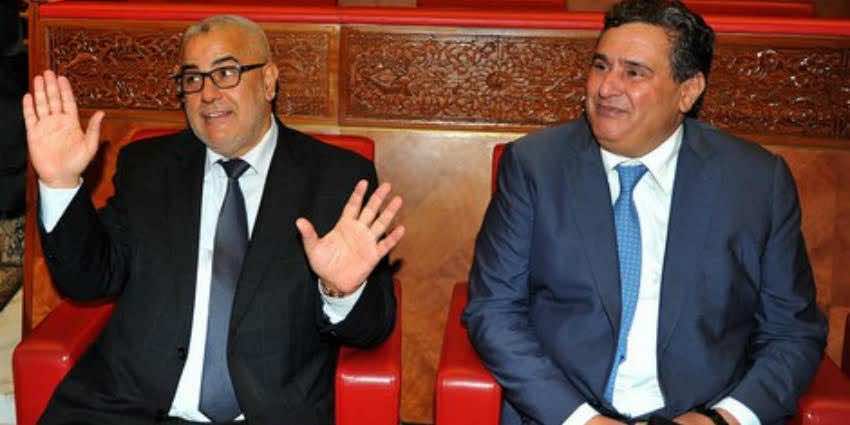
While defending his government’s record today during a session at the House of Representatives, Akhannouch directly blamed a number of current crises facing Morocco, including the increase in fuel prices, on what he called PJD’s failed decade-long leadership.
“There must be a mistake somewhere. The current margins are at the same levels observed in 1997. If your objective is to return to the subsidy, [you will have to] agree with the leader of your party,” Akhannouch said in response to a question from Bouanou.
Akhannouch referenced the position of the former head of government PJD’s Abdelilah Benkirane, who has been backing the liberalization of the energy sector.
He suggested that PJD’s historic failure in last year’s elections was a strong statement about Moroccans’ disappointment with how the party had been leading the country in the past ten years. “The election results are there to provide” proof of Moroccans’ discontent with PJD’s leadership, he argued.
Of PJD’s criticism of the current government’s apparent “failure” to keep its promises, Akhannouch suggested critics should be patient and take into account the context in which his government took the reins of the country. He told the PJD MP: “You are asking others to do what you could not do in ten years.”
Akhannouch went on to directly accuse the PJD of being responsible for the “raised prices which liberalized fuels,” saying: “They [the PJD] were at the helm for ten years and could not secure a national strategic stock of hydrocarbons.”
He also accused the PJD of inaction to tackle the crisis that erupted amid Algeria’s plan to end the contract of the Maghreb-Europe pipeline.
In a context of rising diplomatic tensions in October of last year, Algeria terminated the contract of the transcontinental gas pipeline that had for decades supplied gas to Spain and Portugal through Morocco.
Moroccans have been angry with the soaring prices of fuel and other basic commodities. Fuel prices have been ranging between MAD 14 and MAD 15 per liter recently, causing concerns among average and low-income Moroccans.
Some commodities that used to cost between MAD 5 and MAD 7, including green and red peppers, have seen their prices jump to MAD 10 and MAD 20.
The Akhannouch government has attributed the alarming price fluctuations to global disruptions, including the not-yet-over COVID crisis and the escalating Ukraine-Russia war.