 Join on WhatsApp
 Join on Telegram
Bilingualism, the ability to communicate in two languages with equal fluency and ability, is a skill only approximately 43% of the world’s population can claim. Although some statistics estimate global bilingualism to be as high as 56%, the consensus remains clear: bilingualism, while by no means an anomaly, is not an asset generally enjoyed by the majority of the global population.
As for attaining proficiency in more than two languages, 13% of the global population identifies as trilingual, while 3% of the population can speak four languages. Polyglots, those with a high proficiency in at least five languages, comprise only 1% of the world’s population.
Morocco, especially when compared to the United States and other primarily English-speaking nations, boasts high bilingual and multilingual rates. Due to Morocco’s North African location, proximity to Europe, and time spent as a French Protectorate from 1912-1956, Moroccans frequently speak a mix of Moroccan Arabic (Darija), Standard Arabic, Tamazight (previously referred to as Berber), French, English, and Spanish.
Although proficiency in each language generally depends on a person’s level of education, personal linguistic preferences and priorities, and the region of Morocco in which they were born, Moroccans have long emphasized the importance of multilingualism, and the ability to read and speak several languages is customary.
Yet while the vast majority of Moroccans have attained proficiency in several languages, perhaps the most impressive displays of multilingualism appear amongst the Amazigh people, the Indigenous Peoples of Morocco.
The Battle for Recognition
Appreciating the linguistic customs and patterns of the Amazigh people requires an understanding of the nature and history of their written and oral languages.
Standard Amazigh, commonly referred to as Tamazight, is the historic language of the Amazigh people. As the Amazigh possess a wide range of regional dialects, Standard Amazigh combines the three main Amazigh languages: Tarifit, which is spoken in the Rif mountains in the north, Tashelhit, spoken in the Sous region in the mid-southern part of Morocco, and Tamazight, common amongst the Amazigh living in the Atlas region.
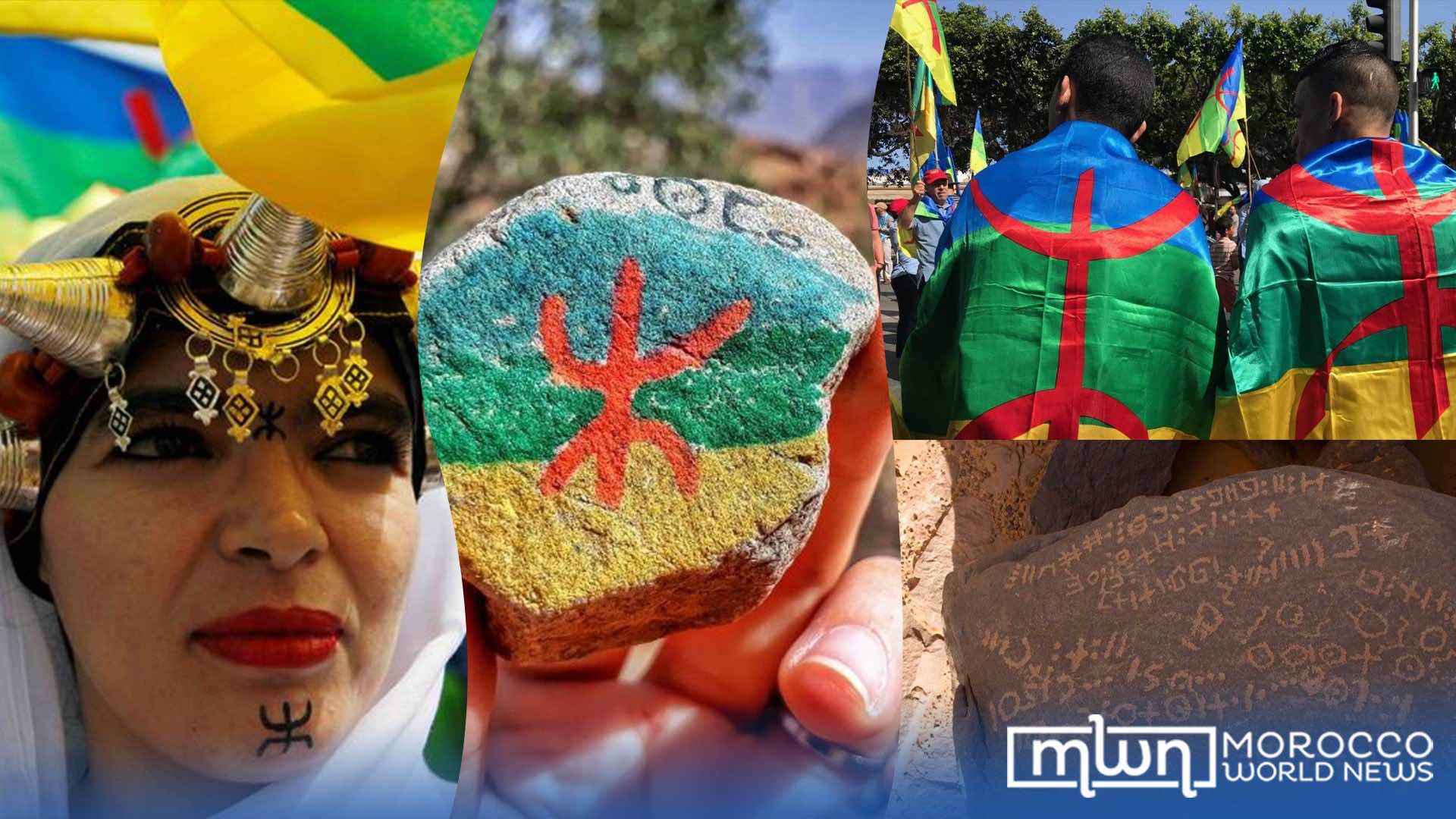
The script form of Standard Amazigh (referred to as Tamazight going forward) is known as Tifinagh. At 5,000 years old, Tifinagh is one of the world’s oldest languages. Written left to right and comprising 33 letters, Tifinagh bears no discernible resemblance to the Arabic script.
Few Moroccans or Amazigh write Tifinagh, however, as the Tamazight language has been preserved primarily through oral tradition, even after Arabs arrived in North Africa in the seventh century and became the dominant culture.
Although many Moroccans define their identity through Arab and French influences, according to the International Work Group for Indigenous Affairs (IWGIA), the majority possess some degree of Amazigh ancestry.
While the 2016 census in Morocco determined the number of Tamazight speakers to be 28% of the population, many Amazigh organizations claim a rate of 65-70%, asserting that the census overlooks rural, isolated areas that are more likely to speak the language.
Given the wide range of statistics, it is reasonable to estimate that around 40% of the population, or approximately 15 million Moroccans, speaks an Amazigh dialect.
Yet despite their rich, centuries-old history as Morocco’s original inhabitants, the Amazigh people have struggled to receive official recognition of their culture and the ability to practice and speak their own language.
In the face of “Arabization,” the promotion of an Arabic-centric policy to establish a unified Moroccan identity following the end of French colonization in 1956, Tamazight was marginalized, as Arabic became the sole official language of the kingdom.
However, the turn of the 21st century saw increased recognition of Tamazight and Amazigh culture. In 2001, for instance, a royal decree by King Mohammed VI established the Royal Institute of Amazigh Culture (IRCAM) to reaffirm and preserve Amazigh languages and culture at both the national and local levels and advance the development of Tamazight courses in Moroccan schools.
Due to the work of organizations such as IRCAM and a willingness of the government to acknowledge Amazigh cultures, 2003 marked the official adoption of the Tifinagh script in Morocco. These efforts culminated in the recognition of Tamazight in Morocco’s Constitution in 2011, which rendered Tamazight Morocco’s second official language, after Arabic.
More recently, in June 2018, the Moroccan government adopted law 26.16 to define the process of implementing Tamazight as an official language and its integration into the Moroccan education system, thus highlighting the government’s commitment to promoting Tamazight in Moroccan schools.
According to a report by the Ministry of Education, almost 600,000 students had studied Tamazight in the 2018-2019 academic year at the primary school level.
The Multilingual Amazigh
Prior to the implementation of Tamazight within the Moroccan education system, many Amazigh peoples had to learn a wide variety of other languages to succeed academically and professionally.
Take Youssef, a member of an Amazigh tribe in the high Atlas mountains. In a conversation with MWN, Youssef said that he first learned the Amazigh dialect Tashelhit at home, followed by Arabic, both Darija and Standard Arabic, in the mosque.
Although he speaks Tashelhit, Youssef said he can understand the other Amazigh dialects. Non-Tashelhit Amazigh often struggle to comprehend the dialect, however, due to its different accent, he noted.
While attending his local school from ages six to 12, Youssef sharpened his Arabic skills and began to learn French, as Arabic and French were the only languages taught at his school at that time.
Although such instruction is typically supplemented by three years in high school, followed by university, Youssef attended neither due to their distance. The nearest universities were in Marrakech or Agadir, he noted, more than 300 km from his village.
However, after finding few job opportunities in his local village, Youssef moved to Marrakech 12 years ago in search of employment, joining his cousin who had relocated there several years prior.
After working at Caterpillar Inc, a construction equipment company, for four years, Youssef then completed a five-month English program at a private school in Marrakech, where he became conversationally fluent and learned the basics of writing in the English language.
Deciding to put his many linguistic skills to use in the tourism industry, Youssef has spent the last four years honing his English skills and learning Spanish, primarily through communication with his clients. He remarked that Spanish was relatively easy to learn, as it has a similar accent to Arabic, but English remains his favorite language, as it can serve as a shared link amongst a diverse group of people.
When asked about the speed at which he acquired both Spanish and English, Youssef merely shrugged his shoulders, noting: “If you listen, you learn.” According to Youssef, learning the many Amazigh dialects enables the Amazigh people to pick up other languages more quickly than an average individual.
In addition to noting the languages he himself is familiar with, Youssef added that it is not uncommon for Amazigh, particularly those who interact regularly with foreigners, to know German, Hebrew, or Italian.
As if to prove his point, Youssef invited another Amazigh tour guide, Rashid, to join the conversation. Like Youssef, Rashid learned Tashelhit at home before picking up Arabic and French in elementary school,
However, Rashid continued on to university, where he studied Spanish, eventually mastering the language.
As a result of sixteen years of experience working with tourists, Rashid has also learned English, German, Dutch, Portuguese, and Japanese, although he is only able to write in Arabic, English, French, and Spanish. Like Youssef, Rashid stressed the ease with which he and other Amazigh are able to teach themselves languages through conversation and listening.
However, as Rashid attended primary school prior to Tamazight’s inclusion in Morocco’s Constitution and education system, he is unable to write in Tifinagh. He therefore praised the incorporation of Tifinagh and Tamazight instruction in a structured academic setting.
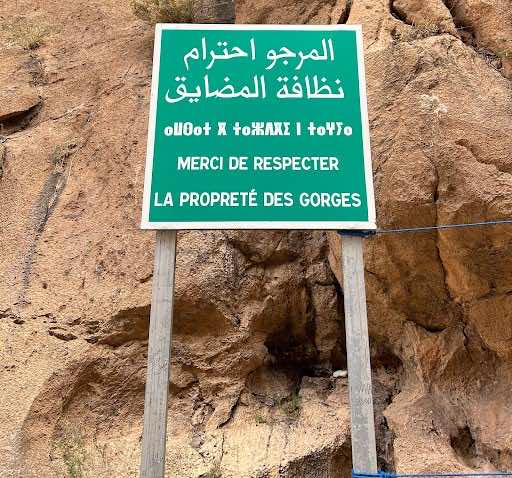
To show Tinfinagh’s incorporation into public life, Rashid pointed to a street sign whose instructions were written in Arabic, Tinifagh, and French.
The Future of Tamazight and Tinafagh
Following the adoption of law 26.16 in 2018, Morocco has further incorporated Tamazigh into public life by integrating Tamazight into the nation’s judicial system in June 2020 and partnering with the IRCAM to create a new, comprehensive curriculum to teach Tamazight in elementary schools in January 2021.
Nevertheless, as of 2021, only four of Morocco’s thirteen public universities — Hassan II University of Casablanca, Sidi Mohamed Abdellah University in Fez, Mohammed I University in Oujda, and Ibn Zohr University in Agadir– taught Tamazight and student enrollment in Tamazight courses was declining.
Additionally, the Moroccan government has yet to make Id Yennayer, the Amazigh New Year which falls on January 12th, an official national day. Algeria, which similarly possesses a large Amazigh population, granted Id Yennayer such status in 2018.
However, the last ten years have seen significant advancements towards a greater recognition and incorporation of Amazigh language and culture in Morocco. Moving forward, preserving Tamazight and advancing Amazigh culture will only enhance Morocco’s distinctive multilingual character.