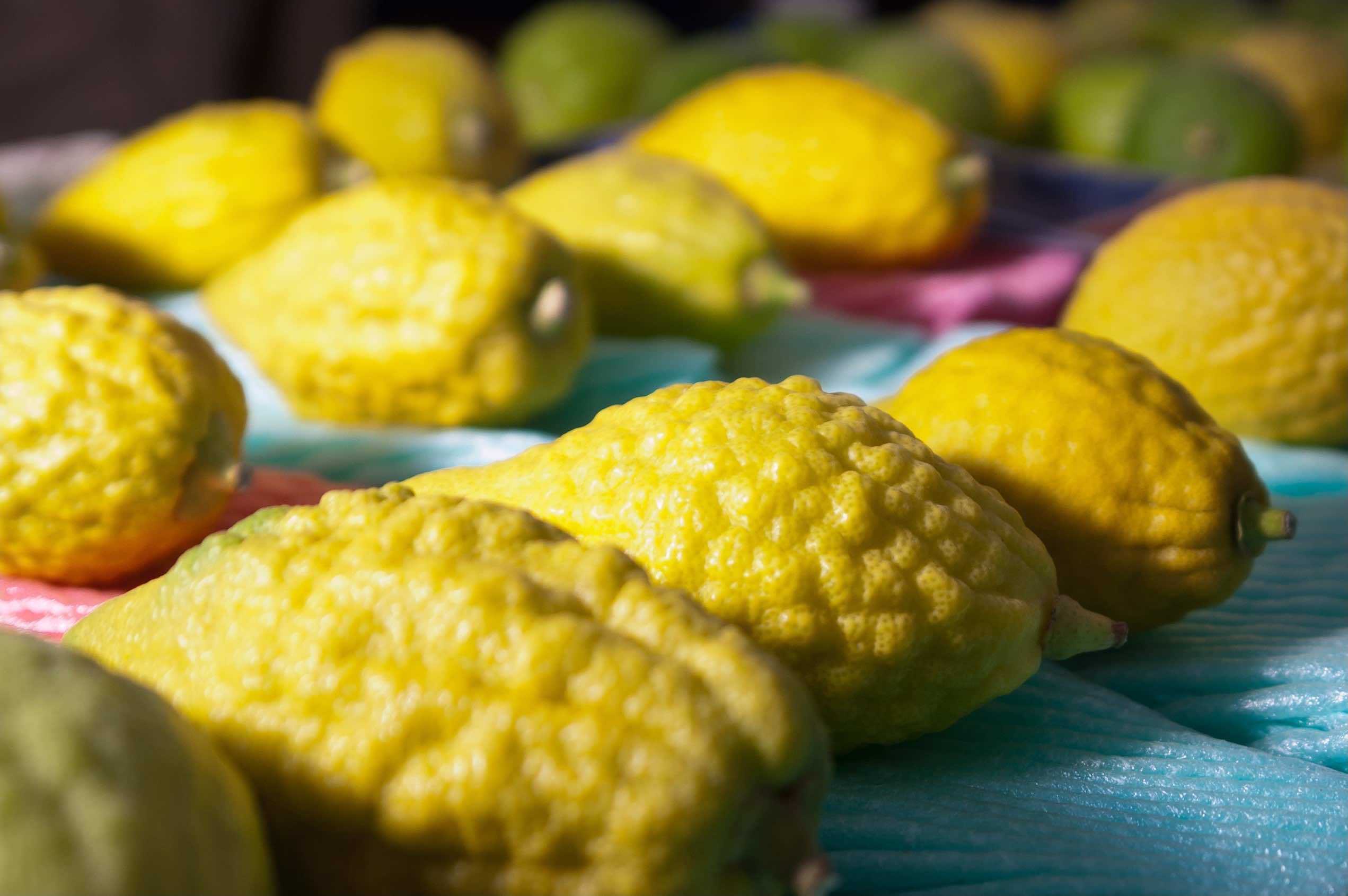
Rabat – Moroccan etrog cultivators have exported 600,000 etrogs this year, marking a 10% increase compared to a typical season given the growth of Moroccan trade with Israel. The yellow citrus fruit is used by Jewish people for their week-long Sukkot celebration.
Speaking to the Jewish Telegraphic Agency, Hervey Levy, an owner of an etrog farm in Agadir, said that the Moroccan exports are designated to the Jewish diaspora.
The yellow citron, cultivated in Morocco by Muslim and Jewish farmers, is used alongside palm, myrtle, and willow branches to make Lulav.
Lulav is a special bouquet that people shake to send a blessing out to all of creation during the seven-day Jewish fall harvest festival named Sukkot.
The festival starts on the 15th day of the seventh Jewish month known as Tishrei, which serves as one of the three pilgrimage festivals to the Temple in Jerusalem.
The production of etrog in Morocco dates back nearly 2,000 years ago, according to the Jewish Telegraphic Agency.
The first tree was planted in the Atlas Mountains by Jews who settled in the North African region after the destruction of the Second Temple in Jerusalem.
Over the years, the plant was cultivated by Moroccan Jews for their religious ceremonies. However, they often resorted to the support of their Muslim neighbors when the cultivation season fell on a Shmita year, meaning the seventh year of the Jewish agricultural cycle. During that season, it is forbidden for Jews to cultivate the soil.
The former head of economic affairs at Israel’s mission to Morocco Einat Levi said: “It is symbolic because it shows how two religions can stand up for each other, so when the Jews cannot work their land, their fellow Muslims can supply what they need during that year, so they can keep their ritual and tradition.”
Read Also: Moroccan Muslim-Jewish Co-Existence Celebrated in New York
The most recent Shmita year was 2021-2022, explaining why Israel welcomed the Moroccan exports despite having its own robust etrog industry as well as strict anti-import policies.
“The customs are very tough to accept etrogim from outside of Israel, except during the Shmita year” Levy said.
The Moroccan exportation of etrogs was made easier this year by the recent re-establishment of relations between Morocco and Israel and Royal Air Maroc’s launch of direct flights connecting Casablanca and Tel Aviv.
“Before the agreement, we always had to sell through a third country,” Levy explained. “It could be Turkey, it could be Spain, it could be Italy, it had to transit somewhere.”
The Moroccan production of etrogs is led by two Jewish family farms including Levy’s farm with 400 trees and other smaller Muslim-owned farms.
“There are lots of Muslim owners but they have smaller land,” says Levy.
The locally cultivated etrogs are divided into three categories from the finest “Aleph-Aleph” products sold at more than $80 (MAD 880) in Morocco to the cheaper types known as “Bet” and “Gimels” priced at $15 (MAD 165) and $10 (MAD 110) respectively.
However, Levy argues that the Moroccan etrogs market generates low profit since only 5% of the crops have “Aleph-Aleph” quality. Meanwhile, 40% of the crops are “Bet” and the remaining 55% are “Gimels.”
For instance, Levy’s family farms annually produce 90,000 etrogs from 400 trees. After the deduction of a year’s worth of expenses, the family makes $30,000 in profit.