 Join on WhatsApp
 Join on Telegram
Propaganda is a form of communication that is used to influence the attitudes and behaviors of a large group of people. The origins of propaganda can be traced back to ancient civilizations, where leaders used various forms of communication, such as speeches and visual art, to promote their ideologies and gain support for their actions.
Propaganda is not a new phenomenon it has been used throughout history as a tool that can shape public opinion and influence events on the ground during times of war. From the ancient Egyptians to modern-day conflicts, the use of propaganda has played a significant role in manipulating the narrative of war and in influencing the actions of governments and militaries.
Propaganda’s past
One of the earliest known examples of propaganda can be found in ancient Egypt, where pharaohs used art and inscriptions to glorify their accomplishments and justify their rule. Similarly, during the Roman Empire, emperors used art and architecture to depict their military conquests and to associate themselves with gods and goddesses.
During the Middle Ages, it was used to influence public opinion during the Crusades. Christian leaders used religious imagery and language to create a sense of moral righteousness to justify their actions against Muslims.
In more recent history, World War I and World War II utilized propaganda on a large scale, it had a significant impact on the course of the war. Both the allied and axis powers used various techniques, such as posters, newsreels, and radio broadcasts. In addition, there are many examples of propaganda during the Cold War, where both the United States and the Soviet Union used various techniques to impact events on the ground.
Modern Propaganda
However, propaganda is still prevalent in the modern era with a strong role in conflicts around the world. In the modern day, social media and the internet have made it easier for governments and non-state actors to disseminate propaganda and mold the global population’s perspective.
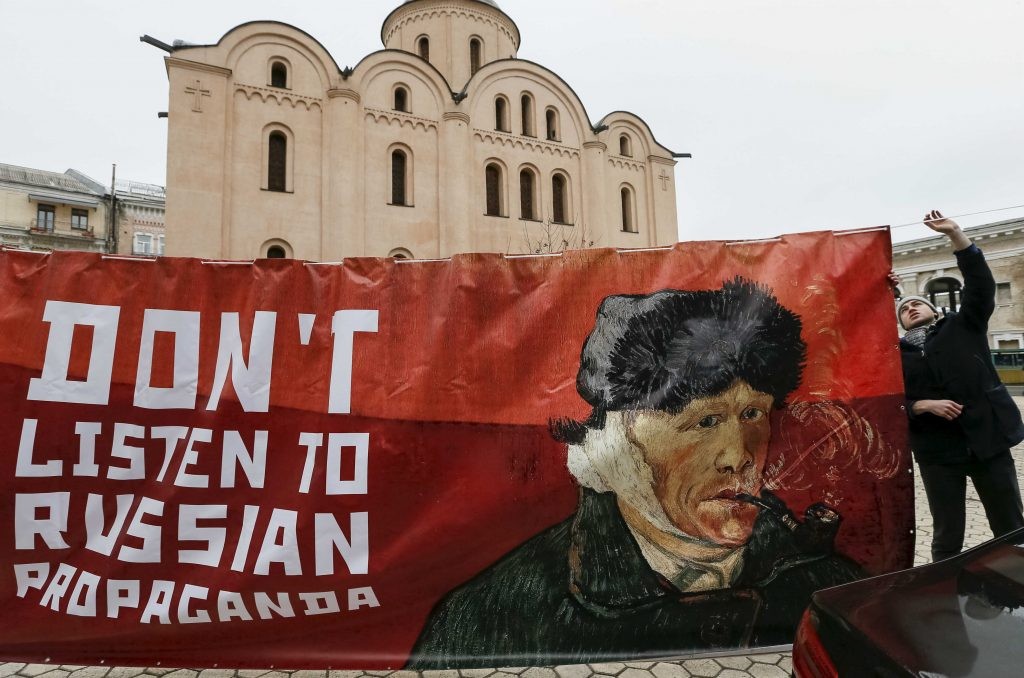
The role of propaganda in the Russian-Ukrainian conflict has been significant as both sides have used various techniques to shape the war’s narrative.
Some techniques were created by the Institute for Propaganda Analysis (IPA). The Institute was a research organization in the United States that was active from 1937 to 1942. It was founded by a group of educators and social scientists to study the nature of propaganda and its effects on society. The IPA aimed to educate the public about the techniques and methods used so that people could better evaluate and resist influence.
The Russian-Ukrainian war has been characterized by the use of various propaganda techniques by both sides including name-calling, bandwagon, and card stacking among others.
Propaganda techniques
Name-calling, for instance, is the utilization of negative or pejorative terms to describe the enemy or the opposition. In the Russia-Ukraine context, state-controlled media in Russia referred to Ukrainian soldiers as “fascists” and “Nazis.” Meanwhile, Ukrainian outlets named Russian-backed fighters “terrorists” and “separatists.” This technique serves to demonize the opposing side and spread negative opinions.
Glittering generalities is another tool that has been employed to create an emotional response from the public. Both Russia and Ukraine utilized glittering generalities to build support for their cause. On Russia’s part, they used the annexation of Crimea as “reuniting” with a “historically Russian” land, while Ukrainian media called the war a “fight for freedom and democracy.”
An image-based style of propaganda known as transfer, is the use of symbols or images associated with positive emotions to transfer those emotions to a person, idea, or cause. The image of the Kremlin has been used to associate their actions in Ukraine with national pride. Ukraine took a similar visual approach and used images of Ukrainian soldiers and the national flag to associate their cause with heroism.
Testimonial, another verbal technique, involves using a famous or respected person to endorse a narrative to others, which have been used in both countries by celebrities and politicians.
Another concept is card stacking which is the use of selectively presenting information to create a biased argument. The Ukrainian media selectively presented information about the Russian government and the war effort to create a negative image of their opposition’s government. In comparison, Russian media selectively presented information about the Ukrainian government to create a negative image.
As made evident through these examples there have been significant incidences where the two countries used propaganda to their advantage, which had a momentous impact on the course of the war.
This has allowed either side to gain support from the domestic population and justify their actions to the international community.
Negative impacts
There negative consequences of propaganda are important to note, such as the spreading of misinformation and the erosion of trust in the media. To overcome false information it is crucial for individuals to critically evaluate the information they consume and to be aware of the techniques being used.
Russian state-controlled media outlets portrayed the conflict as a defensive measure to protect its citizens and Russian-speaking populations in Ukraine from fascist and nationalist forces.
The consequence of both sides using persuasive techniques led to a significant polarization of public opinion and mistrust between the two countries. It also made it difficult for neutral parties to understand the true nature of the conflict and the events taking place.
The propaganda also had a significant impact on the people living in the affected areas. It created fear, mistrust, and hostility among different ethnic and linguistic groups and exacerbated existing tensions. Furthermore, it escalated the conflict, making it more difficult to find a peaceful resolution.
Psychological manipulation
In addition to shaping perspectives, it was used as a tool of psychological warfare and manipulation. False and misleading information from Russia sowed confusion and uncertainty among the Ukrainian population, making it difficult for the government to maintain control. This was particularly true in the Donbas region, where pro-Russian separatists were able to gain control over large parts of the population by spreading misinformation using local media.
Propaganda also played a role in the recruitment of soldiers and volunteers for the separatist forces. Through the media, Russia portrayed the war as a heroic struggle against fascism and Western imperialism, which helped to attract volunteers from across Russia to fight in the conflict.
Furthermore, the impact of propaganda extended to the international community’s perception of the conflict. Where from the Russian perspective depicted the conflict as a civil war and alleged that the Ukrainian government was committing war crimes against the ethnic Russian population.
On one hand, it is clear that the Russian side wanted to demonize the Ukrainian government and military and gain the support of domestic and international audiences with the help of propaganda. On the Ukrainian side, it is evident that propaganda was used as a counter-tool to the Russian narrative and to legitimize their own actions while being backed by domestic and international audiences.
However, the effectiveness of this propaganda in winning the hearts and minds of the local population and the international community counted on various factors, such as the credibility of the source, the target audience’s level of media literacy, and the context of the conflict.
Everything considered it can be argued that the common denominator in how propaganda is used is a fundamental method behind molding opinions surrounding the conflict from both sides. This, in turn, is altering the outcome of the war.
Read Also: Survey: Despite Ukraine War, 37% of Moroccans Want To Keep Ties With Russia