


 Join on WhatsApp
 Join on Telegram
Rabat – OCP Group has published its new investment strategy for 2023-2027, with the vision of making a vital contribution to the global energy transition while playing its role in national sustainability efforts.
Over the coming years, OCP Group is investing $12.3 billion (MAD 130 billion) to boost production while making full carbon neutrality a reality by 2040. In the process, the company intends to create tens of thousands of new jobs and support local small and medium-sized enterprises (SMEs).
OCP’s track record of delivering on similar promises in a previous investment plan shows the company knows how to turn its ambitions into practical change.
Top-level alignment
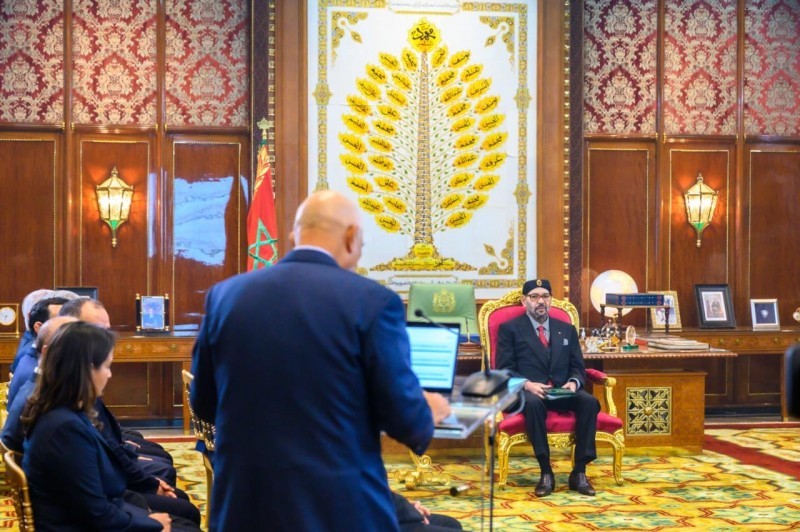
OCP Group’s new green investment program for the coming years comes in direct response to a recent meeting in Rabat chaired by King Mohammed VI. On November 22, Morocco’s top business leaders met in the royal palace in Rabat to discuss the country’s “strategic objectives” regarding the nation’s burgeoning renewable energy industry.
The message from the palace was clear, Morocco’s renewable energy transition needed to be kicked into high gear.
Less than a month later, OCP Group announced its new investment plan that mobilizes billions of dollars to play its part in the realization of the country’s grand ambitions of energy efficiency and sustainable development.
The close alignment between the government, palace, and the state-owned fertilizer company allows Morocco to confront the pressing issues of climate change and its consequences in a manner that spoke volumes about the genuineness of the county’s commitment to clean energy. Illustrating this national commitment is that all top-level actors in Morocco are singing from the same hymn sheet when it comes to the country’s energy transition strategy.
Water needs
A key element of OCP Group’s new green investment strategy is to address some of Morocco’s most fundamental issues head-on.
The country is undergoing severe water stress and regular droughts, while importing an estimated 90% of its energy needs. These two structural weaknesses present a significant risk to the country, making them a key factor in OCP Group’s vast investment plans.
Morocco’s current water crisis is not just a threat to local people, agriculture and wildlife; it is a pressing issue for the water-intensive process of producing Morocco’s most valued export product, phosphate-based fertilizers.
Water is essential to transport mined phosphate rock, produce phosphoric acid as well as a crucial component for a variety of other elements to produce the fertilizers that farmers need worldwide to feed the world’s growing population.
Desalination, which consists in removing the salt from seawater to turn it into usable fresh water, has long been one of the go-to solutions to water scarcity. However, one of this technological solution’s drawbacks is its heavy need for energy to power the desalination process.
OCP Group intends to address this factor by ensuring that its current and new desalination plants will be fully powered exclusively from wind, solar and hydroelectric sources, as well as through cogeneration, where electricity and heat are generated simultaneously.
Through desalination, OCP Group aims to produce its own sustainable water resources while providing drinking water for local communities and urban areas. This year, OCP is already projected to provide 40 million square meters of drinking water for the cities of Safi and El Jadida. This is only a drop in the bucket however, as OCP’s new plan aims to produce 110 million square meters of water by 2023, and 560 million square meters of water by 2026.
New Energy
With roughly 90% of its energy needs coming from abroad, Morocco is currently far from being “energy independent.”
The country has been a global front-runner in large-scale green energy projects such as the Noor solar plant in Ouarzazate, the world’s largest of its kind.
Still, meeting the needs of a growing and increasingly prosperous population will require these efforts to be scaled up significantly. This need for clean, reliable energy has prompted OCP to invest heavily in building a new energy infrastructure to power Morocco’s future.
OCP’s new investment strategy prioritizes Morocco’s need for sustainable green energy as a means to help realize the country’s clean energy ambitions, while powering a vast array of new desalination plants as well as mining and production facilities.
OCP’s energy generation targets are highly ambitious, aiming to produce 5GW of renewable energy in 2027, and 13GW in 2032. These targets would allow the company to use exclusively self-generated green energy by 2027.
Most importantly, scaling up local energy production will allow Morocco to wean itself off foreign fossil fuels, take an important step towards energy independence and produce valuable input products that are essential to the fertilizer production process.
Green value-added products
Morocco’s primary export product is in high demand. Amid an inauspicious global context in recent months, a marked fall in fertilizer supply has led to rising costs for fertilizers that are vital for food production.
Africa in particular has been severely impacted by rising fertilizer prices, with many farmers facing the dilemma of limiting the use of prohibitively expensive fertilizer in order to cut down on costs amid the cost of living crisis. As part of its pan-African commitments, OCP has vowed to not abandon its struggling African customers that have been reeling from the negative repercussions this fertilizer crisis.
Yet as the world’s largest importer of ammonia, a key ingredient in the fertilizer recipe that is commonly produced by countries with access to cheap domestic gas, OCP is now faced with the challenge of curtailing the effects the Ukraine war has had on its ammonia imports.
OCP intends to fix this lingering issue with a vision for the long-term that aims to produce ammonia domestically, not from natural gas, but completely from green energy. Achieving this feat would radically change Morocco’s trade deficit for the better, and remove its dependence on foreign suppliers and the ever-fluctuating price of unsustainable natural gas.
The company aims to pump billions into creating an entirely new domestic industry to produce green hydrogen which can then be used to produce sustainable green ammonia. By 2027, OCP aims to be able to produce 1 million tonnes of green ammonia, rising to 3 million tonnes by 2032.
In addition to green ammonia, OCP is also eyeing to produce fluoride and other ingredients needed to produce Lithium Iron Phosphate batteries, vital for the production of electric vehicles, smartphones and a vast array of other digital technology.
Innovative Industrial ecosystem
In terms of implementation, OCP Group’s new investment plan leaves little doubt about how the company intends to realize its ambitions. The new plan details highly specific investments, new construction plans, new infrastructure, and even contributions to support and strengthen Moroccan SMEs creating tens of thousands of new jobs in the process.
In particular, its new investment strategy, OCP’s plans detail how the Group intends to deploy the billions in investment, from boosting value chains in its industrial and mining sites, to the construction of large solar farms, speciality chemical plants, high-tech desalination facilities, and green ammonia plants.
Meanwhile, OCP is leveraging its significant investment in the field of innovation in Morocco. Over the past decade, it has established specialized research centers at the country’s premier university, the OCP-backed Mohammed VI Polytechnic University (UM6P).
The innovation-oriented approach taken by OCP is leading to the country’s growing expertise in high-tech technology, sustainable fertilization, and renewable energy to take advantage of the ever-changing technological landscape.
From a top-of-the-line data center and Africa’s first supercomputer, to boosting innovation via startups, research and development and laboratories, OCP’s investments are changing the capabilities of Morocco beyond the traditional role played by African countries as exporters of raw materials.
This trend is set to continue in the 2023-2027 plan, which introduces new support programs to provide another boost to the country’s innovative industrial ecosystem. With a focus on industrial SMEs and the energy and agriculture sector, the group intends to create 25,000 direct and indirect jobs, support 600 local companies and ensure 70% of the industrial process can be achieved domestically.
Solid foundations
By building on the successful completion of its 2012-2021 investment strategy, OCP aims to boost fertilizer production from 12 million tonnes to 20 million tonnes in the coming five years. This seems highly ambitious but follows the trend of the Group rapidly expanding its production capacity over the past decade.
Within ten years, OCP has been able to triple its capacity, from 4 million tonnes to 12 million while creating 8400 direct and indirect jobs. Meanwhile, the company’s turnover rose from $2.5 billion in 2005, to $9.4 billion in 2021.
The latest expression of King Mohammed VI’s vision in November has now created a renewed impetus to rapidly accelerate renewable energy production and reach carbon neutrality by 2040.
With support from all of Morocco’s top private and public sector actors, OCP intends to make “sustainable development a real competitive advantage.”
OCP Group’s new plan would drastically transform Morocco and introduce new industries such as a vast network of desalination plants, green hydrogen and ammonia facilities, new mining and production sites, all powered by an immense network of renewable energy farms.
In line with the monarch’s vision, OCP’s new investment plan is set to crucially contribute Morocco’s efforts to reduce its trade deficit, create new employment opportunities for the next generations, strengthen its business ecosystem, and become less dependent on foreign chemicals and fossil fuels.
Given OCP’s alignment with the government’s ambitions and the King’s directives for the future, the group has both the funds, the support, and the detailed plans ready for the coming five years.


