


 Join on WhatsApp
 Join on Telegram
Rabat – “Fountain of Freedom, Source of Light/Where sovereignty and safety meet/Safety and sovereignty may you ever combine!” These are the opening verses of the Moroccan national anthem chanted loud, in Qatar, in every Moroccan household around the world, and in Bean Bagz Cafe, on Tecumseh Street, Windsor, Canada.
There were about twenty Moroccan men, women, and children on this Wednesday afternoon, December 14, 2022. The stage was prepared for a big event. A large screen television on the wall, chairs lined up like in a theater, embellished with large and small flags of Morocco.
The lady behind the counter added a friendly touch to the ambiance. Everybody was waiting for the start of the hyped game between Morocco and France. A reserved optimism was in the air, but everybody was convinced that the Moroccan team would, or maybe should beat France. It is a question of national pride.
In fact, Morocco’s game against France was perceived in Africa and the Arab world in terms of a historical confrontation between the colonizer and the colonized, and the West and the Orient. In Qatar, American political scientist Samuel Huntington’s idea of the “clash of civilizations” morphed into a world clash of soccer played out on the pitch.
In every stadium, fans chant their country’s national anthem, wearing the jersey of their national soccer teams, and do not hide where they come from. Like any other popular sport, soccer expresses a social, cultural, and political significance that represents collective identities on a local, national, regional, continental, and global scale.
Identification with one’s soccer team reflects the idea of the nation as an imagined umma or community as American scholar Benedict Anderson said. Undoubtedly, soccer is one of the few edifices of identity which have endured the postmodern attrition of identity. Its fans belong to the category of citizens who feel more passionate about their national identity and who are ready to defend, vehemently and sometimes violently, their team and its insignia.
To support a national team is to express a certain belonging to a territory, a region, and a culture. But given the dispersion of their fans and players around the globe, national soccer teams have themselves taken on different meanings and colors.
The notion of representing one’s country is more than just an identification card; it is an attitude, a feeling, and a personal preference which neither fame nor time or geography can alter. More than half of the Moroccan squad are born in Europe or Canada. Some of these players played for France, the Netherlands, or Belgium in underage leagues.
But ultimately the footballers decided to play for Morocco, which is a testament to their emotional attachment and loyalty to the country of their parents and to its cultural values and political symbols. Some of these players’ celebration of their victory over Spain and Portugal with their mothers is a forthright recognition of their parents’ contribution to their success.
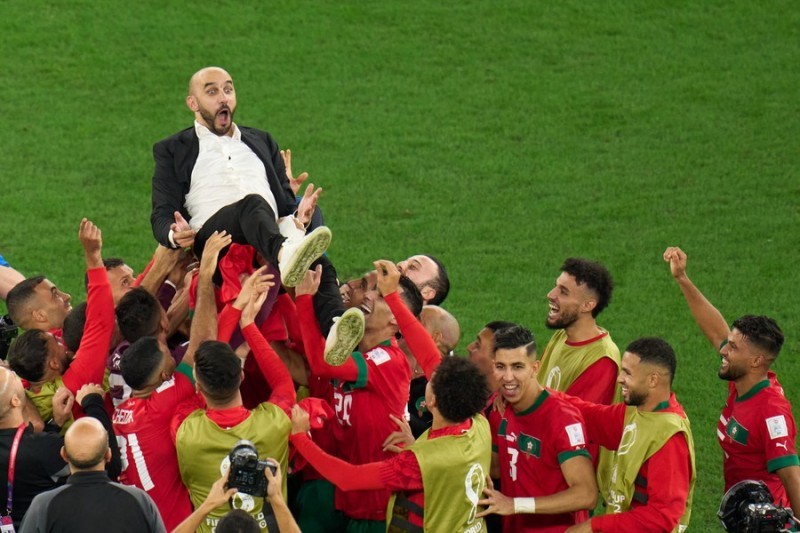
Despite Morocco’s 0-2 loss to France at the al-Bayt stadium, the team, known as the Atlas Lions, have become the emblem of a nation, of a region (the Arab world), and of a continent (Africa).
Its outstanding performance has upset all predictions—Morocco is the first Arabo-Berber and African team to reach the semi-finals—and brought pride not only to Morocco, but to the Arab world and Africa as well. It defeated three European powerhouses, Belgium, Spain, and Portugal, which was described as a ‘fairy-tale’ of the tournament.
For the coach and his staff, the players, and the fans, it was like living a fabulous dream. “We can dream, why shouldn’t we dream about winning the World Cup,” coach Walid Regragui said after his team defeated Portugal.
Morocco’s impressive performance corroborates French psychiatrist Frantz Fanon’s call for Africans and Arabs to think differently of themselves: “Come, then, comrades, the European game has finally ended; we must find something different. We today can do everything, so long as we do not imitate Europe, so long as we are not obsessed by the desire to catch up with Europe,” Fanon wrote in The Wretched of the Earth.
Not only did Qatar and Morocco offer ‘something different’—something beautiful—to the rest of the world, but they also forced the West to review its cultural prejudices and stereotypical images of the Arab world and Africa.


