


 Join on WhatsApp
  Join on Telegram
 Israel’s periphery—commonly referred to as “the place forgotten by God” due to its remoteness, decrepit cities, and lack of funding and resources—was Israeli-born Orly Portal’s first exposure to her Moroccan heritage.
Nearly two hundred kilometers away from the country’s metropolitan centers lay towns untouched by gentrification and forgotten by the elite, their seclusion only strengthening the presence and persistence of ethnic bubbles.
According to Portal, remaining in the periphery rather than being tossed into the simmering melting pots of Israel’s major cities was the key to keeping her community’s Moroccan spark and hiba (“aura” in Darija) alive.
Born in Kiryat Shmona, Israel to an Essaouiri father and Casablancaise mother, Portal spent much of her childhood immersed in an atmosphere fiercely infused with Moroccan flavors—music, food, language (Darija), and community (her village-like enclave consisted of about a dozen families) punctuating her life.
“I was drinking this culture to my DNA,” says Portal with a sense of gratitude and sentimentality. Traversing the lines of identity division, Portal’s Moroccan and Israeli sides have served as both a life-long compass and an inspiration for countless dance creations—the starkly contrasting black and white costumes evoking a never-ending battle between belonging and outsiderness, an entity floating relentlessly in search of a home.
Using modern, classical, and contemporary dance as her jumping off point, Portal slowly made her way to improvisation—deeply drawn to its lawless and playful nature. Years later, a deep calling pushed her to reconnect with her roots and discover Arabic folklore. The familiar tunes of Oum Kalthoum soothed her, and her knowledge of Darija provided her with cultural wealth.
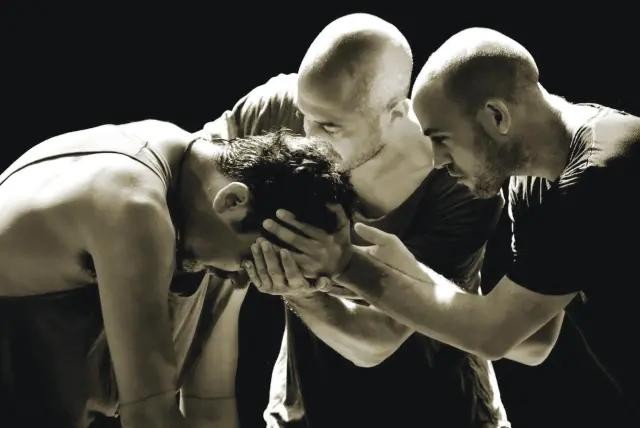
This newfound sense of rooted-ness in both cultures carried over into her professional life—manifesting itself through the synthesis of a new and distinct technique. The Orly Portal method—a concoction of contemporary and improvisational techniques and belly dancing—has come to be studied internationally.
Un-straightening Spines, Unmasking Imperfections
“My dance can be amazing with my history.”
Portal speaks to how classical approaches can often mask, rather than draw inspiration from, internal tumultuousness and brokenness. Freed from the constraints of traditional dance, she displays her cultural heritage through her technical flair—channeling the most genuine version of herself.
“Twenty years of dance didn’t straighten my back,” says Portal with pride. “When I got back to my roots, I felt like I had a place not to be straight now. My back can be bent. My dance can be amazing with my history, with my falling shoulders. So, nothing can make us have straight spines. To be with a bent spine is to be complete with yourself.”
Portal’s Darija-imbued method has revolutionized the Israeli dance scene, empowering dancers regardless of their cultural identity. “People in the West recognized their desire for individuality, and people in the East ‘felt at home’ and rediscovered their identity,” says Portal of her experiences working with dancers.
Dance as a Form of Transcendence
“I, as a woman, am taking a risk all the time—and I need to remember that I am not the first.”
For years, Portal worked only with women, researching the female pelvis as a source of movement and energy—until another calling pushed her to try and bring that same softness to the male pelvis. Portal felt that, in making dance universal and thus collapsing gender binaries, she took her work to the highest level.
Her broader study of women across centuries also sparked reflections about her own place within that timeline. Rabia Al-Adawiyah, an 8th century Sufi mystic and Portal’s biggest inspiration, is considered by scholars to have planted the seeds that allowed Rumi to blossom four centuries later—though often the latter alone is credited as the visionary.
Portal admires the bravery of Rabia Al-Adawiyah—who left her husband to devote herself to God, despite this behavior widely being considered blasphemous at the time—and sees herself as part of this lineage.
“I, as a woman, am taking a risk all the time, and I need to remember that I am not the first.” Nor is she the last. “In each woman there is a Rabia Al-Adawiyah. I find it in Moroccan women—oh my God, they are brave. Not all of them know it, but they are brave.”
Read Also: New SOLAL Festival Kicks off with DJs and Dancing under Essaouira’s Sunset


