 Join on WhatsApp
 Join on Telegram
Morocco has suffered its fair share of difficulties recently, most notably the worldwide COVID-19 epidemic in 2020 and a terrible earthquake on Friday, September 8, 2023. The country’s reaction to these disasters has been extensively followed and recognised across the world, as the kingdom faced challenges such as protecting public health during pandemic and saving lives, rebuilding destroyed regions, and compensating impacted individuals following a natural disaster.
Morocco’s effectiveness in managing these crises provides useful insights into successful catastrophe preparation, response, and recovery measures. As one analyzes the critical aspects that aided Morocco’s perseverance in the face of these momentous tragic events, it is clear that the country’s experiences offer invaluable lessons in crisis management for other countries, from quick government intervention and a competent healthcare system to community togetherness.
Thanks to a multidimensional strategy, Morocco was able to effectively cope with both the COVID crisis and the tragic aftermath of the devastating September 8 earthquake, thus providing a road map for efficient crisis response and recovery for future crises. The key to this accomplishment is not just King Mohammed VI’s strategic leadership, but also the Moroccan people’s solidarity and perseverance. In other words, it is Morocco’s mix of top-down leadership and bottom-up resilience that allowed it to effectively manage these crises and emerge stronger.
Royal Leadership
King Mohammed VI of Morocco has shown exceptional leadership in resolving two big crises that have struck the kingdom in the past four years. The first was the COVID-19 pandemic, in which the King took immediate and successful efforts to restrict the pandemic’s early spread. In March 2020, a rigorous nationwide lockdown was enacted, which helped restrict the virus’s expansion. Travel between cities was limited, non-essential businesses were shuttered, and a curfew was enforced.
Notably a “Special Fund for the Management of the Coronavirus Pandemic Covid-19” was set up in response to the King’s “high instructions.” The fund, which was endowed with 10 billion Dirhams ($2.722 billion), was set to strengthen medical staff across Morocco, including the acquisition of appropriate infrastructure and material. Furthermore, it aided the national economy through a series of initiatives advocated by the Economic Watch Committee.
These actions focused on providing assistance to sectors vulnerable to shocks caused by the Covid crisis, as well as employment preservation and mitigating the societal consequences of the pandemic. To provide comprehensive geographical coverage, the health system was improved and the number of intensive care beds was raised. The deployment of military medical resources was also ordered by the King. As a result of these measures and the vaccination campaign that Morocco launched immediately after immunizing a large part of the population, Morocco has managed to maintain one of the lowest mortality rates in the world.
The second crisis was a severe earthquake in Morocco, which caused enormous loss and destruction. It should be recalled that Morocco has a policy for natural disaster risk management called The National Strategy for Natural Disaster Risk Management, which was formed in 2020 and has gone beyond monitoring by following the courses of reactivity, even proactivity.
In this context, we should highlight the role of the Royal Armed Forces (FAR) that have demonstrated an exemplary commitment to disaster management. Actually, recent joint military exercises with the U.S. Army, focused on disaster prevention, underscore the strength and resilience of the FAR in relief and crisis management operations. These joint training programs highlight the strategic partnership between Morocco and the United States, and their shared commitment to addressing a range of possible threats, including natural disasters or industrial accidents.
This policy reflects a fundamental shift in Morocco’s disaster management approach, emphasizing preventive and proactive actions rather than just responding to catastrophes after they occur. It should be noted that the handling of Covid-19 has allowed all state services to gain valuable expertise.
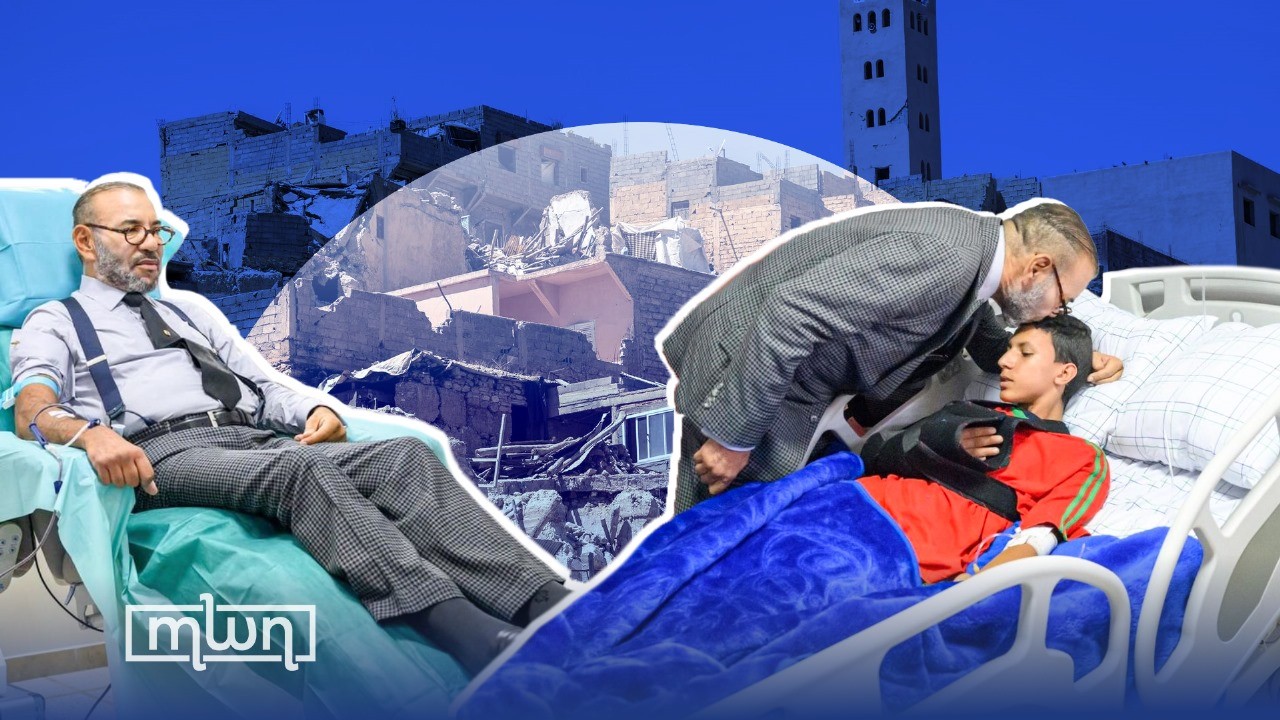
In reaction to the earthquake, His Majesty the King Mohammed V presided over emergency response meetings and visited a Marrakech hospital to speak with survivors. He also directed that 1 billion MAD ($100 million) be donated to an earthquake relief fund.
Despite the criticism leveled at French media’s paternalistic coverage of the post-earthquake crisis, which was exacerbated by Morocco’s refusal to accept French help, King Mohammed VI’s efforts during the earthquake demonstrated his devotion to the welfare of his people and the nation’s resilience. His leadership through these hard times highlighted the critical significance of competent crisis management in minimizing the effects of natural catastrophes.
Population Resilience
The Moroccan people’s tradition of solidarity is a tremendous testimony to their togetherness and perseverance. This culture, which is firmly ingrained in Moroccan identity, has been visible during difficult periods such as the COVID-19 epidemic. The collective reaction of the Moroccan people, characterized by mutual help, collaboration, and a strong feeling of community, has been critical in the country’s attempts to manage the crisis. The value of solidarity not only represents the Moroccan people’s spirit, but it also acts as an example for other countries in times of difficulty.
The COVID-19 epidemic was a difficult moment for governments all around the world, and Morocco was no exception. During this crisis, however, the Moroccan people displayed an unparalleled level of national togetherness. This unity was not only a testament to their fortitude, but it was also a critical aspect in the country’s effective management of the pandemic, which the government initiated under strict directions from the King.
Moroccans across the country banded together to tackle the virus from the beginning of the outbreak. Individuals, corporations, and organizations banded together to help society’s most vulnerable citizens. Many companies provided free or reduced services, while people contributed their time and money to assist those in need.
The overwhelming compliance with public health measures was one of the most notable shows of national togetherness. Moroccans knew that safeguarding one’s personal health also meant protecting the community’s health. As a result, mask-wearing, social separation, and other protective measures were widely adopted. Furthermore, Moroccans of the World (Moroccan diaspora) contributed to the country’s support throughout this period. Many sent financial aid to their family back home, helping to boost the local economy and lessen the financial strain of the pandemic.
During pandemics and catastrophes, community solidarity is essential, and local individuals may play a critical role in providing immediate assistance to those in need. The earthquake that ravaged the El-Hawz region exposed the Moroccan population’s true issue in exercising leadership as response to crises. They are frontline carers, unpaid carers, and community mobilizers who complement one another.
When it comes to Morocco’s ability to manage a crisis, its people are incredibly united. Moroccans were to relieve the affected community in Marrakesh and Taroudant districts, much as they did when the COVID-19 crisis endangered the existence of vulnerable individuals. The country mobilized its own internal systems to execute recovery measures that have necessitated everyone’s participation. Local responders and volunteers were on the ground from day one, immediately coordinating with local authorities and the Royal Armed Forces to assess the situation, support search and rescue operations, and assist affected people before extending any additional requests for international assistance.
True support is provided during times of sorrow. Moroccans all around the world are urgently attempting to support the nation in various ways, and Moroccan solidarity is widespread. Moroccans of the world have once again generously donated to relief efforts in earthquake-ravaged areas.
Moroccans all across the world have shown their support for the victims of the tragic earthquake that broke the country’s heart. With over five million Moroccans residing abroad, it is not unexpected that Moroccans of the World are keen to aid their nation. For instance, Moroccans of the World contribute $6.4 billion in remittances to the kingdom’s economy in the first seven months of 2023.
Morocco’s continuity as a nation is profoundly founded on the leadership of King Mohammed V and the resilience of its people. The severe difficulties brought by the COVID-19 outbreak and the tragic earthquake have put the Moroccan people’s strength and togetherness to the test. Nonetheless, it is exactly in these difficult times that Morocco has distinguished itself from other countries in the region.
King Mohammed VI’s vision of bringing the country to safer shores, together with the exceptional capacity of the Moroccan people to overcome adversity, has been crucial in this respect. These two factors reflect Morocco’s distinct character and people’s ability to not only endure but also prosper in the face of hardships. The lessons learnt from these events will definitely continue to define the nation’s destiny, boosting its resilience and fortifying its future as we move forward.