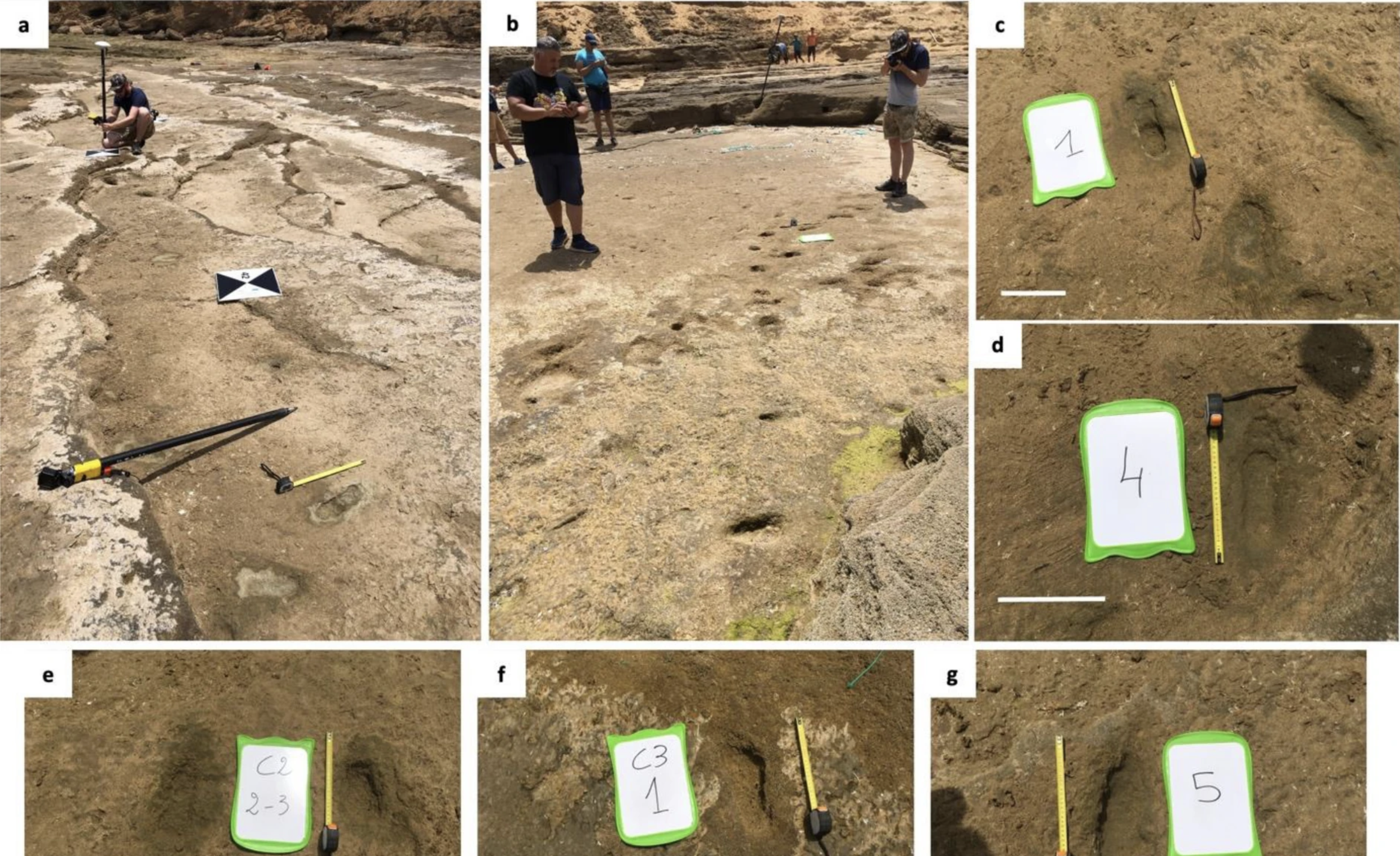
Rabat – Scientists have discovered a significant collection of 85 human footprints on a Late Pleistocene beach in Larache, on Morocco’s northwestern coast.
These footprints, dated between 90.3 and 7.6 thousand years (Late Pleistocene), are attributed to Homo Sapiens and represent the oldest known in Northern Africa and the Southern Mediterranean, according to a research paper published in the Nature Journal this week.
The Larache footprints provide insights into the behavior of Homo Sapiens during the Pleistocene period, the research paper argues.
The varied sizes of the footprints belong to individuals with heights ranging from 120.8 to 189.0 cm, with an estimated average stature of 160.0 cm suggesting multiple individuals, including children, adolescents, and adults, moving along the beach.
The Larache site is crucial for understanding hominin evolution in North Africa, a region rich in archaeological significance. The footprints contribute to the patchy ichnological – the study of footprints – of the North African coast, complementing other key findings in the area, such as the Jebel Irhoud site, which yielded the earliest known Homo Sapiens remains.
While the Larache site is currently well-preserved, ongoing erosion poses a threat to its longevity. The exposure of new footprints due to erosion could provide additional insights into hominin group size and behavior, the research paper explains.
Read Also: Major Archaeological Discoveries Unearthed in Morocco’s Historic Chellah Site