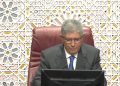

Doha – Every year as the holy month of Ramadan approaches, one of Morocco’s most intriguing rituals takes center stage: the Dorouss El Hassaniya, or Royal Ramadan Lectures. In these prestigious lectures hosted by the King himself, Islamic scholars from Morocco and abroad gather to deliver religious teachings.
In keeping with this annual tradition, King Mohammed VI led on March 15 the inaugural Royal Lecture of the sacred month of Ramadan at the Royal Palace in Rabat.
Far from occurring behind closed doors, the lectures are broadcast live on television and radio. This offers the lecturer a degree of protection, allowing them to freely express views that might otherwise be censored.
With millions of viewers and listeners tuning in, and government ministers, military leaders, and senior officials attending, the lectures have become a pillar of the holy month in Morocco. Their diverse themes over the decades have mapped changing societal priorities and religious influences in the North African nation.
Last year marked six decades since the late King Hassan II revived the tradition started by his forefathers. Its origin dates back to the Alaouite kings, who used to hold it from the month of Rajab up until the month of Ramadan.
The founding of this religious custom in its current form is attributed to the era of Sultan Moulay Ismail (1645-1727), when the months of Rajab, Sha’ban and Ramadan were an occasion for studying juristic and legal matters, especially those relating to new and unprecedented issues.
Successive rulers institutionalized the practice until it was interrupted during the period of French colonial rule in the early 20th century.
Upon ascending to the throne in 1961, King Hassan II brought back his grandfather’s tradition, repackaging the Royal Lectures as a symbol of the Moroccan monarchy’s religious authority. In doing so he was both asserting his status as the “Commander of the Faithful” and pushing back against ascendant leftist-nationalist ideological currents, embodied regionally in Egyptian leader Gamal Abdel Nasser’s Arab nationalism.
Launching the lectures
The 1963 lectures were strictly a Moroccan affair, with leading scholars of the time like Allal al-Fassi, Mohammed al-Makki al-Nasiri, Abdellah Guennoun and others lecturing in classical Arabic and warning against “deviant” modernist influences.
But by the 1970s, King Hassan II had begun inviting prominent Muslim scholars from outside the country as well, including the Syrian Muhammad Said Ramadan al-Bouti, the Indian Abul Hasan Ali Hasani Nadwi, the Egyptian sheikh Muhammad Metwalli al-Sha’rawi, and the Saudi Abdullah bin Abdulmohsen Al Turki, Secretary General of the Muslim World League.
This internationalization coincided with King Hassan II’s push for pan-Islamic solidarity against Arab nationalism. The invited foreign shuyookh (clerics) hailed from diverse doctrinal backgrounds, reflecting the Moroccan monarch’s aspiration to position himself as a broad unifier of Sunni Muslim currents.
In a striking display of this openness, the 1978 lecture saw King Hassan II host Musa al-Sadr, the leading Lebanese Shia cleric who later disappeared on a visit to Libya. The event underscored the warm ties between the Moroccan and Lebanese establishments.
In the early 1960s, lectures were typically delivered extemporaneously without written notes, following the custom of traditional Islamic scholars. Gradually, however, Hassaniya lecturers have become more reliant on pre-prepared scripts. This shift arose from concerns about inaccuracies or digressions when speaking off-the-cuff before such an eminent audience.
The lectures do not conclude with the king’s closing prayers. Follow-up discussions are held at Morocco’s Ministry of Endowments, involving local scholars and foreign guests. Late King Hassan II instituted policies publishing translated lecture transcripts, as well as a book compiling participants’ commentary. In the past, lectures were immediately followed by the king personally initiating a question and answer session, where he would offer his reactions, corrections or queries to the speaker.
End of Cold War symbolism
Geopolitics also flavored the Ramadan lectures in the late Cold War era. In 1989, with the US-Soviet rivalry still raging, the lecturing duties fell to Khalid Abdulhadi Yahya, a professor of religion and history at Boston University. Notably, a Soviet Muslim recited verses from the Quran before Yahya’s talk on the purpose of human existence.
King Hassan II remarked ahead of the closing prayers that Ramadan had brought together diverse peoples in a powerful display of Islam’s role as a “school of political coexistence.” In what seemed to be a veiled criticism of the notion of mere “coexistence,” he praised the “dealings and cohabitation” enabled by the Islamic faith.
Speaking truth to power
The royal platform has not always filtered out friction between politics and religion. In 1989, Moroccan scholar Hassan Ben Seddik chose to focus his lecture on “true religious practice versus innovation.” He highlighted Islam’s prohibition on concluding financial contracts during Friday prayer times, just after the live televised signing ceremony of the Arab Maghreb Union Treaty by five North African presidents.
The symbolic timing – the signing took place during Friday prayers – was not lost on the audience. As Ben Seddik reminded them that agreements signed during the special Friday sermon were null and void according to Islamic jurisprudence, an agitated King Hassan II intervened to conclude the lecture early.
The monarch’s displeasure resulted in Ben Seddik being banned from Moroccan state television for several years. After the ban was lifted, however, he was invited to deliver other Royal Lectures in later years.
Enduring ritual, changing priorities
Half a century since its revival, the Ramadan lectures have become a permanent ritual under King Mohammed VI. If anything, the shift between reigns has reinvigorated the tradition’s symbolic value.
Lecturers today place more emphasis on Morocco’s “moderate” religious model as an antidote to extremism. But while the form endures, geopolitical realities shape the lectures’ substance in new ways.
As long as conflicts and crises continue erupting around the world, Morocco’s Royal Lectures will likely retain their dual religious and political significance for years to come.