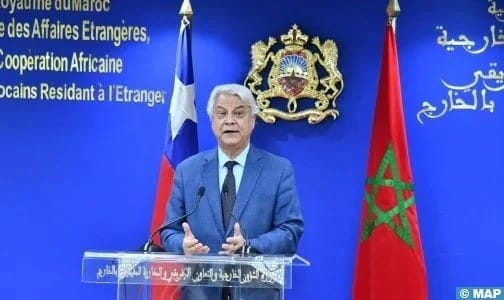
Rabat – A Chilean parliamentary delegation, led by Jaime Naranjo Ortiz, President of the Morocco-Chile Parliamentary Friendship Group, visited Rabat on Tuesday to explore avenues for increased cooperation between the two nations.
The visit highlighted growing interest in strengthening South-South cooperation, a term used to describe collaboration between developing countries.
Naranjo Ortiz’s comments following a meeting with Moroccan Foreign Minister Nasser Bourita emphasized Morocco’s progress under King Mohammed VI.
“We’ve witnessed firsthand the significant advancements Morocco has achieved in various sectors,” Naranjo Ortiz said in a press statement following the meeting. “This positions the Kingdom as a central actor in Africa and strengthens ties with all of Latin America.”
He acknowledged the country’s active role in regional and international bodies, suggesting it positions Morocco as a potential bridge between Africa and Latin America.
The discussions reportedly focused on leveraging the geographic advantages of both nations. Chile, situated on the Pacific coast of South America and Morocco, bordering the Atlantic and Mediterranean Seas, could create a unique link for regional cooperation, particularly between Africa and Latin America.
The meeting also explored areas of shared interest beyond geographical benefits. Naranjo Ortiz noted a “convergence of views” on issues like promoting global peace, strengthening democratic institutions, and empowering women. As told to the press, discussions reportedly touched on boosting trade exchanges, but specifics remain undisclosed.
Morocco’s Western Sahara conflict was also addressed. Naranjo Ortiz reportedly reaffirmed Chile’s support for a peaceful resolution but avoided specifying details of Chile’s stance. The Western Sahara remains a sensitive topic, with differing perspectives on the territory’s status.
This visit comes amidst growing interest in South-South cooperation. Developing nations are increasingly seeking partnerships with each other to address shared challenges and promote mutual development. Experts suggest such partnerships can offer alternative perspectives and approaches compared to traditional North-South cooperation models.