Rabat – Wireless technology has profoundly transformed various aspects of our daily lives, from communication to entertainment, and now it’s revolutionizing healthcare through Wireless Body Area Networks (WBANs).
These networks represent a significant leap forward, utilizing miniature sensors that can be placed on or inside the human body to continuously monitor a wide range of physiological parameters in real-time.
The implications of this technology are vast, offering new ways to manage health and treat diseases more effectively. But how do they work, and what are their practical applications? Let’s explore the wonders and challenges of this emerging technology.
What is a WBAN?
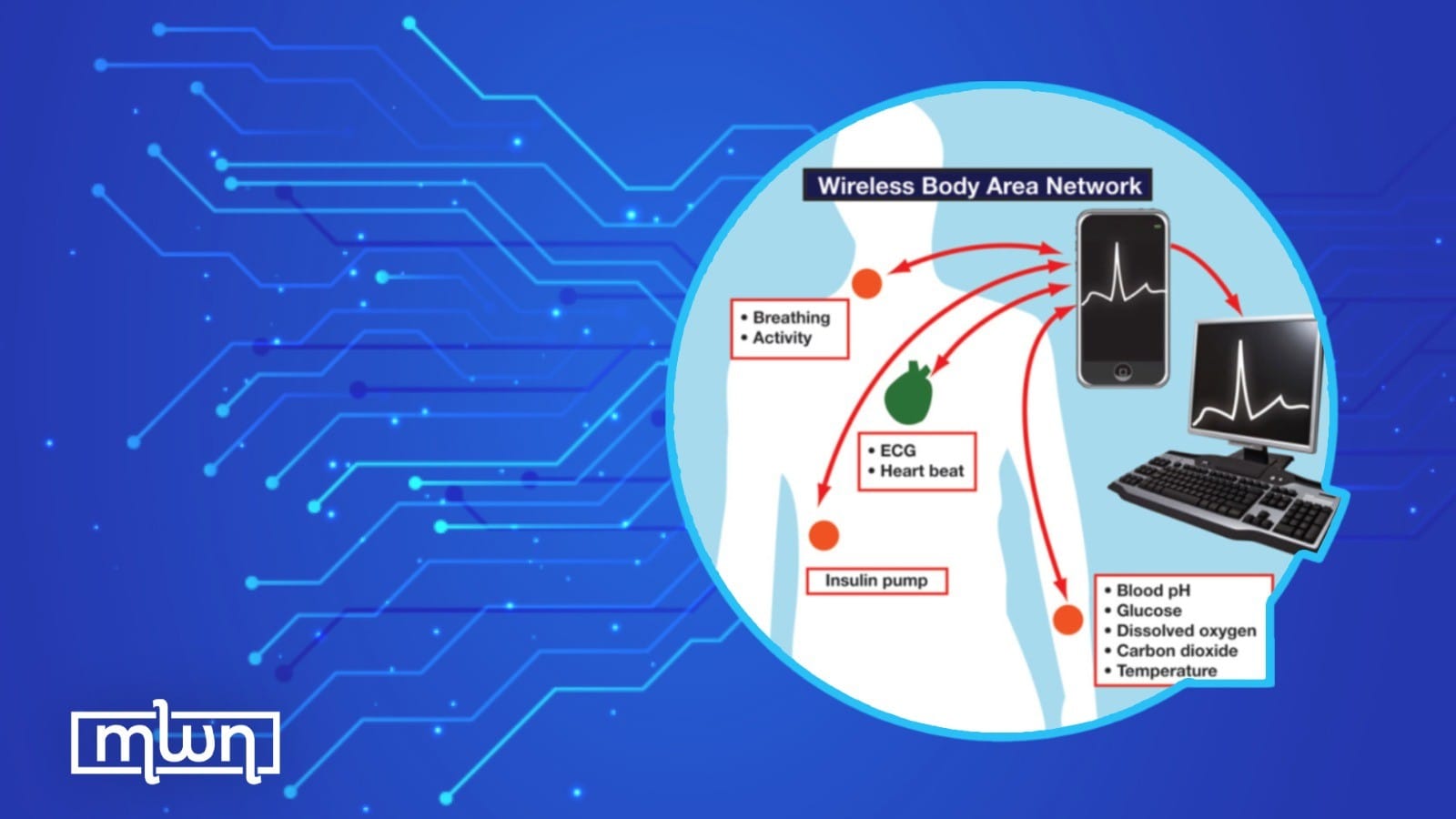
WBANs consist of tiny, sophisticated sensors that can track vital signs such as heart rate, blood pressure, body temperature, glucose levels, respiratory rate, and even the number of calories burned after physical activity.
These sensors can be either worn on the body or implanted internally, depending on the medical requirement. The real-time data collected by these sensors provide an ongoing stream of information about the patient’s health status, which can be crucial for early diagnosis and timely intervention.
These networks are an extension of wireless sensor networks (WSN), but with specific technical requirements due to their bodily implantation. These connections play a crucial role in telemedicine and remote patient monitoring, enabling continuous and non-intrusive supervision of daily activities for individuals requiring intensive care or rehabilitation after an injury.

Figure 1. General architecture of a WBAN
Applications and advantages
Wireless Body Area Networks (WBANs) are transforming healthcare and extending their impact into diverse fields. In healthcare, WBANs allow doctors to remotely monitor patients, particularly beneficial for those needing constant supervision like individuals with chronic illnesses or recovering from surgery.
This continuous monitoring enables quicker responses to potential health issues, improving patient outcomes, and reducing hospital readmissions. WBANs also enhance healthcare personalization by providing detailed insights into a patient’s condition over time, facilitating more tailored treatment plans.
Beyond healthcare, WBAN applications span uses within the military sector, sports, daily life assistance, and even gaming. For instance, they can monitor athletic performance, aid in physical rehabilitation, as well as secure cognitive biometric systems, showcasing their versatility and potential to revolutionize various aspects of human life.

Figure 2. WBAN applications
Read more: Potential Powerful Benefits of Combining BPC-157 and TB-500 Peptides
Technical challenges
Ensuring efficient energy usage is a significant hurdle for Wireless Body Area Networks (WBANs). The sensors, typically relying on small batteries, must sustain long-term operation, without frequent battery replacements, especially when implanted within the body.
Energy loss occurs due to various factors such as collisions, unnecessary listening, fluctuations in network traffic, and suboptimal resource allocation strategies.
Moreover, interference from overlapping wireless technologies like Wi-Fi and Bluetooth, operating within the same frequency band, poses a considerable threat to WBAN performance.
To address these challenges, the IEEE 802.15.6 standard for wireless ad hoc networks aims to optimize WBAN communication by allocating specific frequency bands, minimizing interference, and ensuring reliable data transmission.
Interferences and solutions
Interferences can be a problem with WBANs, especially when other networks or technologies use the same frequency band.
There are two main types of interferences to consider: ones within the same WBAN (intra-BAN) and ones from neighboring networks (inter-BAN).
Intra-BAN interferences, happening between nodes in the same network, can be managed using techniques like time-division multiple access.
However, inter-BAN interferences, caused by nearby networks such as roaming Wi-Fi signals, need more advanced solutions. Researchers are looking into different ways to deal with these interferences, such as controlling transmission power, adjusting modulation methods, and dynamically managing data rates and duty cycles. These solutions aim to keep communication quality high while using less energy and avoiding lost data.
Future perspectives
Looking ahead, the potential of WBANs in medical monitoring is truly groundbreaking, promising quicker diagnoses and proactive disease management.
Take cardiovascular diseases, for instance. WBANs could spot warning signs early on, while diabetics could benefit from continuous monitoring, ultimately reducing the risk of severe complications.
Moreover, in the realm of physical rehabilitation, WBANs could become indispensable, aiding patients in regaining independence post-accident.
In summary, WBANs signify a remarkable leap in technology with wide-ranging applications. Yet, to unlock their full potential, the manufacturers must tackle technical hurdles, especially in terms of energy efficiency and interference management.
Ongoing and future research endeavors will further refine these technologies, paving the path for even deeper integration into our daily lives, spanning the medical domain and beyond, into innovative sectors.