
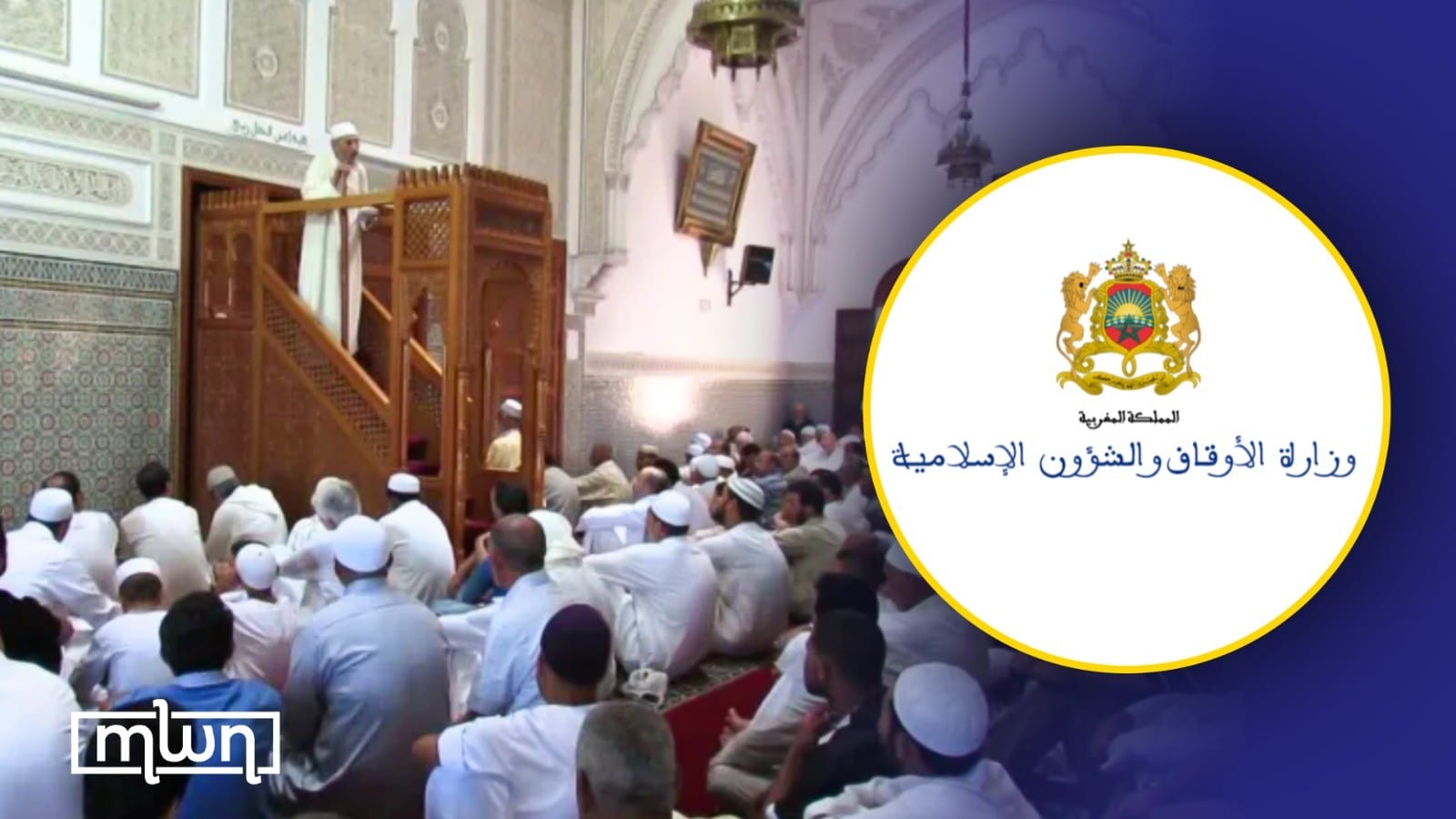
Marrakech – The Moroccan Ministry of Endowments and Islamic Affairs announced late last month a new plan to unify Friday sermons across the country, sparking widespread debate and controversy in the past few days.
Dubbed “The Plan for Guiding Communication for a Good Life,” the initiative aims to standardize the content and themes of Friday sermons in all mosques in Morocco.
The rationale behind the plan
According to the ministry, the decision to unify sermons was made after the Supreme Scientific Council observed that current religious communication is not effectively changing people’s lives and elevating their religiosity to a level where it positively impacts their reality.
Said Bihi, president of the Scientific Council of Hay Hassani District in Casablanca, told Al Jazeera that religiosity has turned into “superficial religiosity, hollow appearances, and ideology” without achieving the intended purpose of religion in creating a good life for believers.
Bihi explained that the council felt it necessary to re-examine the discourse of religious communication to rectify it and achieve its intended purpose.
He noted that despite millions of people attending mosques every Friday to listen to sermons, these sermons often leave no impact on their lives, with deviations increasing and costing individuals, families, and the state dearly.
The ministry plans to implement this vision through unified Friday sermons and lessons for preaching and guidance in mosques.
Preachers will deliver a unified sermon on a designated topic each Friday, which will then be presented in preaching and guidance lessons held in mosques throughout the week.
Divided opinions
The decision to unify Friday sermons has been met with mixed reactions from the public and religious scholars alike. Some have praised the move, believing it will help close what they describe as “strife” and contribute to reforming society and educating people about their religion and worldly life.
On the other hand, critics argue that the decision will transform preachers from individuals with religious training who can choose appropriate topics and deliver them in their own style, into mere readers of pre-written sermons that may not be suitable for the diverse contexts of different mosques and communities across Morocco.
Concerns and objections
Ahmed Kafi, a professor of higher education in Islamic studies, told Al Jazeera that he agrees with the need to reform Friday sermons but opposes their unification for several reasons.
A good and impactful sermon depends on the preacher’s competence and creativity, Kafi argued, stressing that unified sermons can be detrimental to both the sermon and the preacher.
He also argued that this decision disregards the varying realities and needs of people in different neighborhoods and regions, as a single sermon cannot address the specific issues and concerns of everyone.
Reforming sermons should involve everyone in diagnosing problems and finding solutions, rather than being monopolized by a single institution or group of individuals, Kafi concluded.
Driss El Ganbouri, a researcher in religious affairs, views the decision to unify sermons as contradictory to Morocco’s project of restructuring the religious field, which included establishing an institute for training imams, male and female guides.
In comments to Al Jazeera, he questioned the purpose of training imams if their role is reduced to simply reading pre-written sermons prepared by another entity.
El Ganbouri believes that unifying sermons undermines the role and value of the preacher in the eyes of the people, stripping away the trust placed in them as qualified individuals.
He argued that this runs counter to the state’s goal of training imams and reforming the religious field to create a class of religious leaders trusted by the public.
#Restriction_not_improvement
Many Moroccans have taken to social media platforms to express their objections to the decision. The public response has been swift and passionate, with numerous individuals sharing their thoughts on platforms like X (formerly Twitter).
One commenter emphasized the significance of the sermon in Islamic tradition, stating: “The sermon is part of the Friday ritual. Diminishing its impact and restricting its content is an unacceptable infringement on the message of the pulpit established by our Prophet Muhammad, peace be upon him.”
The sermon was meant to be “clear, eloquent, and unambiguous, flowing with truth and certainty, raising determination, and absolving from falsehood,” they further argued, concluding with a plea: “Do not kill the Moroccans’ religion.”
Another called for action, urging Moroccans to voice their concerns online. They wrote, “In response to the topic of unifying and standardizing Friday sermons in Morocco in an unacceptable manner that turns pulpits into mere echoes of a single voice, and based on the duty to defend the status of the mosque, and in rejection of further restrictions on sermons and attempts to nationalize pulpits… a call to tweet under the hashtags: #Restriction_not_improvement #No_to_nationalizing_pulpits”
A third tweet highlighted the central role of mosques in Muslim life while also acknowledging potential conflicts: “The mosque is our scientific, moral, and behavioral starting point as Muslims. However, this religion conflicts with the desires, lusts, and interests of some souls.” This commenter also included the aforementioned hashtags in their post.
These tweets, among many others, contributed to the launch and popularization of the hashtags #Restriction_not_improvement and #No_to_nationalizing_pulpits. These hashtags quickly became rallying points for those opposing the decision.
The first suspension
The debate over unified sermons took a new turn when the ministry suspended Ahmed Agendouz, a Friday preacher in Tangier, after he criticized the unified sermon from the pulpit, describing it as an insult to scholars and their knowledge.
According to the news website Voice of Morocco, Agendouz told worshippers in his sermon on June 28, the first Friday of the unified sermon implementation, that the ministry had distributed a unified sermon to preachers. He notably expressed his rejection of the ministry’s decision, saying that unifying sermons is “totally unacceptable, as if we are nothing.”
Agendouz also described the ministry’s move as an affront to preachers, scholars, and their knowledge, stating that receiving a unified sermon implies they are unfit for preaching or forming a sermon for Muslims. He argued that his role is to address the problems and issues facing society and interact with them, not to read a pre-written sermon.
On July 3, 2024, Agendouz received a decision from the Minister of Endowments terminating his assignment due to “inserting the unified sermon into narrow sensitivities,” according to the suspension text.
Temporary measure or permanent change?
In response to the growing controversy, the Ministry of Endowments and Islamic Affairs issued a clarification on its Facebook page. Preachers and guides have always enjoyed freedom accompanied by responsibility in delivering their sermons and lessons, the ministry said. They are considered trustworthy and competent in this regard, except for a very few cases that occasionally deviate from this framework, it stressed.
The decision to unify sermons is temporary, not permanent, the ministry argued, noting that the move aims to raise general awareness about this project, build responsiveness to it, and discuss specific topics in regular preaching lessons within the institution’s plan.
The controversy has brought to the forefront critical questions about the role of religious institutions, the autonomy of preachers, and the most effective ways to address the needs and concerns of Morocco’s diverse communities.
Read also: Friday’s Unique Religious, Cultural Significance for Moroccans