


 Join on WhatsApp
  Join on Telegram
 Marrakech – The annual report from Morocco’s central bank, Bank Al-Maghrib, presented to King Mohammed VI on Monday, shed light on the country’s economic, monetary, and financial situation in 2023.
Despite challenges including a difficult international context, consecutive years of drought, and the severe earthquake in the Al Haouz region, the national economy showed noticeable improvement with a growth rate of 3.4%.
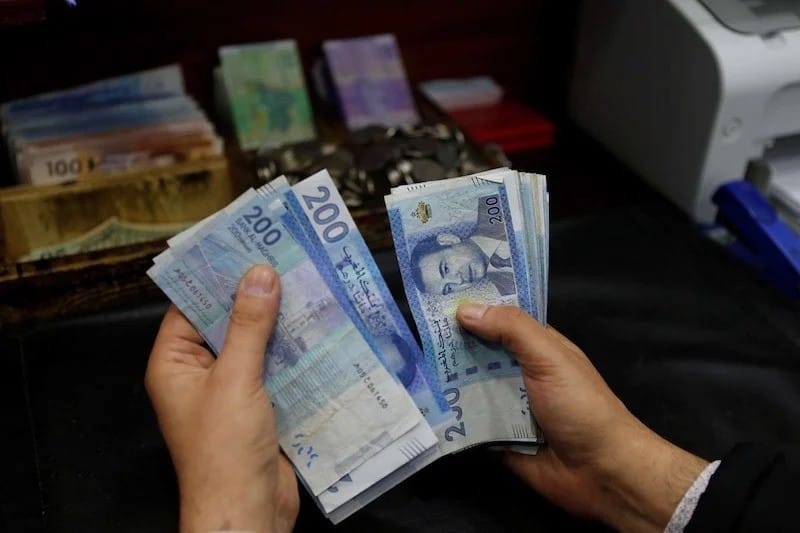
One of the most striking revelations in the report was the high level of cash circulation in Morocco, reaching nearly 30% of GDP.
Bank Al-Maghrib Governor Abdellatif Jouahri previously expressed concern over this figure, emphasizing it remains “among the highest in the entire world.”
The report highlighted that banknotes in circulation increased by 10% to 2.7 billion notes, representing a current amount of MAD 408 billion. Additionally, the number of coins in circulation rose by 2.9% to 3.2 billion pieces.
Cash transactions increased by 11% in 2023 to reach MAD 412.8 billion, with the 200 dirham banknote dominating at 57% and the 1 dirham coin at 29%.
To address this issue, a committee chaired by the central bank and including banks, relevant ministries, and researchers was established. The committee aims to analyze the reasons behind the high cash usage and propose solutions for Morocco to limit this phenomenon.
On a positive note, inflation, which peaked at 10.1% in February, gradually decreased to an average of 6.1% for the year, compared to 6.6% in 2022. This was attributed to lower external pressures, government measures, and Bank Al-Maghrib’s tightening of monetary policy while continuing to meet banks’ liquidity needs.
However, the job market remained challenging in 2023, with a loss of around 157,000 jobs, reflecting significant declines in the agricultural sector. Other sectors showed relative improvement but not enough to offset these losses.
Read also: IMF Chief Commends Morocco’s Economic, Social Progress Under King Mohammed VI
Efforts to strengthen the budget continued, with the deficit decreasing to 4.4% of GDP thanks to the good performance of tax revenues, significant returns from innovative financing mechanisms, and resources mobilized through the special fund created by royal instructions to manage the effects of the earthquake.
On the external accounts, the current account deficit fell to 0.6% of GDP due to the continued dynamism of the automotive industry and the influx of tourism revenues and remittances from Moroccans living abroad. Bank Al-Maghrib’s official reserve assets improved to MAD 359.4 billion, equivalent to about 5.5 months of imports.
Regarding currency counterfeiting, the annual report highlighted that the rate continued its downward trend, reaching 2.3 counterfeit banknotes per million in circulation, down from 5.2 banknotes in 2019. The number of counterfeit banknotes detected amounted to 6,092, equivalent to MAD 837,000, with the 200 dirham banknotes continuing to dominate at 54%.
The report also mentioned that all requests regarding identification documents and secure documents printed by Dar As-Sikkah (the national printing house) were met. This included 2 million biometric passports, 2.2 million electronic driver’s licenses, and electronic registration certificates, 70,000 weapon licenses, as well as 75 million stamps and badges.
Read also: Commemorative Coin, Stamp Mark 25th Anniversary of King Mohammed VI’s Reign
Despite constraints and successive shocks, Morocco continued its program of reforms and major economic and social projects, even expanding their scope, according to Jouahri. This approach, along with its credibility as a trusted partner, allowed Morocco to obtain positive assessments from international institutions and easier access to financial markets and financing and credit instruments.
The challenge now lies in maintaining this momentum, consolidating gains, and ensuring their sustainability. To contribute more to Morocco’s transition towards a social state, the social dialogue should adopt an approach that considers, in addition to improving working conditions, social justice and reducing disparities.
Completing the reform of pension systems remains crucial, as the balances of these systems are still fragile. For a successful transition to a green and sustainable economy, in addition to necessary emergency solutions, policies for adapting to and combating climate change must be accelerated and made more effective and coherent.
The digital transition, on the eve of launching a new strategy, remains conditional on strengthening basic infrastructure, improving education quality, promoting digital culture, and providing an environment that encourages the emergence of an integrated digital ecosystem.
In the financial field specifically, Bank Al-Maghrib intends to create a special fund for new financial technologies that will provide financial support to project holders in addition to assisting them in implementation.
He concluded that Morocco continues its development journey and transition to the ranks of emerging countries with determination. Achieving this transition remains dependent on public policy continuing to focus on the fundamentals of development, mobilizing all the country’s active forces in a spirit of seriousness and responsibility, while giving top priority to the national interest.


