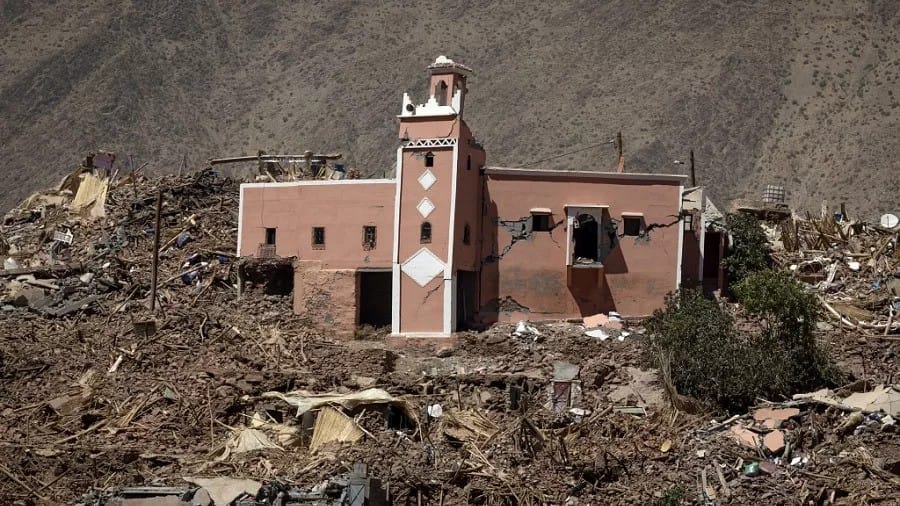
Doha – Nearly a year after a magnitude 6.9 earthquake struck Morocco’s Atlas Mountains, killing around 3,000 people and displacing some 500,000, many survivors are still living in tents or temporary shelters.
The quake, which hit in September 2023, was the country’s deadliest in more than 60 years, damaging or destroying nearly 60,000 homes, as documented by The New Humanitarian.
While the Moroccan government pledged to rebuild and provide financial assistance to affected families, the pace of reconstruction has been slow.
Hamid Abdellah, president of Anmoun Amsguine, a local organization in the village of Amsguine, told The New Humanitarian, “We understand everyone is focused on Gaza right now, but people have largely forgotten what happened to us.”
Government data obtained by The New Humanitarian indicates that 56,607 families whose homes were either damaged or completely destroyed have received an initial installment of 20,000 dirhams ($2,070) for reconstruction.
However, an official in Al Haouz province stated to The New Humanitarian that as of May, only 26,000 families had received at least one payment to help with reconstruction.
Navigating bureaucratic hurdles
For many survivors, receiving financial assistance is only the first step in the rebuilding process.
“We received the first part of our reconstruction aid, but we can’t do anything with it, as we do not have permission to build,” said Ahmed Id Ellmouden, a 61-year-old hotelier from the village of Ouirgane. “Only three houses are finished in our village, and one is currently under reconstruction.”
Government data reviewed by the newsroom journalists shows that 51,031 reconstruction permits have been granted, but local media reports suggest that only around 3,000 damaged and destroyed houses across Al Haouz were under construction as of late March.
Reasons for this discrepancy include land vulnerability assessments and requests for government re-assessments of damage, the report detailed.
Some families have been disqualified from receiving assistance altogether due to official residency registrations.
Abdellah noted to the humanitarian news outlet that he was aware of 35 families who lost their homes but were denied aid “because their national identity cards were registered in other cities even though they have been living here a long time.”
Gaps in aid and basic services
Survivors also report insufficient housing, aid, and access to basic services like clean drinking water.
Audrey Stauth, operations manager for the International Federation of Red Cross and Red Crescent Societies (IFRC) response, highlighted disparities in cash assistance to The New Humanitarian, with some communities receiving aid for 80-90% of villagers while others received much less.
The IFRC is designing a “cash for basic needs” strategy to target the most vulnerable, in collaboration with authorities, noted the report.
But Omar Id Ben Said, a 51-year-old who lost his two daughters in Amsguine and was denied government aid without explanation, said: “Nothing is making me happy. I am just waiting for aid from people and trying to survive.”
Community resilience and solidarity
Despite the challenges, affected communities are coming together to support one another, with the help of local and international NGOs.
Local associations were set up in the immediate aftermath of the quake to ensure equitable distribution of aid. Now, they focus on advocating for continued attention to their plight, according to The New Humanitarian’s report.
Saïd Ait Bihi, a member of his local association in the village of Tassila, noted that while initial aid came from various sources, “These days in our village, Moroccans, both local and those passing through, are giving us the most donations, contributing whatever they have to help our community.”
According to The New Humanitarian, solidarity is evident in the actions of people like Bihi and his wife, Khadija Ait Mbark, who temporarily moved out of their own container shelter to accommodate two young volunteers from CorpsAfrica after their tent burned down.
Mental health and unmet needs
Mental health support remains a significant unmet need for many survivors, the report further revealed.
Abdelaziz Indjarene, who lost his mother, grandmother, and family home in the village of Imi N’Tala, said: “Only now am I beginning to process what happened.”
“In the first months, people were busy trying to get aid and help. It wasn’t until a few months passed that we truly realised what had happened. We are really shocked and really in need,” he added.
According to the report, volunteers like Fatima-Zahra Aznag and Ghizlan Laabiky from CorpsAfrica have stepped in to provide ad hoc mental health care, offering a space for women and children to express their emotions and share their experiences.
“We give these women and children a space to express their emotions, share their experiences, and try to offer comfort,” Aznag explained.
The road ahead
As the one-year anniversary of the earthquake approaches, survivors are finding ways to adapt and diversify their income sources.
Local associations are establishing cooperatives to create new employment opportunities, while families like Ellmouden’s have improvised small businesses to make ends meet.
But the road to recovery is long, and the IFRC estimates that reconstruction may take longer than the initially estimated one to two years.
Stauth emphasized to The New Humanitarian the challenges posed by aftershocks, extreme weather events, and the remoteness of some affected communities.
Despite the hardships, the resilience and solidarity demonstrated by the survivors of Morocco’s devastating earthquake serve as a testament to the strength of the human spirit.
As the world’s attention shifts to other crises, it is crucial that the international community does not forget the ongoing struggles of those left to rebuild their lives in the wake of this disaster.
Read also: Portugal Hit by 5.3 Magnitude Earthquake, Tremors Felt in Morocco