 Join on WhatsApp
 Join on Telegram
Morocco has experienced an unprecedented rise in global sports in recent years, with football leading the way. The Moroccan national football team was the darling of many global football fans and the flag bearer of the underdog nations during the Qatar world cup, where the team became the first African and the Arab team to make it to the semifinals of the prestigious global competition.
The achievement, which far exceeded most Moroccans’ expectations and made everyone part of the “Dima Maghrib” excitement and dream of a historic finish at the World Cup. Although the journey ended with a semi-final defeat to France and a loss in the third-place match, the Atlas Lions’ heroic journey in Qatar empowered the nation with a lot of pride; in addition, It boosted the morale of Moroccan sports around the globe.
The upward trajectory continued into the just concluded Paris, where Moroccans expected their country’s representatives to once again make Morocco proud with their performances.
However, the Moroccan football team’s eye-catching triumph, coupled with the frustrating early exits of Moroccan representatives in other sports, led to a debate on the current state and future development of Moroccan athletics.
Morocco’s Glorious Olympic History
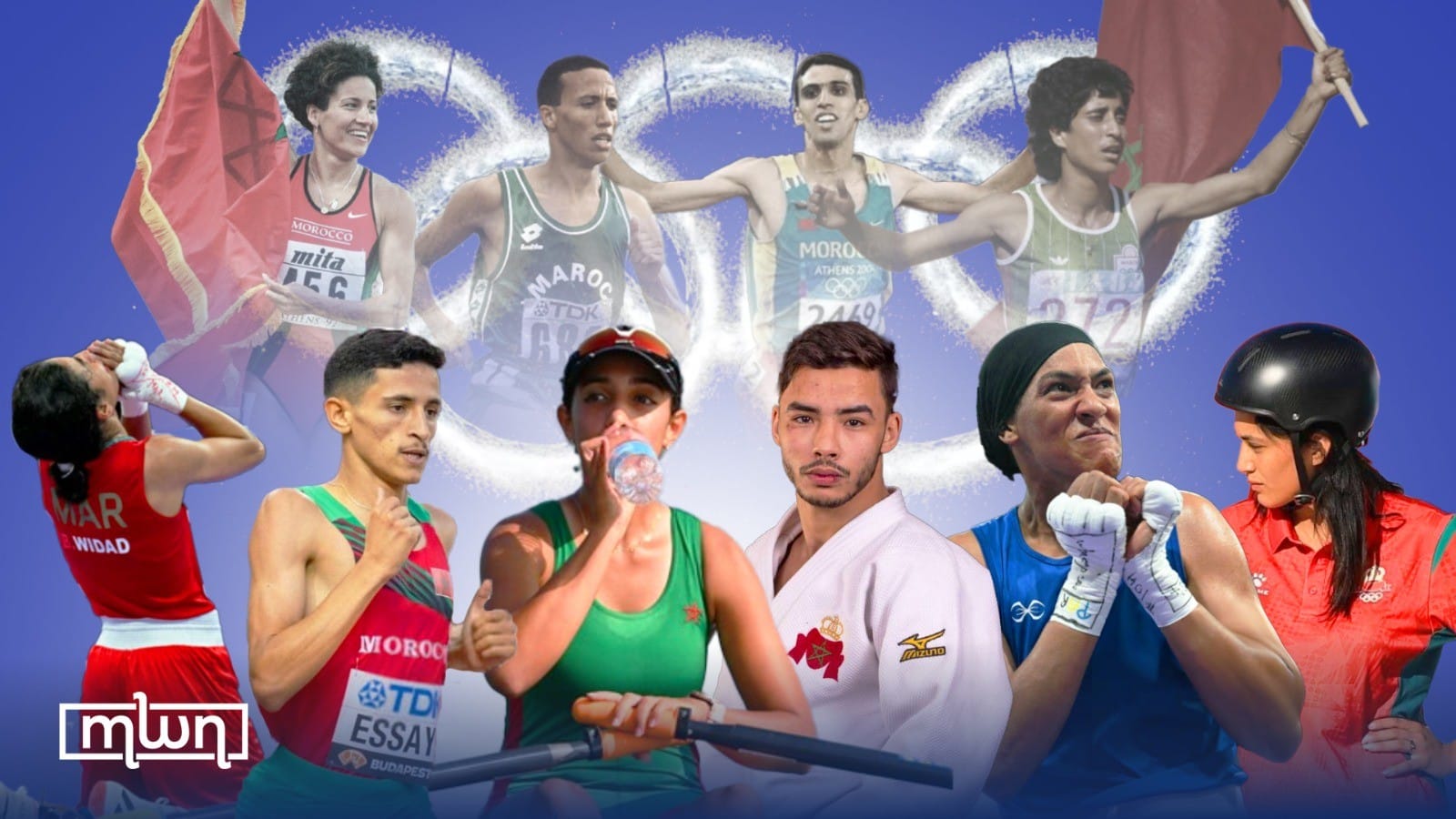
The Olympics are one of those events where Morocco, in some way, was always a winner, a place where the country was capable of bleeding with pride among equals. It all started for Morocco at the 1984 Olympics held in Los Angeles, where Moroccans Saïd Aouita and Nawal El Moutawakil wrote their names in the history books by claiming the country’s first ever gold medals. Their victories were personal achievements and national accomplishments that placed Morocco on the map for international competitions.
Aouita later set world records, becoming a Moroccan legend while El Moutawakil paved the way for women in athletics, especially in the Arabic and Islamic world. Morocco subsequently produced another super athlete, Hicham El Gerrouj, who has set records for middle-distance running that remain unbeaten to this day.
What these athletes did was to go out there and not only win medals for their country, but also engrave the ability of Moroccans in the sands of time. Morocco’s sporting achievement has over the years been described as remarkable especially in athletics for many decades.
The performances of these legends led many people to believe that Morocco was a sporting nation through and through. But the outcome of the recently held Paris 2024 Olympics, where Morocco got only two medals — one bronze and one gold — force a rethink. What went wrong?
A Moment of Reflection: Morocco’s Poor Performance at Paris 2024
The latest poor display at the recently concluded Paris 2024 Olympics has many people wondering about the current status of Moroccan sports. Morocco won only two medals in total and was one of the lowest ranked countries, a very disappointing journey for a country that was once so brilliant. This rather appalling result becomes even more apparent when compared to countries such as The Netherlands (with a nation of only 17 million), which garnered 15 Golden medals, or when compared to the statistics of other nations that despite having far less means managed to surpass Morocco’s tally. The results from Paris suggest that there is something very wrong with Morocco’s rationale for sport at the national level.
Rebuilding Morocco’s Sports Infrastructure
For Morocco to bolster itself as a sports nation, the “Morocco sports” concept and strategies have to be reexamined and revamped. As popular and successful as football is across Moroccan schools and universities, it cannot be the only sport product.
As other countries such as Spain, Brazil, Italy and South Korea have discovered, Morocco has to also venture into other sports besides football. This investment should begin at the grass-root level with emphasis on talent hunt and talent cultivation.
This can be done through the establishment of sports programs in all the twelve regions of the country to see that every child is well equipped with sports right from their tender age. Kindergarten children can learn and possibly develop an interest in many forms of sporting activities at this age. One may also always organize for role models or the sports ambassadors to come and encourage young talents.
This is not to displace football as Morocco’s national sport, but to develop other sports and make sport-talented Moroccan children diversify their interest pool and their dreams of future personal and national glory.
There should be a commission of talent search and development whose prime duty would be to search for young talented athletes. This commission could have relationships with local schools, sports clubs and other communities to feed them right through to the professional level. New training facilities and better coaches are essential, but so are competitions that prepare the athletes and create an environment that immerses them in the demands, pains and thrills of top-level international events.
In addition, Morocco must take advantage of the favorable conditions to practice different disciplines of sports. The provision of the climate, geographic features ranging from seas to mountains, makes the country ideal for year-round training in such additional sporting disciplines as athletics, boxing e.t.c.
And so, by aiming very high in a wide range of sports, Morocco can ultimately build not only a strong football headquarters, but also a very comprehensive, viable sports formula for a nation that can cover its territories with a stronger, clearer trumpet call.
The rhetoric was that everyone has got his/her own role to play
In other words, you don’t necessarily have to be an athlete to help put Moroccan sport back on the map. Just as it is the case with climate change projects, where one sees many youth involvement and innovativeness, sports development can also reap from the involvement of all Moroccans.
From simple things like sponsoring local sports teams, to volunteering at sporting events, to issues as trivial as promoting the importance of physical activity, young people can take the lead on issues like climate change and technology. Just as young people are taking the lead on climate change and new technologies, they can take the lead on sports.
The Need for New Heroes
Morocco requires new sporting role models to look up to and emulate for the future as those who are taken as role models for instance Said Aouita, Nawal El Moutawakil and Hicham El Guerrouj .
It was not about medals for Morocco; it was about making a statement – to show, as Moroccan representatives compellingly did at the 1984 Olympics in Los Angeles, that Morocco can compete and win on arguably the most coveted international stage.
These heroes are still celebrated today because they represented the soul of a people desiring to create for itself a place in the global village. Looking forward, Morocco needs to have its eyes set on creating more champions who will continue with the tradition.
Looking Ahead to LA28
It was the first time in 32 years that a Moroccan athlete reached an Olympic final. Since the 1984 Summer Olympics in Los Angeles, Morocco, Africa and the Arab world have been on the rise in various sports.
It was a moment of triumph when Morocco was able to show itself to the world as a force to be reckoned with in the sporting arena.
The hope is for team Morocco to have captured that spirit by the time it is ready to be contesting in the Los Angeles 2028 Olympics. Hence, the energies and efforts of the nation should not be channeled on the 2030 World Cup only but also on ensuring LA28 another turning point in Moroccan sports.And as we prepare to send our athletes to Los Angeles, let us be inspired by Nawal El Moutawakil’s defining life quote. Describing her state of mind before her successful race, she said, “It is your time, it is the city, it is the hour, you cannot miss it.
As she has stressed in numerous interviews, she mostly remembered feeling determined to succeed irrespective of the cost, so as to bring honor to her country. “You have to leave this country with something,” she told herself as she took the stage to represent Morocco.This is the spirit we should encourage our would-be Olympic heroes to emulate as they head to LA 2028. It is not just a race to be the best; it is a race to maximize performance, to understand that they are the representatives of the nation and that it is their duty to bring victory. Thus, our athletes can go to the Games with the right attitude that will drive them to make their own history.
This should be our challenge and our promise: to bring the Olympic Games back into the limelight, to perform and represent something, to build new heroes and thus establish sports for the future and the generations, to honor the path of the past.
Morocco’s next triumph awaits.