
 Join on WhatsApp
 Join on Telegram
Rabat – The Taliban introduced severe new regulations last week to curb women’s behavior under the guise of promoting “virtues” and preventing “vice.”
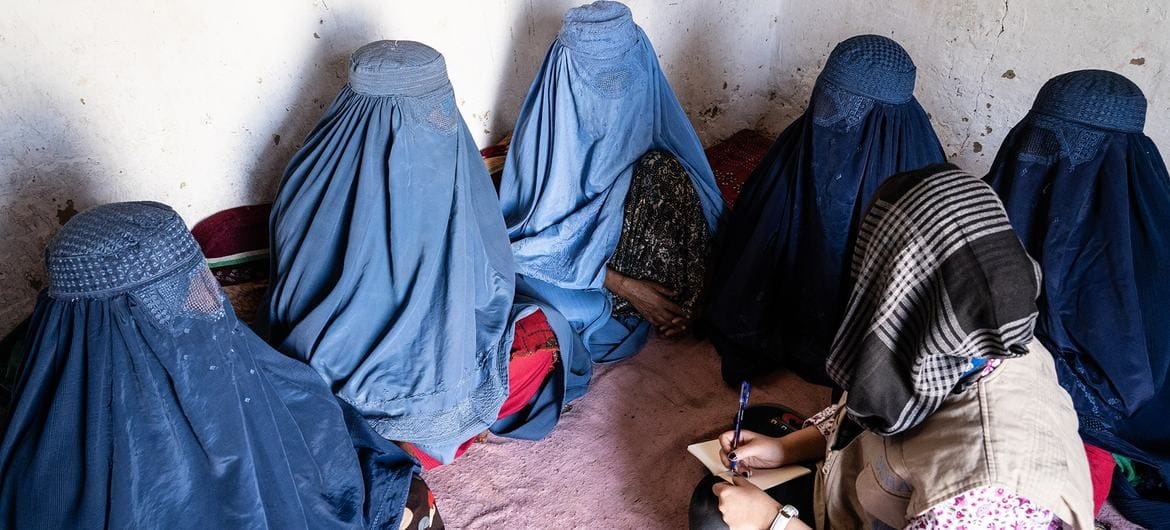
The new laws mandate that women must cover their bodies and faces entirely in public, prohibiting any display of their voices, whether through singing, reciting, or reading aloud.
The Taliban’s latest measures, approved by their supreme leader Hibatullah Akhundzada, come from their newly established Ministry for the “Propagation of Virtue and the Prevention of Vice.”
Created after the Taliban took control of Afghanistan in 2021, this ministry now enforces the stringent restrictions on women’s bodies, appearances, and voices.
Women are forced to veil themselves in the presence of all men who are not close relatives, regardless of their religious affiliation.
Any public auditory display by women is deemed a form of intimacy and is consequently banned and punished by the law.
These laws reflect extreme efforts to control and objectify women, essentializing them to mere agents of sin and further erasing their individuality and agency within society.
Earlier this year, the Taliban also declared the reinstatement of public flogging and stoning of women for adultery.
Continued oppression and public defiance
The Taliban’s repressive crackdown on women is not new. Since their return to power in 2021, they have imposed numerous restrictions such as barring girls from education beyond sixth grade and restricting women’s employment and engagement in the public sphere.
They have established what human rights organizations describe as a “gender apartheid,” barring women and girls from nearly all public spheres and preventing them from accessing the justice system.
Afghan women have turned to social media as a platform for resistance. Videos have surfaced online showing women singing and speaking publicly, acts that directly challenge the Taliban’s egregious laws.
This defiance is not just individual but collective; groups of women have gathered in solidarity, using their “banned” voices to advocate for freedom and resist the Taliban’s patriarchal regime.
A social media campaign that emerged under the name “Free Afghan Women” has become a crucial tool in amplifying their message and mobilizing international support.
The campaign has gained significant traction on platforms like X, where activists and supporters have posted powerful statements condemning the Taliban’s laws.
One notable X post reads: “Women in Afghanistan are being obliterated—no voice, no face, no existence. The Taliban’s latest decrees are nothing short of barbaric: women are banned from singing, reciting poetry, or even speaking aloud in public. Their faces and bodies must be hidden from the world.”
International condemnation and human rights concerns
UN Women Representative Alison Davidian highlighted the severe impact of these measures on Afghan women’s mental health.
“68% of women we surveyed said they had bad or very bad mental health, and 8% of women said that they knew at least one other woman or girl who had attempted suicide,” said Davidian.
Ravina Shamdasani, Chief Spokesperson for the UN Office of the High Commissioner for Human Rights, also condemned the new laws as an attempt to reduce women to “faceless, voiceless shadows.”
She emphasized that these restrictions violate Afghanistan’s international human rights obligations and called for their immediate repeal.
The new Afghan legislation also imposes additional restrictions on society at large, such as mandating that men grow beards, prohibiting music in vehicles, and restricting media publications.
State authorities are granted sweeping powers to detain and punish individuals for infractions.
In response to international criticism, including concerns from the UN, the Taliban has defended the new regulations.
According to reports, they assert that their measures, including the bans on women’s voices and bare faces in public, are in line with their interpretation of Islamic law and local customs.
The Taliban contends that these issues are internal matters to be resolved locally, rejecting the UN’s concerns as external interference.