 Join on WhatsApp
 Join on Telegram
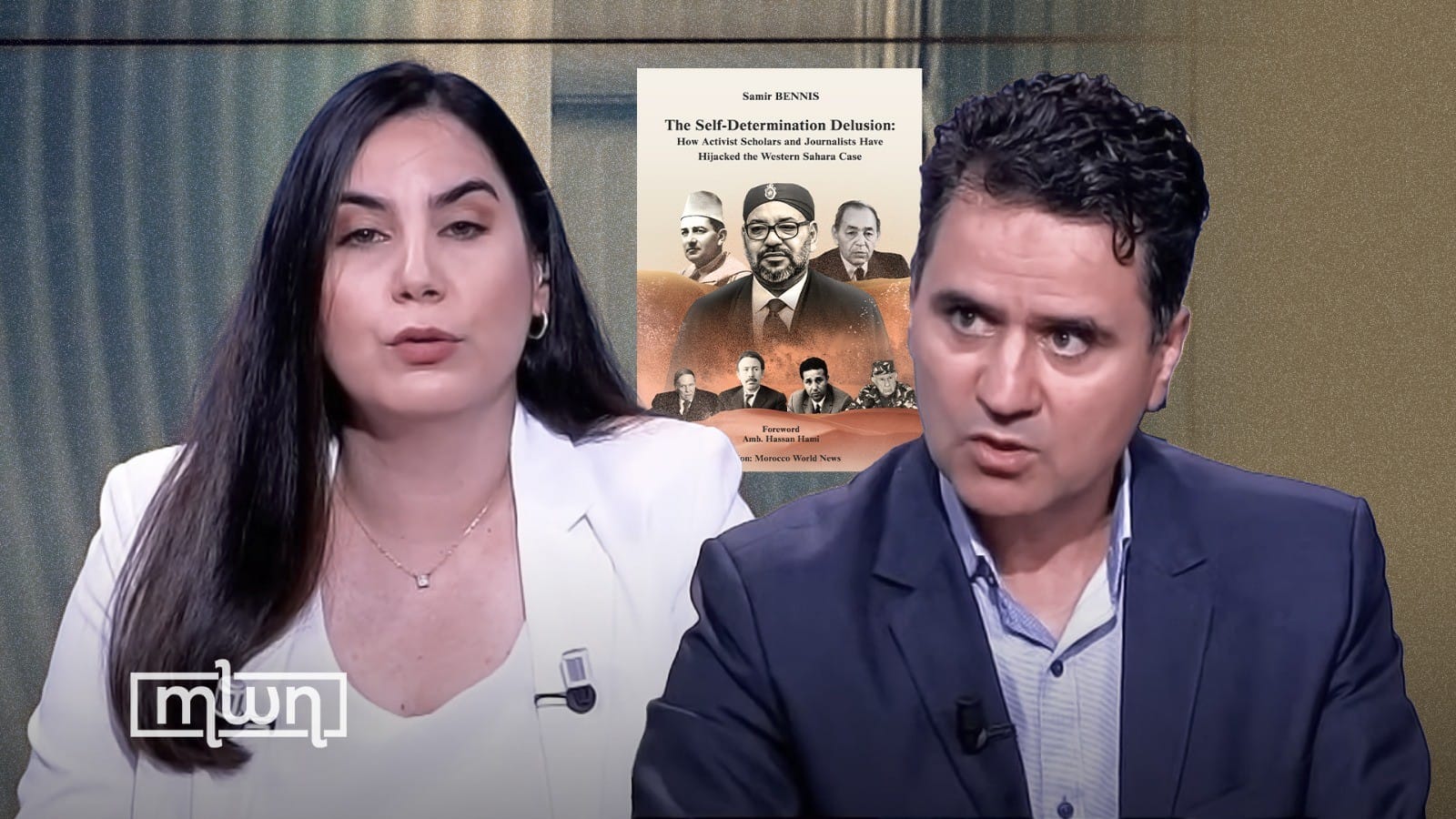
Rabat – Samir Bennis, Co-founder of Morocco World News and expert in geopolitics, discussed on Friday his latest book on the Sahara dispute in an engaging interview on Medi1 TV’s “L’invité de la rédaction.”
The book, titled “The Self-determination delusion: How activist scholars and journalists have hijacked the Western Sahara case,” offers a provocative critique of the international discourse surrounding the Sahara conflict.
According to Bennis, one of the book’s central aims is to shift the conversation by providing compelling historical evidence in support of the legality and legitimacy of Morocco’s position.
During the interview, Bennis shared his personal journey in writing the book, shedding light on how decades of frustration with biased reporting in the Sahara inspired him to set the record straight.
A 20-year journey
When asked how the idea for the book first came to him, Bennis traced its origins back to his doctoral research in France, where he began examining Morocco’s relationship with Spain.
“The conflict over the Sahara was part of my thesis,” Bennis explained. “Since then, I’ve always had the conviction that Morocco’s position was legally and historically justified.”
However, it wasn’t until Bennis moved to New York that he became fully aware of how misrepresented Morocco’s stance was in international media.
“I realized there was a blatant bias against Morocco. In American, French, and Spanish publications, Morocco was often portrayed as the villain in the conflict,” he recounted.
His frustration grew as he continued to read works by foreign academics and journalists, who he believes oversimplified and distorted the Sahara issue. “I often felt frustration, sadness, and rage,” he admitted.
This emotional response fueled his determination to provide a counter-narrative and defend Morocco’s position on a global scale.
In 2011, Bennis took his first step toward reclaiming that narrative by co-founding Morocco World News, an English-language media outlet.
“That was when the idea of writing a comprehensive book, based on a holistic approach, really started to take shape,” Bennis noted. “I wanted to expose the emptiness of the claims against Morocco and highlight the strength of our argument.”
The power of words
The title of Bennis’ book, “The Self-determination illusion,” serves as a pointed critique of how ideology and self-righteousness have tragically dominated the academic and journalistic discourse surrounding the Sahara dispute in the West.
Bennis explained that the title was chosen deliberately to challenge the prevailing narrative that the conflict could only be resolved through a referendum leading to independence.
“When we read Western newspapers—whether from Spain, France, or the U.S.—there’s always this insistence that the Sahara conflict should be resolved through self-determination, which they narrowly define as independence,” Bennis said.
He argued that this interpretation is misleading and overly simplistic. According to international law, self-determination can be achieved through integration with an existing state, not just independence.
Bennis was particularly critical of those who continue to rely on the 1975 International Court of Justice (ICJ) advisory opinion, which he described as “consultative and non-binding.”
He explained that while this opinion is frequently cited by supporters of the Polisario Front, it is no longer relevant to resolving the conflict.
“Since 2003, the referendum option has been sidelined in favor of political solutions grounded in realism and pragmatism,” Bennis asserted.
The three phases of the conflict
One of the core arguments in Bennis’ book is that the Sahara conflict has passed through three major phases, each marked by significant changes in international attitudes and the legal framework governing the dispute.
“The conflict has gone through three major phases,” he explained. “From 1957 to 1965, it was considered a bilateral issue between Spain and Morocco. By 1966, it became multilateral. And since 2003, the referendum option has been sidelined.”
In the early years, the conflict was largely seen as a bilateral issue between Morocco and Spain, then the colonial power in control of the Sahara.
From the Moroccan perspective, the Sahara had been an integral part of the kingdom long before European colonization. However, Spain resisted these claims, and the issue remained unresolved.
In 1966, as Morocco called on the UN General Assembly to pressure Spain to enable the population of the Sahara to exercise its right to self-determination to decide its fate, the General Assembly entered the scene, becoming the UN body in charge of helping concerned parties find a solution to the dispute.
The Polisario Front, a movement advocating for an independent Sahrawi state, gained recognition during this period. Backed by Algeria and other nations, the Polisario waged an armed struggle against Morocco and Mauritania, adding a new layer of complexity to the conflict.
“The UN focus on a referendum persisted throughout this phase, but no lasting solution emerged,” Bennis explained, noting how this prolonged period of international involvement fueled unrealistic expectations about the viability of independence.
The third and current phase began in 2003, at which point the idea of a referendum had been largely sidelined in favor of seeking a political solution based on realism and pragmatism. The UN Security Council began to emphasize the need for a negotiated settlement, leading to Morocco’s proposal of an autonomy plan for the Sahara in 2007.
This plan, supported by key international players like the United States, and France, envisions the Sahara as an autonomous region under Moroccan sovereignty.
“The world has moved beyond the referendum option,” Bennis said. “The focus now is on finding a political solution that works for all parties involved.”
Shifting geopolitical realities
One of the core arguments of Bennis’ book is that the Sahara conflict has evolved significantly over the years, particularly in favor of Morocco. During the interview, Bennis outlined how the geopolitical landscape has shifted.
Bennis highlighted the significance of recent international developments, including the U.S. recognition of Morocco’s sovereignty over the Sahara in 2020 and Spain’s endorsement of Morocco’s autonomy proposal in 2022.
He noted that these diplomatic breakthroughs reflect a broader trend in which the international community is moving away from advocating for a referendum and towards a political solution that acknowledges Morocco’s legal and historical claims.
“The U.S., Spain, and even France have all shifted their stances, which shows that from a legal and geopolitical perspective, the conflict has evolved in Morocco’s favor,” Bennis said.
The challenges of uncovering the truth
For Bennis, writing this book was not just an exercise in advocacy—it was a deeply personal and intellectual endeavor.
Throughout the interview, he emphasized the rigorous research that went into the book, explaining how his fluency in four languages—Spanish, Arabic, French, and English—enabled him to access a wide array of sources.
“I spent nine years working at the United Nations and now live in Washington. My experience and access to key UN documents allowed me to compile a book based on primary sources,” Bennis said.
He also revealed that he had discovered declassified CIA documents, which provided critical insights into key moments in the conflict.
The key diplomatic moment of 1974
During the interview, Bennis revealed a significant event that he discusses in the book, one that he believes altered the trajectory of the Sahara conflict.
In September 1974, Spain, under the rule of Francisco Franco, announced plans to allow a referendum in the Sahara, potentially paving the way for Sahrawi independence. Morocco urgently needed international support to counter this move.
This led to a crucial meeting between Moroccan and Mauritanian officials in September 1974. The two countries had historically competing interests in the region, but their cooperation was vital to challenge Spain’s plans at the UN.
“Morocco needed support at the UN, and this meeting was crucial in securing that backing,” Bennis explained. “Had that meeting not occurred, the history of the Sahara could have unfolded very differently.”
Mauritania’s backing gave Morocco the leverage it needed to sway opinion within the UN and set the stage for the 1975 Green March—a mass demonstration in which 350,000 Moroccan civilians peacefully marched into the Sahara to assert Morocco’s territorial claim.
Personal passion and professional mission
Throughout the interview, it became clear that Bennis’ motivation for writing the book was deeply personal.
His passion for the subject, combined with years of professional experience, drove him to tackle the biased narratives that have long dominated international discussions about the Sahara conflict.
“This book is not just about facts and legal arguments—it’s about reclaiming our history and setting the record straight on the international stage,” Bennis said.
As the conversation drew to a close, Bennis expressed hope that his book would contribute to a more balanced and nuanced understanding of the Sahara issue. “I want this book to help shift the discourse and provide a more accurate portrayal of Morocco’s position,” he concluded.