


 Join on WhatsApp
  Join on Telegram
 Doha – As Morocco proudly unveils its visionary $5 billion infrastructure plan for co-hosting the 2030 FIFA World Cup, The Guardian newspaper has once again targeted an Arab nation’s preparations, echoing its controversial 2021 report on Qatar.
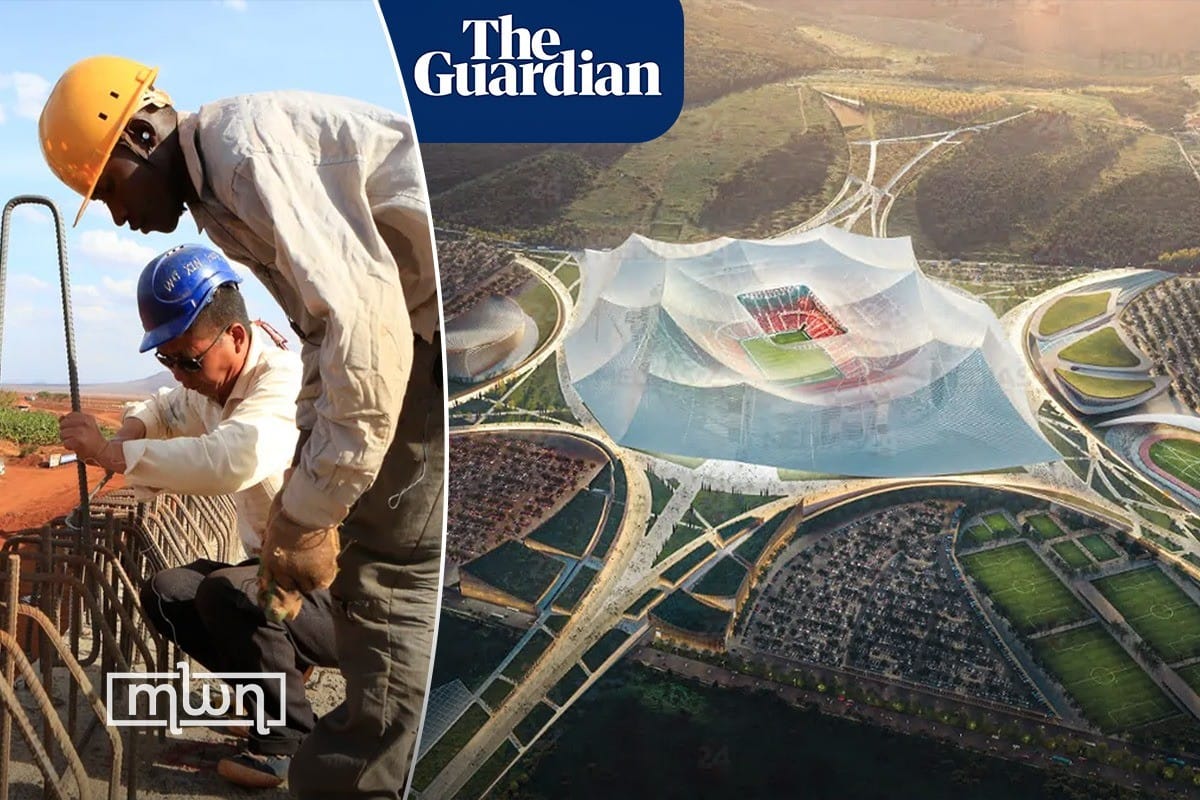
Morocco’s ambitious project, centered around the 115,000-capacity Grand Stade Hassan II near Casablanca, aims to create the world’s largest football stadium and a venue for the 2030 final.
While Moroccan authorities have stated the project’s potential to generate thousands of jobs and stimulate the economy, The Guardian has chosen to focus on speculative concerns about migrant worker rights.
The British newspaper’s approach bears a striking resemblance to its coverage of Qatar’s World Cup preparations, where it claimed 6,500 migrant worker deaths – a figure that was later disputed by Qatari officials.
Alex Carlen from FairSquare in London, quoted by The Guardian, suggests that migrant workers could be in a “precarious position” in Morocco. While migrant worker safety is indeed an important topic of concern, this assessment appears to be based on questionable press freedom rankings rather than concrete evidence of any issues in Morocco’s World Cup preparations.
For the 2022 World Cup preparations, FIFA and Qatari officials initially said only three work-related fatalities and 37 non-work-related deaths, a stark contrast to the 6,500 that The Guardian’s 2021 report noted.
A high-ranking Qatari official eventually reported “between 400 and 500” deaths during the tournament.
The Guardian’s report attempts to draw parallels between Morocco and Qatar, despite the significant differences in context and circumstances. It’s worth noting that Morocco, as a transit point for many migrants from sub-Saharan Africa, has a complex relationship with migration that cannot be simplified into simple, sensationalist headlines.
While The Guardian raises concerns about worker welfare, its reporting fails to acknowledge Morocco’s commitment to ensuring the safety and well-being of all workers involved in World Cup projects. The newspaper’s sole focus on potential issues rather than the positive economic impact and job creation raises questions about its agenda.
The Guardian hasn’t updated its data
The Guardian’s reporting on Morocco’s labor rights situation seems as if it has not been updated to reflect recent developments. While the newspaper highlighted concerns about migrant workers, it has not covered significant legal and institutional changes that have been implemented in the country.
Morocco enacted a comprehensive Labor Code in 2003, implemented in 2004. This code regulates employer-employee relations, covering contracts, working conditions, wages, and dispute resolutions.
The code increased worker protections, raising severance pay and extending the statute of limitations for labor claims from one to two years. The code also strengthened regulations on child labor, workplace safety, and collective bargaining rights.
Morocco has established key institutions to oversee human rights. The National Council for Human Rights, founded in 2011, monitors and promotes human rights, including labor rights. In 2024, Morocco won the presidency of the United Nations Human Rights Council, signaling international recognition of its human rights efforts.
Morocco’s Labor Code further introduced significant changes to employment mediation. It established the National Agency for the Promotion of Employment and Skills as a public institution to facilitate job placement. The code also allows private employment agencies to operate, expanding options for job seekers and employers.
The Labor Code affirms the right to form and join trade unions, a fundamental right enshrined in Morocco’s constitution. It outlines conditions for establishing unions and protects workers’ rights to union membership. The code also provides mechanisms for collective bargaining and resolving labor disputes.
Furthermore, worker compensation has been enhanced under the Labor Code. It mandates various types of compensation, including severance pay, notice period pay, and compensation for unfair dismissal.
The code sets specific formulas for calculating these compensations based on factors like length of service and worker category, aiming to provide fair treatment to workers in case of job loss.
However, it’s worth noting that reports from Western media such as The Guardian often employ a postcolonial lens when discussing developments in Arab nations. This perspective frequently overlooks the nuances of local contexts and the genuine progress being made. Such reporting seems by some to portray a discomfort with Arab nations making strides on the global stage.
Read also: Ceuta Migration Surge Revives Usual Anti-Morocco Lies in Spanish Media


