


 Join on WhatsApp
 Join on Telegram
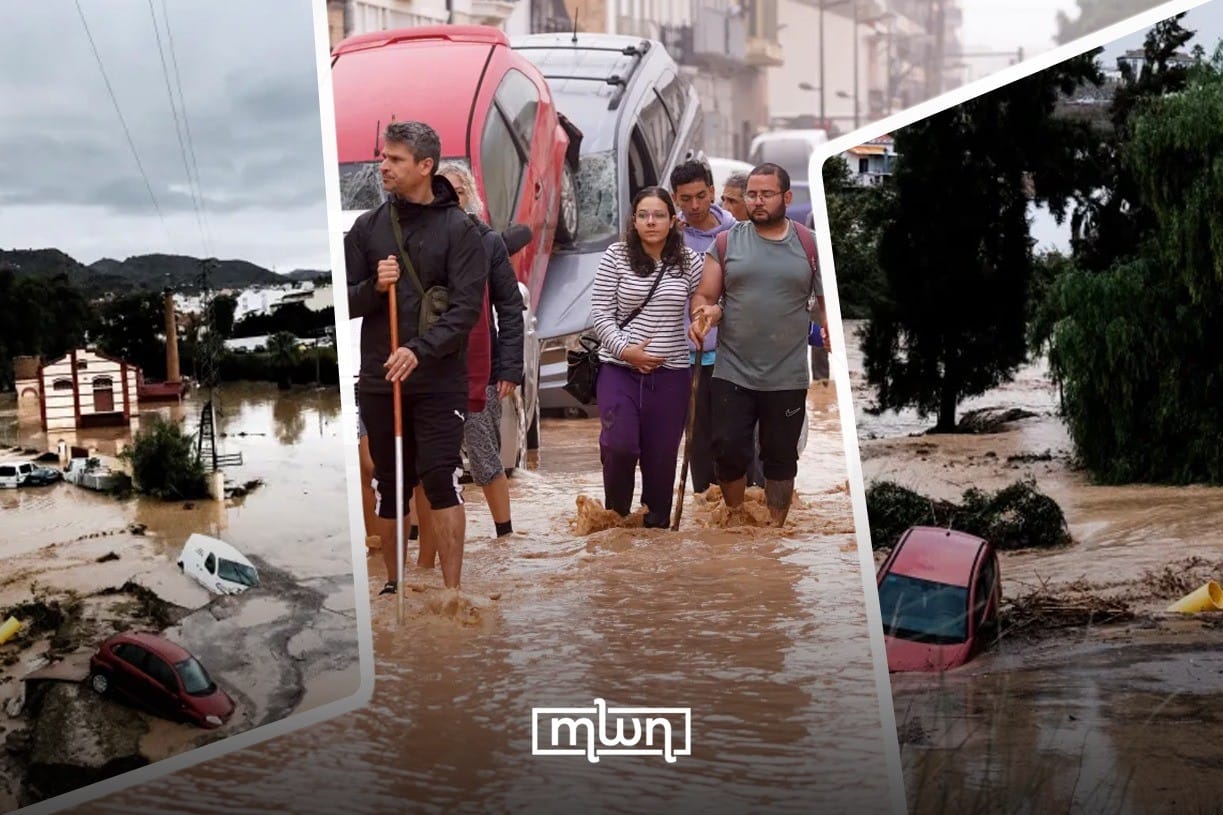
Doha – Spain is reeling after torrential rains and flash floods triggered by a record-breaking “cold drop” weather system slammed into the eastern regions of Valencia, Castilla-La Mancha, Murcia and Andalusia.
According to the latest provisional figures from Spain’s Interior Ministry, at least 62 people have perished so far, with the death toll expected to rise as emergency responders reach cut-off areas. Dozens more remain missing.
The province of Valencia bore the brunt of the devastation, with at least 51 confirmed deaths and many still unaccounted for after raging floodwaters swept through towns, inundated homes, and cut off roads.
Thousands had to evacuate or shelter on rooftops awaiting rescue. The city of Valencia itself also saw some flooding in the lower-lying neighborhoods.
‘There is poor management by local authorities’
Soraya Aybar Laafou, a Spanish journalist from Valencia, talked with Morocco World News (MWN) about the devastating floods that have hit the Valencia region.
“It’s going to rain heavily in many localities of the Valencian Community, specifically in the province of Valencia, in areas like Turís, Requena, and Utiel,” Aybar Laafou said. “As the day progressed, the rains became not only stronger but also caused a ravine to collapse in one of the ravines located in the interior of Valencia, which has led to the flood that we have been seeing in the news and that has collapsed many Valencian municipalities.”
She explained that the affected areas are “specifically those on the outskirts of the city of Valencia, but near the new riverbed of the Turia River, which was built several years ago to divert the river that had overflowed and flooded the city of Valencia many years ago.”
“A new diversion was built so that the Turia River would never again pass through the city of Valencia, the capital, to prevent another flood from occurring in the future. However, this new diversion has caused flooding in other localities of Valencia outside the capital,” Aybar Laafou said.
“The problems right now are several: on the one hand, the lack of communication, the electrical networks are down, the internet is not working in many of the localities, and that is causing many of those affected, especially in towns a little further away in the interior, such as Montserrat or other municipalities near Montserrat, to not have connectivity or access to the internet,” she explained.
Aybar Laafou added, “There is also the evident problem that access for security and auxiliary forces is complicated because there are many road closures, either due to landslides or because the roads are collapsed by all the cars that have been swept away by this flood.”
“Another problem is that there is poor management, or so many of the people who are affected are demanding, poor management by local and municipal authorities. Evidently, the UME, which is the Military Emergency Unit, is deployed on the ground, but it is not enough for the immensity of the tragedy,” she said.
A region in shambles
In the town of Letur in neighboring Albacete province, a desperate search continues for at least six missing people, including two municipal workers, whose vehicle was found empty near a rambla after being swept away by the surging waters. Rescuers there had to briefly suspend operations due to continuing rainfall.
Other affected areas include the Valle del Guadalhorce in Málaga, where 14 people had to be rescued, and the town of El Ejido in Almería, where huge hailstones the size of golf balls ravaged over 4,200 hectares of greenhouses, with losses projected at around €30 million.
Spain’s Prime Minister Pedro Sánchez expressed his condolences to the victims’ families and promised to “help with all necessary resources for as long as it takes.” King Felipe VI also conveyed “solidarity with the thousands affected” and his “most fervent wish that the missing are found alive.”
In an appeal for prudence, PM Sánchez urged residents in the alert zones – which include parts of Andalusia, Valencia, Aragon, Castilla y León, Catalonia, Extremadura, Navarra, La Rioja and Ceuta – to take precautions, stay informed via official channels and avoid all non-essential travel.
The rain is projected to continue until at least Thursday, though not as severely, as the storm system slowly shifts northeast. Nine regions and the enclave of Ceuta remain on alert.
The scope of the damage to infrastructure is still being assessed, but is expected to be extensive. Over 155,000 homes lost power. Major highways like the A-3 Madrid-Valencia and the Mediterranean rail corridor are cut off. Ports in Valencia, Sagunto and Gandía are closed, and dozens of flights diverted.
‘There is no accessibility to many of the areas’
Aybar Laafou also emphasized to MWN the challenges with rescuing the victims that do remain. “I think the latest data spoke of 62 deaths, including children, although the figure is expected to rise as the hours go by, especially taking into account what I mentioned, there is no accessibility to many of the areas,” she said.
“The firefighters and the local police have not managed to access many of them, but there is already a growing count of new deaths of people trapped between cars or even covered by the mud created by the sludge,” she added.
In the city of Valencia, which has not suffered any damage, she said that the water supply has been completely cut off, and homes currently have no water. As a result, supermarkets are also being overwhelmed by people seeking supplies, especially water and other food items.
“We are still waiting for new figures and also for the mobilization of the Government of Spain to see to what extent humanitarian aid will be deployed in these affected areas,” she said.
As the nation unites in mourning, questions are being raised about the preparedness and the timeliness of the alerts. Regional president Carlos Mazón defended the emergency response, while acknowledging the 112 hotline was overwhelmed at times. He dismissed circulating misinformation and urged people to heed evacuation recommendations.
With more downpours in the forecast and swollen rivers like the Júcar and Magro still rising, anxious residents can only watch, wait and hope – that the rains subside, the missing are found, and their sodden communities can begin the long road to recovery from this historic “cold drop” that brought a tragic deluge.




