 Join on WhatsApp
 Join on Telegram
Rabat – Estonia has affirmed its steadfast support for Morocco’s territorial integrity and sovereignty over its southern provinces in Western Sahara, describing the Moroccan autonomy initiative as “a serious and credible foundation” for achieving a lasting resolution to the longstanding dispute.
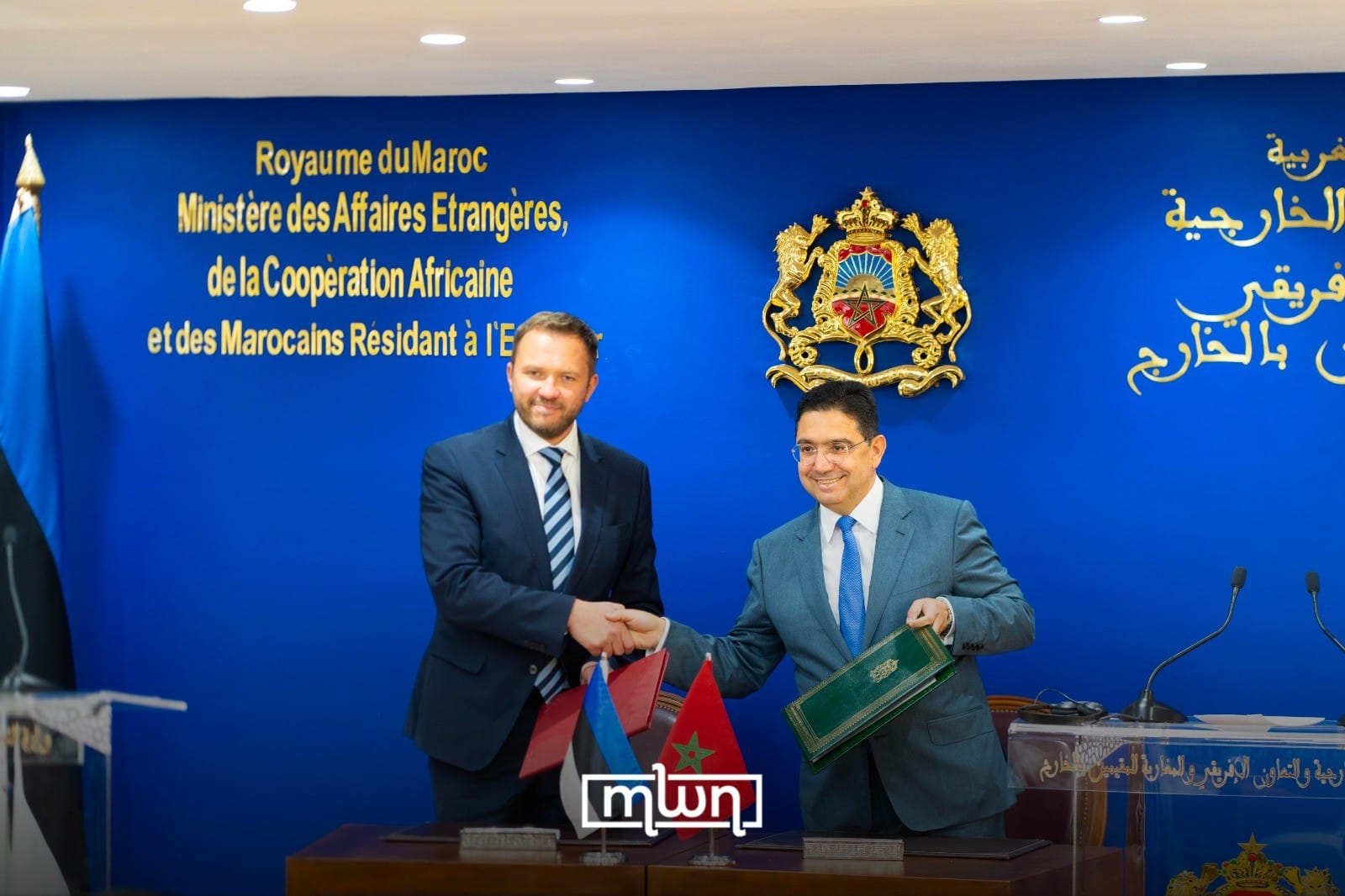
“The Estonian government views the autonomy plan, presented in April 2007 by Morocco to the UN Secretary-General, as a serious and credible foundation for a definitive solution to the issue of the Moroccan Sahara,” stated a joint declaration following a meeting today in Rabat between Nasser Bourita, Morocco’s Minister of Foreign Affairs and his Estonian counterpart, Margus Tsahkna.
The Estonian foreign minister reiterated his country’s backing for the UN-led process aimed at achieving “a fair, pragmatic, sustainable, and mutually acceptable political solution” to the Western Sahara dispute. Both countries also reaffirmed their commitment to the fundamental principles of the UN Charter, particularly regarding the respect for the sovereignty and territorial integrity of states.
Estonia’s recent endorsement of Morocco’s autonomy plan is part of a large and expanding support for Morocco’s position that has been garnering attention among the international community.
This support challenges hostile maneuvers, including the contentious ruling from the European Court of Justice (ECJ).
On Friday, October 4, the court accused the EU Commission of infringing on “the right to self-determination of the people of Western Sahara” by entering into trade agreements with Morocco that involved products from the region.
In response, the European Union reaffirmed its commitment to its strategic and mutually beneficial partnership with Morocco. This position has garnered support from several EU member states, including Spain, France, Belgium, Hungary, the Netherlands, Finland, Portugal, and the Czech Republic.
Growing ties between Morocco and Estonia
During their meeting, Estonian Foreign Minister commended King Mohammed VI’s initiatives aimed at promoting peace, stability, and socio-economic development in Africa. The joint declaration included support for the Royal Initiative to enhance Sahel countries’ access to the Atlantic Ocean, the “Atlantic African States Process,” and the Morocco-Nigeria Gas Pipeline project.
Both nations reaffirmed their commitment to strengthening the “Euro-Moroccan Partnership for Shared Prosperity,” a strategic framework designed to bolster bilateral relations.
The declaration noted the increasing dynamism in Morocco-Estonia relations and their mutual interest in expanding cooperation. To improve coordination, the ministers agreed to hold regular consultations and facilitate reciprocal visits across various sectors, while expressing their dedication to improving economic and trade relations to unlock their full potential, agreeing to broaden discussions to create a more favorable investment environment.
The discussions also covered several key areas for collaboration, including maritime infrastructure, agriculture—especially fertilizers—tourism, education through academic exchanges and online learning, and cultural cooperation in film and museums, along with legal and judicial collaboration.
They assigned experts to review existing agreements for effective implementation and to explore potential new accords. They also welcomed the creation of parliamentary groups, recognizing their importance in strengthening parliamentary cooperation.
Estonia additionally expressed support for Morocco’s bid for a non-permanent seat on the UN Security Council for the 2027-2028 term.