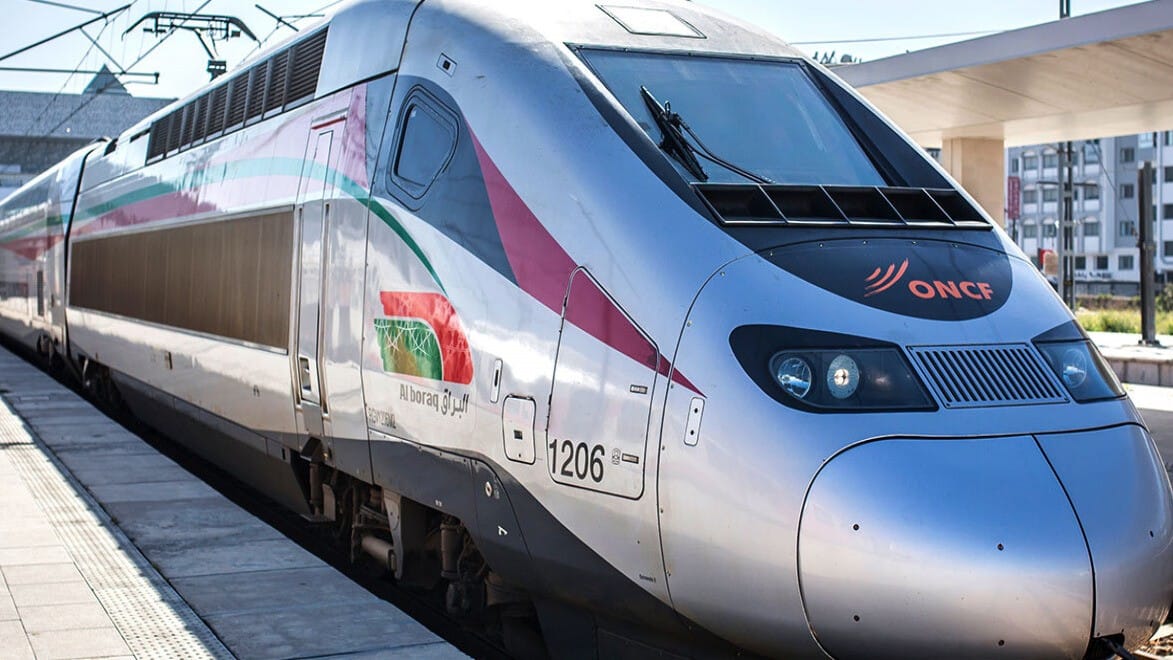
Rabat – Germany’s Vossloh Cogifer and China’s Railway Shanhaiguan Bridge have been awarded contracts to supply critical components for Morocco’s high-speed rail expansion, the national railway operator (ONCF) has announced.
These upgrades will bolster the Kénitra-Marrakech line, one of the country’s most vital transport corridors, ONCF said in a statement today.
The national operator launched the tender to expand the capacity of the high-speed rail network (LGV), dividing the project into two parts. Vossloh Cogifer, a leading German rail technology company, won the first lot.
Their contract, worth MAD 487 million (around $47.4 million), focuses on providing switches and crossings for the new LGV track. These components are essential for the safe and efficient operation of high-speed trains, particularly at junction points and track intersections.
China Railway Shanhaiguan Bridge, a major Chinese infrastructure firm, secured the second lot.
Valued at MAD 89.7 million (approximately $9 million), this contract covers the turnouts for the conventional line, which will run parallel to the new high-speed route as part of a broader network upgrade.
In total, the investments for both contracts amount to MAD 577 million ($56.2 million), a significant but more cost-efficient figure compared to the initial estimate of MAD 638 million ($62.2 million).
These upgrades are key to enhancing the overall capacity and efficiency of Morocco’s railway system, which plays a critical role in both passenger transport and economic development.
The high-speed line itself will extend from Kenitra, north of Rabat, to Marrakech, connecting key cities along the country’s Atlantic coast.
This expansion includes exclusive high-speed corridors, new and upgraded stations, as well as additional maintenance facilities to support the growing rail network.
The award of this contract marks a significant milestone in the development of Morocco’s high-speed rail network.
The Kenitra-Marrakech HSR project is expected to reduce travel times between the two cities from 4.5 hours to just 1 hour and 45 minutes. This will boost tourism and economic development in the region.
The project is also part of Morocco’s broader plans to modernize its transportation infrastructure. The ONCF has been investing heavily in recent years to improve the country’s rail network. This includes the construction of new high-speed lines, as well as the upgrading of existing lines.
The national railway operator has also been working to improve the quality of its services. This includes the introduction of new train models, as well as the development of new ticketing and reservation systems.