Join on WhatsApp
 Join on Telegram
Doha – Medical, dental, and pharmacy students from across Morocco staged today a national protest in the capital, Rabat. This demonstration marks the tenth month of an ongoing crisis in Morocco’s medical education system, making it the longest student protest in the country’s history and the second-longest globally.
Organized under the slogan “Morocco’s Youth and Professionals for Better Health and Rights,” the protest saw students from various public medical schools converging on Rabat.
They aimed to voice their grievances against what they perceive as the government’s disregard for their primary demands and to denounce recent incidents of physical and verbal abuse against students and doctors.
Speaking to Morocco World News (MWN), Nour, a fifth-year medical student from Oujda, emphasized that students belong in their faculties, not on the streets.
“We’re here to reiterate our demands for quality education. Unfortunately, the ministry refuses to engage in dialogue with its students, who are only concerned about the quality of their training,” she stated.

The National Commission of Medical, Dental, and Pharmacy Students has been at the forefront of organizing these protests.
In a statement on October 3, they invited the National Union of Moroccan Students to join the demonstration, for solidarity in the face of recent repressive actions witnessed on Rabat’s streets the previous week.
The National Executive Office of the National Union of Moroccan Students responded with a statement of support on October 4, announcing their intention to participate.
The Union also condemned the targeting of peaceful union work and all forms of violence, repression, and restrictions that the students have faced throughout their protest movement.
The statement included hashtags calling to “Stop the injustice and tampering” and “Do justice to medical and pharmacy students.”
Key demands of the students include maintaining the seven-year medical education program, reinstatement of expelled students, and organizing exams in two sessions: regular and make-up.
These demands are seen as crucial for ensuring the quality of medical training and, by extension, the health of Moroccan citizens.
Read also: Morocco Loses 600 Doctors to Emigration Every Year
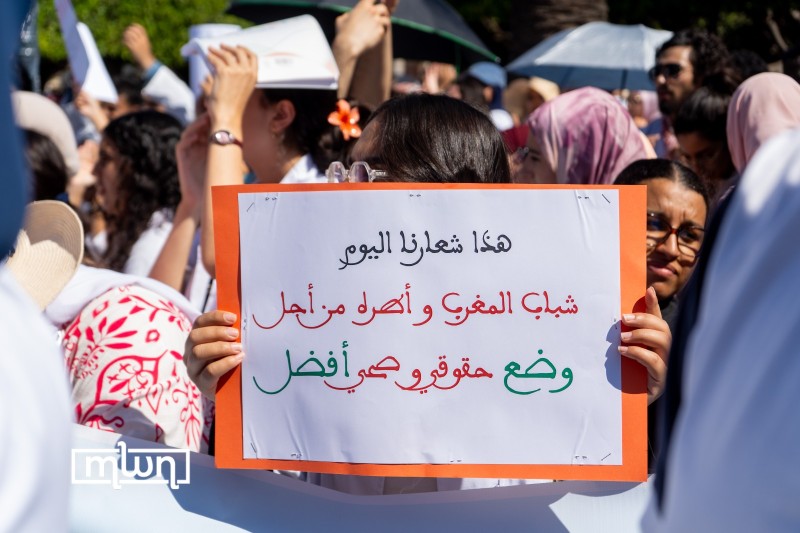
Rachad El Mallouki, a representative of medical students in Fes, expressed hope for intervention from officials and meaningful mediation to resolve the issue.
Speaking to MWN, he criticized the ministry’s approach of scheduling exams, stating, “Today, the problem isn’t about exams or ‘zero’ scores. Our demands are strong and concern training.”
The students have been boycotting exams, with participation rates in the boycott reaching as high as 100% in some faculties.
On Friday, October 4, they boycotted exams for the sixth time since the crisis began in December of the previous year.
In another interview with MWN, Imad Hami Eddine, a member of the National Commission, highlighted the unified stance of students from all public faculties.
He criticized the closure of dialogue channels by the ministry for over five months, questioning, “How do they expect students to return under these conditions?”
Hami Eddine also addressed the violence students faced in the past week, mentioning “various forms of beatings and repression” during their peaceful protests.
The crisis has escalated to legal proceedings, with 27 medical students and interns scheduled to appear before the Rabat Court of First Instance on October 23.
They face charges of disobedience, participation in an unarmed gathering, and failure to disperse after legal warnings.
Marouane Beggar, president of the Medical and Pharmacy Student Council in Oujda, expressed frustration with the prolonged nature of the protest in his interview with MWN.
“We didn’t come out to set records for the longest student protest. We came out for our demands,” he stated, placing full responsibility on the Minister of Higher Education Abdellatif Miraoui for the current situation.

The students remain firm on their stance regarding the seven-year program, viewing it as crucial for ensuring quality education and, by extension, the health of Moroccan citizens.
“After everything, our sole responsibility and concern is the health of the Moroccan citizen,” Bakkar emphasized.
As the crisis continues, students are calling for meaningful dialogue involving all parties – students, professors, and officials.
They stress their commitment to serving their country and appeal to national leaders to intervene, viewing themselves as the foundation of the future healthcare system.