 Join on WhatsApp
 Join on Telegram
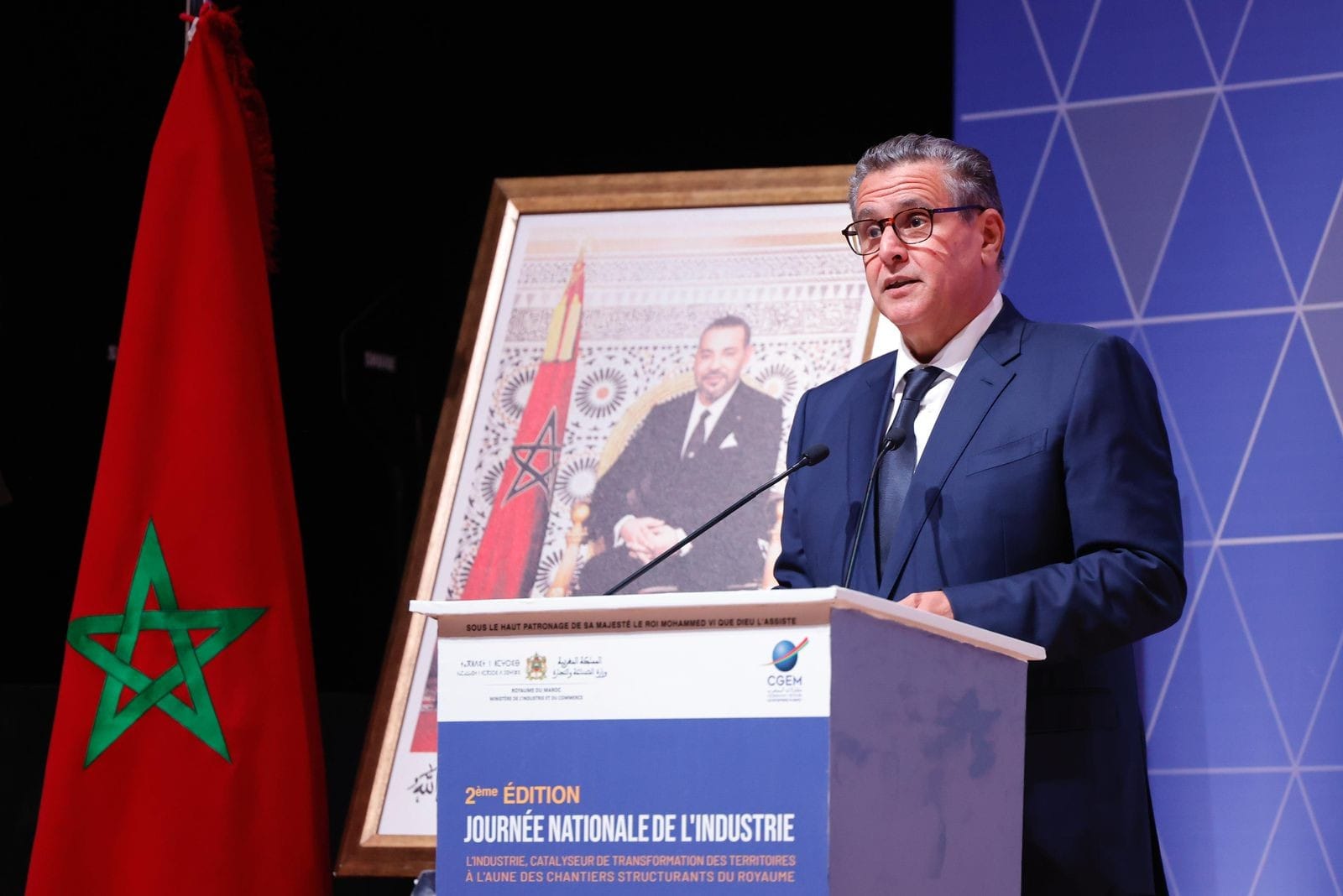
Doha – Speaking at the second edition of Morocco’s National Industry Day on Wednesday, Head of Government Aziz Akhannouch highlighted the remarkable progress of Morocco’s industrial sector over the past quarter century, with exports reaching MAD 376 billion ($37.6 billion) in 2023, up sixfold from 1999.
“Under the reign of His Majesty King Mohammed VI, and in a quarter of a century, the size of the national industry has multiplied,” Akhannouch stated in his opening address. “This is reflected in the sixfold increase in the value of industrial exports, from MAD 61 billion in 1999 to MAD 376 billion in 2023.”
The number of industrial companies in Morocco has nearly tripled over this period, from 4,500 in 1999 to around 13,000 in 2023. Employment in the sector has also doubled, from 477,000 jobs in 1999 to nearly 1 million today, with women representing over 43% of the qualified human capital.
Akhannouch noted that this industrial growth has been supported by ambitious strategies, structural reforms to improve the business climate, and major infrastructure investments. These include the Tangier Med Port, ranked first in the Mediterranean basin and Africa, an 1800 km highway network, and the provision of 13,000 hectares of industrial land across 150 industrial zones.
Morocco has also broadened its economic openness through free trade agreements, giving it access to over 2.3 billion consumers worldwide.

Despite global tensions impacting the industrial sector, the government has taken proactive steps to boost industry, such as establishing the “Industrial Projects Bank,” and launching the “Innovation Support Fund” in 2023, which has seen great success. They have also implemented a new investment charter, and rolled out the national “Morocco Digital 2030” strategy.
The new investment charter will offer specific measures to support very small, small and medium-sized enterprises (VSMEs), which make up over 90% of Morocco’s economic fabric, by incentivizing investments between MAD 1 million ($100,000) and MAD 50 million ($5 million).
Other key initiatives include enacting a law on payment deadlines, creating 22 new industrial acceleration zones across 8 regions, and paying companies over MAD 20 billion ($2 billion) in VAT arrears.
“Thanks to these measures and the climate of political stability and macroeconomic balance enjoyed by the Kingdom under the enlightened leadership of His Majesty King Mohammed VI, Morocco is now a global destination for many cutting-edge sectors,” Akhannouch affirmed.
In the automotive industry, Morocco has become Africa’s top producer of passenger vehicles and the leading exporter of thermal cars to the European Union, doubling its car exports between 2021 and 2024. In 2023 alone, Morocco manufactured over 570,000 automobiles – one vehicle per minute. The country has also made significant advances in electric vehicle and battery manufacturing, developing an integrated value chain.
Morocco’s aeronautics industries are seeing continuous development and increased exports, attracting over 140 of the world’s largest investors to set up operations in the country. Morocco has also strengthened its position as a major player in agribusiness, petrochemicals, pharmaceuticals, as well as leather and textiles, with strong export performance in these sectors.
The country is also banking on the energy transition to achieve zero-carbon production and boost the competitiveness of industrial output, with plans to invest in the green hydrogen sector through the “Morocco Offer” which has attracted interest from major global operators.
Morocco’s non-agricultural GDP averaged 3.6% in 2023 and 3.4% cumulatively since 2021, outpacing the 2014-2021 average by 1 percentage point, and reflecting the economy’s resilience amid successive shocks. In the first half of 2024, the industrial sector, including crafts, created 92,000 jobs, surpassing the services sector.
“The government is working today to ensure that the national industry is fully prepared to inaugurate a new industrial era, focused on and driven by the notion of sovereignty,” Akhannouch concluded, a statement in line with the royal directives outlined by King Mohammed VI in his message to the first National Industry Day in March 2023. “The government is betting on the development of the industrial sector’s performance as an essential lever for the promotion of productive and sustainable employment and as a government priority.”
Read also: Morocco’s Ambitious Modernization Agenda Looks Promising Despite Challenges