 Join on WhatsApp
 Join on Telegram
Stress is dangerous. In the case of individuals, it is curable. In the community sector, it is variously managed. Whether it is an individual (or a community-driven phenomenon), stress needs serious and steady management. However, the healing process depends on the ability of the person who suffers from it to realize the risk he runs if he does not make the appropriate effort to get out of it.
Yet, stress is a matter of serious worry when it is detected in political decision-makers’ behavior, including heads of state, foreign ministers, or seasoned diplomats. Studies on stress in foreign policy are numerous and a high-quality contribution to understanding the diplomatic life (Holsti Ole R. & Alexander L. Georges, Political Sciences Annals, Vol. 6, 1975, p. 275).
On October 31, 2024, a strange image has been circulated on all media outlets around the world, where we have watched Amar Ben Jamaa, Ambassador Permanent Representative of Algeria to the United Nations, almost shouting in front of his colleagues in the Security Council. This image will not be forgotten any time soon. Not because of its impact on United Nations style in international conflict management, but because of its absurd, unjustified, and ostentatious nature.
The Algerian diplomat got himself trapped in a circle of denial that drove him into total blindness with respect to reading changes that are taking place on the geopolitical and diplomatic, regional and international chessboard.
Godfathers Gone Missing
This behavior is surprising because while he is busy pulling himself together, he is interrupted by one of his assistants who hands him a smartphone, which he consults fictitiously and pauses as if he wanted to assimilate the instructions that would have been given to him from Algiers.
A state of panic attests to the loss of the political compass, which proves that he is not aware that the forum in which he speaks is the most important in terms of international conflict management and diplomatic balance of power.
The Algerian representative got himself stuck in a situation of denial that pushed him to adopt a defiant posture, assaulting, in the process, the United States and France. No doubt, unconsciously, he was tempted to duplicate what Nikita Khrushchev, head of government of the USSR, did on September 23, 1960, who stared a show by hitting the lectern at the United Nations General Assembly with his shoe in order to grant himself the right to speak.
This image was enshrined in people’s mind in the light of the Cold War, in the aftermath of the Indochina War (1946-1954), in the midst of the Vietnam War (1955-1975) and impacted the Berlin Crisis (1958-1963) leading to the division of the German city between the East and the West.
Or perhaps he was thinking of this laconic but politically and ideologically lethal sentence General Charles de Gaulle launched on September 10, 1960, about the Congo war: “This thing called the UN.” General de Gaulle meant the United Nations for having lectured the victorious powers of the Second World War on the way they had to manage peace and war back then.
Unless the Algerian diplomat was thinking of Muammar Gaddafi, who, on the occasion of his speech to the United Nations General Assembly in September 2009, began to vilify the Organization by randomly reading a few articles of its Charter before throwing it away as a sign of contempt and carelessness.
However, these examples were staged before the United Nations General Assembly and remained short-lived insofar as this chamber resembles a kind of registration chamber or a flea market with no power of getting its resolution implemented. This doesn’t apply to the Security Council. The Algerian diplomat’s challenge took place within this mythical body that has proved in the past to be chameleon and intractable if offended by non-permanent members whose bargaining capacity is almost ineffective.
This unacceptable behavior is followed by a sort of injunction to the United States and France, blaming them for taking a wise decision on the way to resolving the artificial conflict over the Moroccan Western Sahara issue on the basis of realism and the dynamics set in motion since 2007. Attacking France, accusing it of having adopted a mercantile approach by siding with Morocco, is nothing more than a left hand in a bee-eater.
This has proven to be more of an untimely reaction that wouldn’t be quickly forgotten. Algeria is aware of having been abandoned by a sponsor who keeps reminding it that it was created only in 1962 following a three-stage referendum and an implicit unilateral dependency that continues to this day. This is why Algerian President Abdelmajid Tebboune went to Moscow in 2023 to ostensibly plead his country’s case for joining the BRICS but obviously as stated in the joint meeting with President Poutine, to beg for Russia’s protection.
The Algerian president did not hesitate to describe Russia as an appropriate protector and its president, Vladimir Putin, as a friend of mankind, which brought about the smirk of the latter. Betrayed in its dedication to playing the role of a best-second, Algeria is deadly blinded by anger and illusion.
It is as if we heard the Algerian leaders repeating in chores, “The godfather is dead; long live the godfather!” However, the godfathers, according to the traditional perception of unilateral interdependence—not to say applied suzerainty—do not jostle in front of the steps of an Algeria wounded in its self-esteem and now unable to restore its image.
Indeed, the godfather is dead; long live the godfather. Yesterday was France doing this job; today Russia does. The Algerian representative’s desire to introduce an amendment about human rights into the mission of the MUNIRSO in the draft resolution 2756 (2024) on the Sahara denotes an amnesiac memory of an entire political system that is locked in the most hallucinatory denial.
Amar Ben Jamaa seemed to have forgotten that in 2013, the United States had shimmered the idea of introducing this dimension but was forced to give up on it following Morocco‘s refusal and Russia and China’s fierce opposition. These two countries perceived the move as a machination that the United States would use against them later by highlighting the human rights situation in the North Caucasus, Tibet, or in the Muslim province of Xinjiang.
Algeria is struggling to digest its nightmare awakening of having lost everything in the middle of a harsh fight to make its geopolitical case. This self-confidence, which she had displayed during the 1970s as being the champion of so-called just causes in the midst of the Cold War, is today crushed, shredded, and thrown on the path of political realism enshrined in an international system in transition.
The hypothetical end of the Cold War brought alley cats out of hiding. Today, Algeria is exposed to a kind of two-faced curse. On the one hand, the erosion of the revolutionary narrative that no longer garners any votes anywhere. On the other hand, there is the risk of an intra-national implosion that would have the effect of a groundswell that would sweep away everything in its path. In short, Algeria is none other than a giant with feet of clay.
Arab moviegoers may remember the 1984 film Al-Halfout الهلفوت, where Adil Imam plays the role of a handyman. There is a scene that sums up the brilliant idea of the director, Samir Sayf, in which Imam walks nearby the house of an individual (Salah Kabil), an unbearable character who intimidates the people of the village by relying on his physical strength.
Imam discovers that this is not true and that the bodybuilding that this character boasts of is made up of bandages and clothing accessories. Stunned at first, he decides later to challenge him. An altercation followed by the death of this puppet of a hero who suffered a heart attack. The chapter of hegemony over the village is closed. This is what, it seems, is happening to Algeria.
However, instead of making the right reading and turning the page on the hegemonic temptation in the region, Algeria is locking itself in its illusory world of artificial power. This behavior is reminiscent of the novel Don Quixote de la Mancha, by Miguel de Cervantes Saavedra de la Mancha (published in two parts in 1605 and 1615), a parody of the chivalric ideal and the loss of existential landmarks of adaptation and integration into medieval society.
The headlong rush in all its glory
This behavior also reminds of the hero of Moumen Smihi’s film (Moroccan Chronicles, 1999). In the film, there is a scene towards the end in which we see a fisherman from Tangier (played by Miloud Habachi) who is getting himself ready to sail. He is challenging other fishermen who make fun of him because he claims that he can find a treasure hidden in the belly of a sea monster.
The scene depicts the fisherman in his small boat sporting a makeshift javelin and heading straight for a boat, mistaking it for the wanted monster in order to shoot it down and dig out the missing treasure. The scene subtly takes up the idea contained in Cervantes’ work. These two examples can also be applied to Algeria, which is dying to get its hands on the treasures of the Moroccan Sahara and, by the same token, have access to the Atlantic, using an illusion monster, the polisario.
Tangier city, which recalls the Maghreb dream on the occasion of the meeting of the parties of the Istiqlal of Morocco, the Destour of Tunisia, and the National Liberation Front of Algeria in 1958. Tangier, through which the Africa-Atlantic gas pipeline will pass. Tangier will undoubtedly see the realization of the fixed link project between Africa and Europe.
Tangier, which witnessed the hostile attitude of Algeria following the tension over the islet of Leila (Persil) between Morocco and Spain in July 2002. For the record, Algerian decision-makers rushed to sign the Treaty of Friendship, Good Neighborliness, and Cooperation with the Iberian country in return for the latter’s continuation of its opposition to Morocco over the Sahara dispute.
Ironically, once Spain had endorsed the Moroccan thesis, Algeria suspended this treaty while hopping for better fortune in the foreseeable future. Algerians will have another half-century to wait and risk shattering the lark’s mirror that their decision-makers have used to play the diversion and whose reflection no longer has any impact.
The illusion can be detected also in the bland and insipid family photo in which we see the heads of state of Algeria, Tunisia, Libya, and Mauritania next to the head of the pseudo-SADR and the chief of staff of the Algerian army harboring a compact physiognomy. The photo was taken on the occasion of the celebration of the 70th anniversary of the outbreak of the Algerian war of independence.
Illusion in all its glory after a series of diplomatic disappointments—not to say defeats—of an Algeria that, by dint of chasing after the memory rent, has ended up sinking into identity amnesia. Amnesia, but also a headlong rush to set up a new Maghreb without Morocco. This translates to a sort of nostalgia for a golden age that no tangible records have ever sustained.
Ironically, there too, because at the time the photo was taken (November 1, 2024), a ministerial meeting of the energy ministers of the ECOWAS (Economic Community of West African States) member countries was opened in Abuja. One of the items on the agenda was the Atlantic Africa gas pipeline project. Morocco and Mauritania took part in.
This gigantic project (spread over 6000 km) aims to achieve regional integration for the benefit of a population estimated at 400 million individuals through co-development, the win-win approach, and the community inclusion of thirteen countries.
As for the reading one might be tempted to make about photos and images, what would they say about the scene of the Algerian diplomat on October 31, 2024? Without irony or levity, we can draw a series of conclusions that can be laid down accordingly.
One: This behavior will have serious consequences for Algerian foreign policy. Algeria’s aspiration to run for the position of permanent member of the Security Council for the African region in the event of the implementation of the reform of the UN Security Council is not only compromised; it has already joined the museum of history.
Second, Algeria’s regain of its credibility within international and regional organizations will suffer a serious loss in the near future. By making the issue of the Moroccan Sahara its Trojan horse, neglecting the other issues it is supposed to defend as a non-permanent member of the Security Council (2024-2025), Algeria is becoming (with all due respect to my Algerian friends) like a mangy camel (البعير الأجرب) that everyone is careful to stay away from.
In the absence of axes, a scorched earth as a second option
Three: Algeria’s fixation on the Moroccan Sahara will end up prolonging its strategic decision-makers in a state of denial of the geopolitical reality and sending them back to the turbulence of a colonial past that they are trying by all means to erase from Algeria’s collective memory.
Four: The reaffirmation of the definitive burial of the idea of the partition of the Moroccan Sahara already enshrined in 2002, as well as that of the abandonment of the idea of the referendum, sounds like the death knell of an Algerian’s diplomacy that walks backwards by giving itself the illusion of walking straight.
Five: The principle of the right to self-determination written in golden letters in the new Algerian constitution adopted in 2020 may at the end be fatal to the unity of Algeria. This might be some sort of sprinkler watered, as a cynical politician might ironically deem. This principle is already used by the Movement for Self-Determination of Kabylie (MAK) and will also be used by the Tuaregs rebellion in the south of the country.
Six: The most serious fear that impacts the Algerian decision-makers’ minds is the polisario’s rolling stones at uncontrolled speed. Obviously, the separatist movement has no clue where to head. It has no better choice than to stay in Tindouf indefinitely. The bet on northern Mauritania as a substitute hotbed is a chimera that neither Mauritania nor its allies in the region and Europe will tolerate.
Polisario has scratches of state structures that only the Algerian state will keep recognizing while taking hold on a territory subject to the provisions of the border agreement between Algeria and Morocco signed in 1972.
Already, voices emanating from a few Polisario components, aware that the Sahara issue is settled in favor of Morocco, are integrating into their thinking the idea of taking Tindouf as a base for a state, whether or not it is recognized by the international community.
Seven: Algeria’s challenge to France and the United States is suicidal behavior. France holds archives on the history of Algeria since its occupation in 1830. Above all, it holds compromising documents on the negotiations between the leaders of the Algerian FLN and the former Metropolis in the aftermath of the outbreak of the war of liberation in 1954.
For its part, the United States holds archives on the subterfuges that Algeria used during its mediation for the release of fifty-two American diplomats and civilians at the American embassy in Tehran (1979–1981). The United States is also aware of the unorthodox methods that Algeria used to pressure Washington to align itself with its position on the Moroccan Sahara.
For the records, it was at this time that the Carter administration (1977–1981) had decreed an embargo on the sale of arms to Morocco. Morocco found itself in a delicate situation fighting the Polisario separatist guerillas, who were well trained and armed to their teeth by Libya, Algeria, and some Eastern European countries, helped as well by Cuban military advisors.
Eight: Algerian decision-makers are hovering in another orbit. They might be better advised to meditate on the correlation between stress and the decision-making system in foreign policy (Samuel Kirkpatrick, A., “Psychological Views of Decision Making,” in Political Sciences Annals, Vol. 6, 1975, pp. 39-113). An exercise that would prevent them from being the laughing stock of foreign political and military planners.
Nine: Algerian decision-makers have, since independence in 1962, succeeded in failure. The question of borders will eventually implode Algeria. Neighboring countries, which were forced to sign border agreements with Algeria in 1983, realize that this country is a giant with feet of clay. Similarly, Algeria has proven to be a country that challenges the United Nations, as such a behavior is reflected by its permanent representative’s insipid performance on October 31, 2024.
Ten: Algerian decision-makers have nurtured a hegemonic perception of the relations they have intended to build with their neighbors. They now only harvest wind. As far as Morocco is concerned, the behavior of these decision-makers has indirectly contributed to the acceleration of the democratic process in Morocco, particularly after the two wars that Algeria waged against it in Amgala in 1976.
Eleven: Algeria’s hostility has enabled Morocco to modernize its army, to federate the social and political expectations of Moroccans, and to entrench the consciousness of national belonging on the way to the confirmation of its national independence.
Twelve: Algeria should bite its fingers for having been elected to the United Nations Security Council for the years 2024-2025 at a time when the issue of the Southern Provinces is on the way to its epilogue. The false self-assurance that she displayed the day after her election, presented as a heavenly victory, has been converted into a tirade of lamentations and anger. This has reached such a point as to blame two permanent members of the Security Council, accusing the first one (France) of being mercantile or even opportunistic, as if diplomacy were a matter of Samaritans, and the second one (the USA) of being a manipulator and chameleon.
The syndrome of the sun rising from the west
Thirteen: However, Algerian decision-makers are entitled to two satisfactions. The first satisfaction is to have anchored, since 2020, in the understanding of the majority of Algerians that Morocco is an eternal enemy. Even Algerians who claim to be part of the opposition (with a few exceptions) have shown a face of distress following France’s confirmation of its recognition of the Western Sahara as part of Morocco, and the adoption of Resolution 2756 (2024) by the United Nations Security Council on October 31, 2024.
The second satisfaction is to have unmasked a minority of Moroccans who have a transnational allegiance that they sanctify to the detriment of their allegiance to their own country, even if the ideological and political frame of reference they venerate is likely to undermine Morocco’s existential interests.
Fourteen: There is a risk that delusions of grandeur, the refusal to accept reality, and the absence of alternatives will push Algerian decision-makers to opt for terrorism in order to destabilize Morocco. They tried to do it in 1994 through the attack on the Asni Hotel in Marrakech.
Fifteen: A preview of this intention was the publication by an Algerian government newspaper of a fabricated statement fraudulently attributed to the French Ministry of Foreign Affairs warning French nationals to travel to Morocco because of the risks of prominent terrorist attacks.
Sixteen: The height of heresy was such forged news because the publication of this pseudo-communiqué took place while the French president (and a large delegation of ministers and businessmen) was in Rabat as part of the state visit he was making to Morocco. The response was the dissemination of open-air images showing President Macron and his delegation enjoying succulent dishes of Moroccan tagines.
Moreover, Algeria and schizophrenia, to use a description dear to Abdellah Laroui, like to play the deception. Algerian decision-makers are trying to dupe observers and political and military analyses. During the military parade organized on November 1, 2024, they paraded weapons in poor condition as if to mislead their opponents.
This also might be an ambush to make Morocco believe that in the event of a war that Algeria unleashed, it would have a great chance of winning it. Unless the objective was to give credit to the budget of 25 billion USD that the military institution allocated to embark on a mad arms race with Morocco.
Another attempt at deception is that of giving credence to the idea that the Maghreb still includes five countries, but without Morocco (replaced by the pseudo-SADR), of which the family photo mentioned above would be the illustration par excellence.
A childish maneuver insofar as, according to some political and diplomatic satirists, the same photo presents glaring anomalies: a country with two presidents (Algeria), a head of government controlling only part of his country (Libya), a president trapped because he tries to maintain balanced relations with the major players in the region (Mauritania), and a president of a self-proclaimed entity-state taking up residence on the territory of another state (the pseudo-Sadr).
Even more aggressive is the rumor that Algeria would have three presidents if we added the leader of the Movement for the Self-Determination of Kabylie (MAK).
Joking aside, Algeria is in an uncomfortable situation. Next year, on the occasion of the celebration of the 71st anniversary of the outbreak of the war of national liberation, much will have changed with regard to the country’s institutional structures.
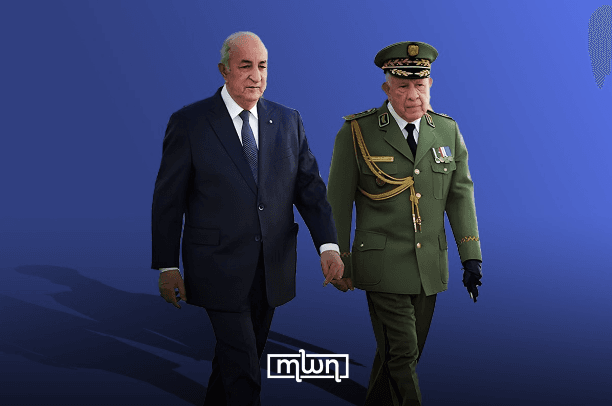
The duality of power in the form of Algerian-style taqîa should cease or be muted to avoid the reproduction of this scene within the Ministry of Defense where we see the Chief of Staff of the Armed Forces, Said Chengriha, taking the seat of President Tebboune and forcing him to sit on his right and the Prime Minister on his left. A clear message that it is the military establishment that runs the country.
On the international level, Algeria may find itself alone in meditating on the line of Meursault, hero of Albert Camus’s novel ‘’The Stranger’’ (1942), when asked why he had killed the Arab on the beach. His answer could not have been more absurd and surprising. He would have killed him because of the sun and the stifling heat, he argued.
If, by chance, we were to ask the Algerian decision-makers about their diplomatic conundrum as manifested for at least six years, we would risk having the following answer: “It is because of the sun rising from the west.” This is to say that from absurdity to heresy, there is only one step.
This nonchalant step is visible since this stampede of Algeria’s permanent representative in the United Nations Security Council. Algeria has killed what was credible and sound to it by locking itself in denial and reluctance to accept that the Moroccan Western Sahara issue is about to be definitively resolved. Running away for not voting for resolution 2756 (2024) on October 31, 2024, will not stop the bandwagon of a Morocco that is evolving with quiet strength and vigilance in apotheosis.
It will happen in the near future that the only memory of this long and insipid play that dates back almost fifty years would be memoirs written by former personal representatives of the United Nations Secretary-General, consumed by the feeling of having failed to triumph over Morocco or forcing it to bargain if not sell off its sovereignty.