 Join on WhatsApp
 Join on Telegram
Is a new Middle Eastern order possible in light of what has been happening lately? Is there an Arab order worthy of the name? What about expressions that have been rehearsed for three decades, such as the New Middle East? Common Arab security? The Arab axes? Security complexes? This series of questions is legitimate in light of what has been happening in Syria for the past two weeks. An intriguing situation, but one that comes in the wake of the geopolitical upheavals that the Middle East, North Africa, and the Eastern Mediterranean are experiencing.
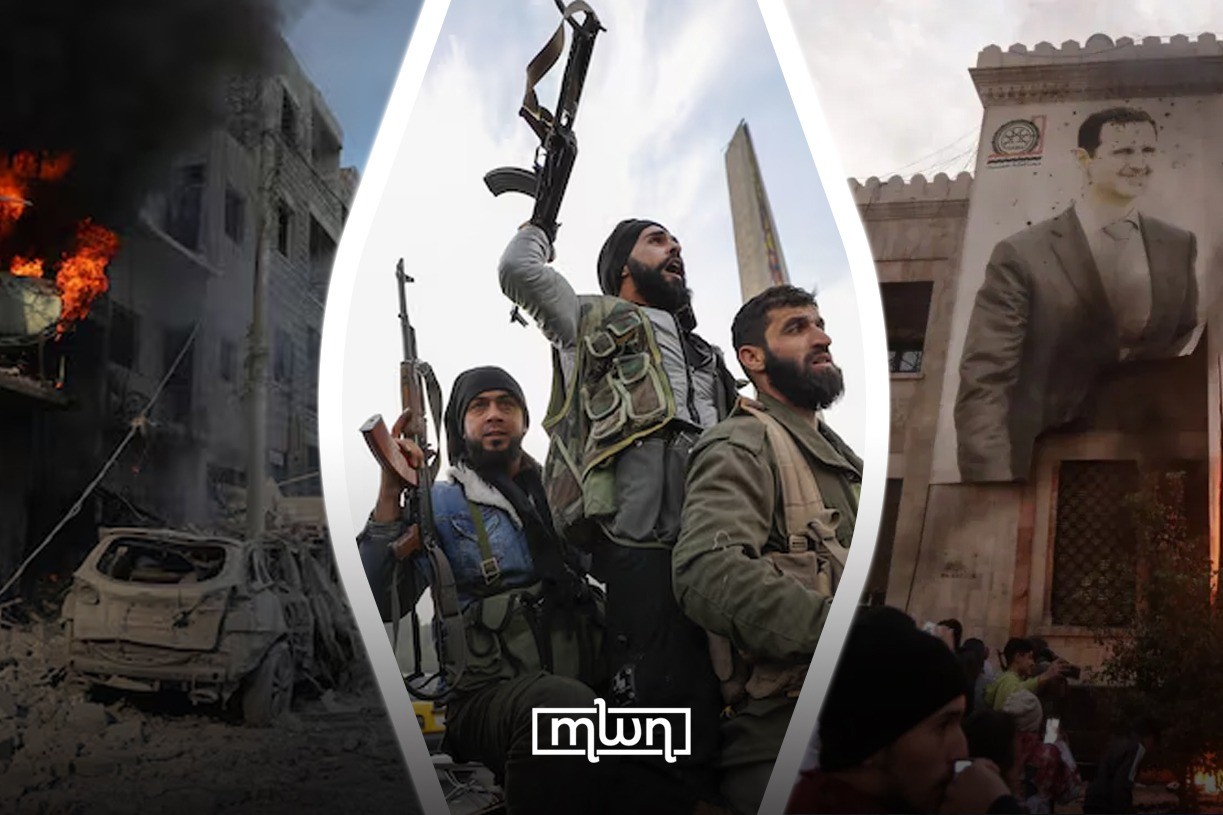
Indeed, for two weeks, Syria has been at the heart of the political and strategic search for deals. The Levant Liberation Organization, a former branch of al-Qaeda in Syria, ended up winning its bet and took over Aleppo, Hama, Homs, and Damascus, respectively. Initially, it was not clear whether the opposition forces were on their own or whether it was fostered by the classic intervention of regional interests.
On Sunday, December 8, the regime of Bashar al-Assad was blown away by the wind. The Syrian president was abandoned by everyone. He found a safe haven in Russia for a humanitarian reason, the Kremlin stated later in the evening. A fall that will have consequences on the strategic chessboard in the Middle East.
The idea put forward argues that the political and diplomatic status quo in sub-regions with endemic conflicts and uncontrolled intra-national oppositions would be shaken and that some fragile state actors would pay the highest price for not being able to read signals sent (See Hassan Hami, Le système international in transition: de la prolifération des acteurs au désordre programmé, Rabat, 2018). These are signals stemming from reading epistolary political crises since the break-up of the USSR, the attacks of September 11, 2001, that hit the United States, and the international financial crisis of 2008.
In the Arab periphery, things were even more salient following the outbreak of the “Arab Spring” in 2011 and the bitter failure of its initiators and those who embarked on it later on.
Read also: International Community Pledges Support for Syria’s Political Transition
What’s new, then? Two general explanations might help understand what’s played on the stage. First, there is the confirmation of our argument that certain regimes in the Arab and Islamic periphery are henceforth out of service. The international system in the process of being reshuffled would no longer need strategic intermittents who slumber politically, suffocate economically, and drown culturally and socially. Some regimes are agitating to regain their new virginity, but most are strangling themselves in the strings they want to put around the necks of their opponents, state and non-state actors.
Second, the color launch for the redesign of regional alliances has intensified in the aftermath of the COVID-19 pandemic. Alliances are no longer obvious, and politico-diplomatic deals are no longer a secret to anyone. Everything seems to be predictable except for the hotheads—those who combine strabismus and daltonism in matters pertaining to geopolitics.
Some might argue that all that is said ranges in the box of general explanations that bring nothing new to the overall analysis. This observation is judicious, so much so that I will sustain it by an even more substantive reading. This reading alternates between what is obvious and what is latent in what relates to prospective geopolitics.
In the register of evidence, we can mention a certain number of facts. First, the panic of some political actors and strategists in the Middle East and North Africa after the election of President Donald Trump as head of the United States. Everyone fears the comeback of such a personality who does not make a fuss. His program for the Middle East and the Near East is well known. It would be in line with what he was willing to achieve between 2018 and 2020, during his first term.
Blindly trusted, carried away by the wind
Second, the U.S. with Donald Trump will accelerate the process of settling (or monitoring) regional conflicts to focus on strategic battles on the systemic levels. This includes the revival of the global economy and the encirclement of rising forces that want to make common cause with China and Russia to outwit the Americans.
Third, the propensity to keep crises under control without the intention of resolving them definitively. The objective is to keep monitoring the political, diplomatic, and strategic chessboards using a technique of returning elevators so as to capitalize on the relative lull and stability witnessed in certain regional conflicts.
What about geopolitical foresight? I will lay down my argument in what I assume was a series of diversions.
The first diversion is rooted in four observations: One: Steps taken for resolving the conflict between Russia and Ukraine. There’s a common understanding that this option will be a priority in US foreign policy under the Trump administration.
Two: the reactivation of conflicts in Syria (and later in Iraq, Yemen, Sudan, and Libya) would be part of a diplomatic strategy aimed at restructuring and prioritizing conflicts. The Middle East and the Middle East are regaining importance, but the conflicts raging there must be integrated into the framework of future battles over the geopolitics of hydrocarbons and the race for control of the most vital passages and seaports for world trade.
Three: the commitment to a process that would force the various proxy movements to claim publicly their alliance, allegiance, and survival instinct. The various reactions recorded in Lebanon, Iraq, and Yemen on the situation in Syria are parts of this claim. By combining declarations of open and direct support and unusual hesitations, these movements are tangled up in political and strategic brushes.
Four: the obligation imposed on strategic state intermittent workers to uncover themselves in turn. Some are doing so in a hurry, as is the case with Algeria, which is in a race against time not to be on the list of targeted countries in the near future. She plays the scarecrow and scares herself at the same time.
Over the last months, Algerian decision-makers have proven to be quick to support phantom separatist movements in North Africa and the Sahel-Saharan area. They have reached out to so-called Amazigh movements in the Rif (Morocco) and in Libya. They support Azawad movements in northern Mali. By the same token, they are trying to set an existential trap for Mauritania to join the circus of a new Maghreb of axes.
Read also: Syrian Rebels Declare End of Bashar al-Assad’s Rule, Claim Liberation of Syria
Algerian decision-makers are rubbing their hands together after having momentarily forced Tunisia’s president to side with them. They cannot fool independent observers who share the view that their objective is to close their eyes to the obvious, which is the claim for independence of the people in the Kabylie in the north and the Touareg in the south of Algeria.
The second diversion can also be read in four observations. One: the situation in Syria is drowned in the issue of Israeli hostages in Gaza. Some people equate the Lebanese crisis with the Syrian crisis to establish a hierarchy of priorities and solutions. A package strategy, so to speak. Yes, Israel can exercise some restraint, provided that any solution to the Syrian crisis requires two conditions.
On the one hand, that the maintenance of Bashar al-Assad (under one status or another) be accompanied by the abandonment of any further claim to the occupation of the Golan by Israel. On the other hand, that support for Syrian factions that want to change the regime in Syria does not cause them to fall into the hands of substitute actors other than Turkey or Iran.
On both claims, Israel is winning as Bashar el-Assad is gone, and it has started to extend its military presence beyond the line of truce in the Golan Heights. Furthermore, it would be every pretext to weaken the new forces in Syria and make sure they wouldn’t resume their hostility against Israel in the same way Hezbullah, Hamas, or other radical movements had been doing over the last decade.
Two: the new US administration, which will officially take office on 20 January 2025, is already making its mark. An envoy of the US president-elect met last week with Israeli officials and Arab mediators. The message was clear: whatever arrangement the outgoing administration reaches in the six weeks left in office would be called into question if the priorities outlined by Donald Trump were not taken into consideration.
Three: preparing the ground for future bargaining with regional players who are pulling the strings of confusion (Turkey, Iran, the United Arab Emirates, Saudi Arabia, Qatar, and Egypt). These actors must stick to the script or risk paying the price for a misreading of the new geopolitics in the Middle East.
Four: the far-fetched negotiations and agreements between the PLO and Hamas for the co-management of Gaza after the potential (and currently unlikely) withdrawal of the Israeli army. Such developments would not bode well for the peace process between Israel and the Palestinian Authority. The Palestinians are already starting from a position of weakness. And one can’t rule out that Hamas’ sponsors, even if the movement is weakened, will accept losing everything in the process.
Now, Syria itself is a party to the stakes and a scapegoat. Caught in the vise of a false reading of the changes that took place in the aftermath of October 7, 2023, the Syrian regime nurtured no illusions about its future. If for the past four years, the question of President Bashar al-Assad’s continuation had been a requirement, everything fell in a matter of seconds.
Several indicators attest to this, which can be broken down as follows. First, the regime of Bashar al-Assad asked for urgent military support from Iran. Tehran procrastinated. And what could she have reaped from it? Tehran subtly played the card of express demand. She did not do so in 2012 when she sent advisers belonging to the Iranian Revolutionary Guards to train the Syrian army and fighters recruited in Afghanistan, Iraq, Pakistan, etc.
Secondly, the Houthis of Yemen and the Iraqi Hashd al-Shaabi, who declared themselves ready to intervene, waited first for Tehran’s approval. This didn’t happen. Indeed, for the time being, Tehran is going through a delicate situation. Concerns with respect to the political transition at the top of the state take precedence over all other considerations. As for Hezbullah, he is only a shadow of his former self, and he is stuck in his dilemma of compromising or disappearing.
Reshaping a strategic field free of the hotheads
Thirdly, one thing is certain: solidarity among proxy movements is now, if not impossible, at least difficult, and these movements must have the approval of their sponsors and mentors, which is far from being achieved in the short term.
Fourth, the world upside down: Everyone wanted to keep Bashar al-Assad in place, and everyone wanted to get rid of him. While the return of opposition movements came as a relative surprise to most observers, it was nonetheless a determining factor in the reshaping of the geopolitical field dedicated to non-state actors at the mercy of major regional players in the Middle East.
Fifth, the hand and role of foreign advisers (former senior decision-makers in their countries) in impacting new issues is undeniable. However, if political and diplomatic bargaining is part of the rules of the game in geopolitics, the ideas that these advisors are used to defending no longer seem to carry the weight.
Sixthly, this is the case with the idea of creating zones of influence in three separate areas in Syria without going so far as to divide the country. The ethnic and religious dimension would be taken into account, provided it wouldn’t end up igniting future epistolary conflicts.
Seventh, the recuperation of political movements that were rejected or enthroned on the eve and in the aftermath of the Arab Spring. This applies to the case of radical political Islam, smoked out to play the scarecrow against moderate political Islam.
Eighth, it follows from the previous idea that a new approach is worked out that aims to fish out those among the competing state actors to relaunch them into targeted diplomatic mediation roles (i.e., the United Arab Emirates, Qatar, Egypt, Turkey, and Kuwait). Yet, what is called moderate Islam’s proponents must be careful; nothing is clear-cut, and nothing prevents old-new radical-moderate Islamism’s trends from multiplying intra-national undermining actions to force these actors to keep up if not to force them to compromise, giving the new changes on the political and strategic chessboard.
Can we therefore speak of a new Arab order or a reshaping of regional security complexes, including that of the Middle East and the Maghreb? It is risky to venture down this path, but this does not exclude putting them in line with the global change that the structure of the international system is experiencing.
However, there are nuances to consider. The first nuance consists in the fact that the Arab order does not necessarily mean Arab security. Rather, it means arrangements that are based on keeping the situation under control to prevent the risk of imminent external aggression.
A second nuance stems from the belief shared by certain Arab actors in the Gulf who are in epistolary conflicts that they cannot neutralize each other indefinitely. The 2013 and 2017 despising games are a distant memory.
A third nuance stems from the persistence of an impasse with respect to claims for unity in the Maghreb region. The security complex that could have sustained, even laboriously, the institutions set up by the Arab Maghreb Union in 1989 has broken down because of the tension of roles between Algeria and Morocco.
The fourth nuance describes a kind of squint in the perception of security, insofar as, curiously, the actors co-opted to animate the new Arab order in progress find in the Maghreb region a secondary field of confrontation.
The rotary of change-oriented set in motion
The fifth nuance confirms the fact that the hierarchy of actors in the Maghreb has changed and the most influential actors can no longer accommodate pressure from elsewhere, and even less so from the Middle East.
The sixth nuance is that the strategic springboard between Russia and Turkey to reduce Iran’s influence is doomed to fail. Indeed, the overall stability will currently depend on the outcome of the political transition in that country. Stability will also depend on its ability to maintain the alliances it has created in the region through its armed wings in neighboring countries.
What’s more to add? Ironically, all countries that have opted for an anti-monarchical republican system of government with an inordinate propensity to change regimes in neighboring countries are now under the double threat of regime change at home and the loss of significant portions of their territories.
Indeed, Syria and its protectorate over Lebanon for three decades have served for nothing. Iraq remains under the threat of virtual and real fragmentation. Libya is a candidate to serve as the first laboratory in North Africa for an overall upside down. Algeria would not be immune either.
The Syrian crisis has been the subject of dichotomous readings that have been inspired by ideological strong beliefs and opportunistic tendencies with a view to occupying the media chessboard without the risk of seeing its analytical mirror withered away. Theoretically, these readings don’t lack k in relevance.
One: Syria is doomed to a radical upheaval because three of its main supporters have been forced to leave the stage: on the one hand, Hezbollah’s militias have been redeployed to southern Lebanon to stop the Israeli army’s offensive, and on the other, Iranian and Russian military advisers have been withdrawn, leaving the Syrian army at the mercy of its opponents.
Two: complicity between Turkey and Russia is established. The reason for this would be that Russia gets gains in Ukraine and Turkey kills the Kurdish threat for good. I would add that Russia wants to get rid of the financial burden imposed by indefinitely supporting Syria. Russia did the same thing with regard to Nagorno-Karabakh, which was almost totally recovered by Azerbaijan in 2022-2024. Unconditional support for Armenia was unbearable for Russia since 2014.
Three: Israel is said to have supported certain warring factions in order to exert pressure on Iran and force it to withdraw permanently from Syria and Lebanon.
What can we say in the end? There is only one conclusion: state actors in the Middle East and North Africa who have been operating for five decades by feeding on confusion and supporting dissident movements while playing the role of strategic belts must wake up.
They would be concerned by the next wave of refocusing of regional security complexes. Some are even threatened with geographical fragmentation imposed by the requirements of renewed geopolitics.
Moreover, Middle Eastern actors who believe themselves to be indispensable in the future security and strategic equations will lose nothing by waiting for the day when they become disillusioned, like those who preceded them and bite the dust in the end.
Commenting on one of my last articles on the Middle East, a few friends assumed that the only winner in what is happening on the security and strategic chessboard (they call it general chaos) would be Israel. I am not sure this would be true, given the fact that in geopolitics, intermittence and strategic priorities could change overnight.
By the same token, arrangements reached, mainly between Russia, Turkey, and Iran, could collapse unless two issues were kept under control: the Kurdish issue and the North Caucasus issue with respect to perception of geopolitics rooted in culture and religion.