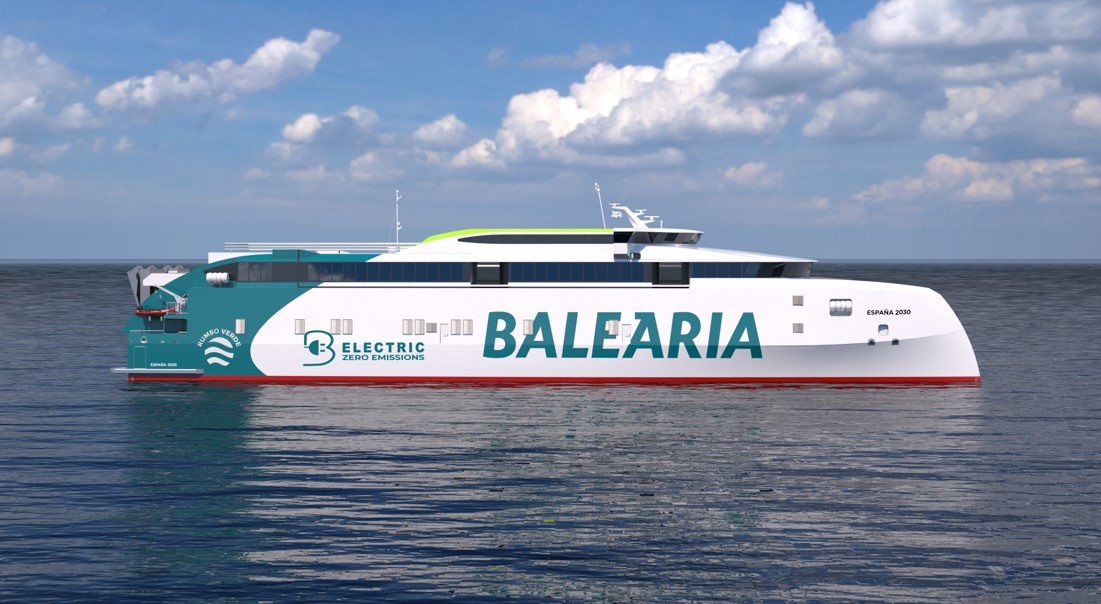
Doha – Spanish ferry operator Baleària has unveiled plans to establish the first green maritime corridor between Morocco and Spain, introducing two fully electric fast ferries to operate between Tangier Ville and Tarifa.
The groundbreaking project, set to launch in 2027, marks a significant advancement in sustainable maritime transport between the two continents.
The initiative follows Baleària’s successful bid for a 15-year contract awarded by the Algeciras Bay Port Authority (APBA) last December to manage the Tarifa-Tangier Ville route.
The APBA’s decision prioritized technical and environmental criteria in establishing this first intercontinental green line.
“This is a pioneering and technologically advanced public-private project that will enable us, for the first time ever, to run the entire route using only electric energy and, therefore, zero emissions,” said Adolfo Utor, Baleària’s President and Owner.
Technical specifications and infrastructure
The twin catamarans will be constructed at the Armon shipyard in Gijón, Spain. The vessels will be equipped with 16 MW of electric power from four electric propulsion units and will feature an 11,500 kWh battery capacity.
Each catamaran will measure 25 meters in beam width and accommodate 804 passengers along with 225 cars, capable of reaching a maximum speed of 26 knots.
For emergency situations, the vessels will be equipped with four diesel backup generators providing a total capacity of 11,200 kW.
The maritime infrastructure will undergo significant upgrades to support these electric vessels.
Both Tarifa and Tangier ports will be fitted with 8 MWh gross batteries and specialized charging systems.
The ports will feature shore power supplies, with Tarifa offering 5 MW and Tangier providing 8 MW capacity.
Each port will install two autonomous robotic arms that will connect to the ships through an Onshore Power System (OPS), enabling a complete battery recharge within 40 minutes during the standard one-hour port stops.
Economic and environmental impact
The project represents a major investment in sustainable maritime transport, with the Port Authority’s electrification projects in Tarifa and Algeciras requiring €62 million alone.
José Antonio Santano, Spanish Secretary of State for Transport and Sustainable Mobility, emphasized that “the decarbonization of transport is one of the Ministry’s priorities.”
The route’s economic significance is highlighted by growing passenger numbers, with the Strait crossing operation recording 3,442,770 passengers in 2024, marking a 6.9% increase from the year before.
Projections indicate the route could handle up to four million passengers in the future.
The new vessels will be named “España 2030” and “Marruecos 2030,” reflecting their connection to both the 2030 Agenda and the upcoming 2030 World Cup, which will be hosted jointly by Spain, Morocco, and Portugal.
This naming choice emphasizes the growing cooperation between the two countries.
“This is our southern border. Everything that benefits Morocco benefits Spain,” Utor stated, highlighting the importance of strengthening economic ties between the two countries.
He noted that the maritime connection would complement existing industrial developments, including automotive manufacturing operations by Renault and PSA in Tangier’s free zone.
The project represents a significant step forward in maritime transport decarbonization, meeting 2050 environmental objectives well ahead of schedule while maintaining efficient service on one of the busiest maritime routes between Europe and Africa.
The route, covering 18 nautical miles (approximately 28 kilometers) between the two ports, will serve as a vital link in one of the busiest maritime corridors between Europe and Africa, combining efficiency with environmental sustainability.
Read also: Maersk Shifts Major Shipping Route from Algeciras to Tanger Med