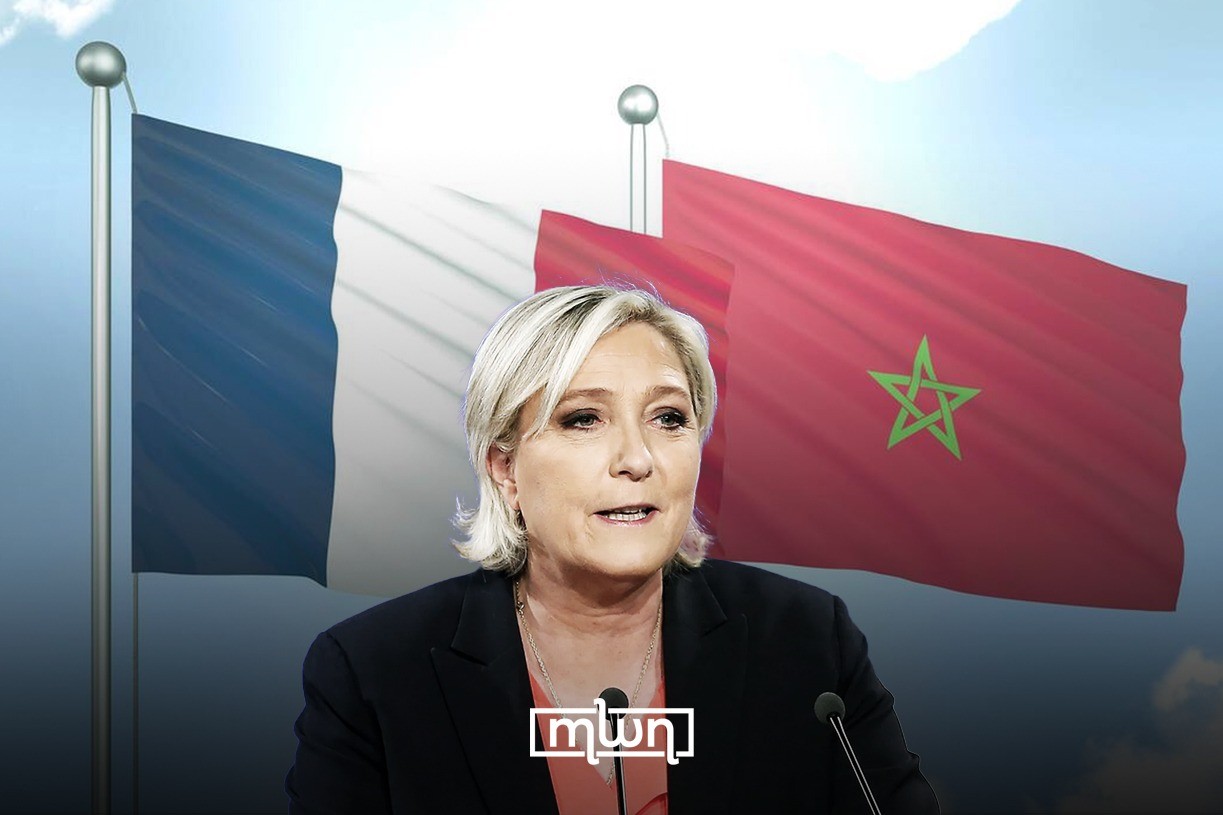
Doha – The far-right Rassemblement National (RN) party has secured the presidency of the France-Morocco parliamentary friendship group at the French National Assembly, following a contentious selection process that concluded on Monday, January 13.
The decision came following weeks of negotiations in which the parliamentary groups failed to reach a consensus.
A rotating selection method was ultimately adopted, allowing the largest groups to choose first from disputed presidencies.
As the largest group among those vying for the position, RN was immediately selected for the France-Morocco group’s presidency.
RN’s leadership view Morocco as a priority, describing it as a “major country for diplomacy and economic development” and an “important actor in the fight against immigration.”
The party also recognized Morocco’s “strong diaspora” presence, considering the appointment a “strong signal” for bilateral relations.
The selection process extended beyond the Morocco group, with RN also securing presidencies of the France-Italy and France-United Kingdom friendship groups.
The groups for the United States, Israel, and Spain were assigned to the Macronist Ensemble pour la République (EPR), while La France Insoumise (LFI) obtained the presidencies for Senegal, Lebanon, and Mexico groups.
Green Party deputy Sabrina Sebaihi criticized the selection method, stating it “advantaged the largest groups, the first to pass through the rotation.”
She described the outcome as “very unbalanced” and blamed the “central bloc” for the situation.
‘I will not sit in a group presided by the far-right’
Deputy Karim Ben Cheikh, who represents the 9th constituency of French citizens abroad and has worked since 2022 to strengthen bilateral relations, expressed strong opposition to RN’s appointment.
In a public statement, he declared, “By principle, due to the xenophobic ideas defended by this party that I have always fought against, out of respect for Moroccans in France and their families, I do not intend to sit in a group presided by the far-right.”
Ben Cheikh reiterated his commitment to continue working for French-Moroccan relations despite his withdrawal from the group, stating, “I will continue to carry the voice of French citizens established in Morocco and maintain the deep ties that connect me to this country, which remains dear to my heart and my mandate.”
RN’s relationship with Morocco
The RN’s connection to Morocco traces back to Jean-Marie Le Pen, who died last week, and his leadership of the party’s predecessor, the Front National.
In contrast to his pronounced hostility toward Algeria, Le Pen demonstrated a markedly different approach to Morocco.
The distinction was evident in his consistent support for Moroccan sovereignty over the Western Sahara, making him one of the first French politicians to openly back Rabat’s position against the separatist Polisario Front supported by Algiers.
A pivotal moment came on December 9, 1990, when Le Pen met with King Hassan II at the royal palace in Rabat.
The meeting followed a week-long tour of Morocco in an aircraft provided by the sovereign.
During the hour-long audience, both men discovered shared intellectual interests, including French classics and music.
The meeting gained additional significance as it occurred shortly after Hassan II’s statements on Antenne 2 about the impossibility of Moroccan integration in France – remarks that Le Pen had publicly praised as a “great manifestation of patriotism.”
Le Pen’s support for Morocco extended beyond diplomatic niceties. When the country faced criticism over alleged human rights violations, particularly following the publication of Gilles Perrault’s book “Notre ami le roi” in 1990, Le Pen stood firmly with Rabat.
He condemned what he termed in a telegram to Morocco’s ambassador in Paris as “an obsessive press campaign… encouraged at the highest level of French politics.”
This pro-Morocco stance sharply diverged from Le Pen’s position on Algeria, which was shaped by his experience as a paratrooper during the Algerian War in 1956.
His antipathy toward independent Algeria remained constant, even leading him to call in 1974 for France to “recover the Sahara and all its riches, which are French” during the first oil crisis.
The party’s Morocco-friendly position has continued under his daughter Marine Le Pen’s leadership, particularly regarding the Western Sahara issue.
In July 2024, following France’s recognition of Moroccan sovereignty over the territory, she said on social media: “The French government has waited too long to recognize Morocco’s constant commitment over decades to stabilizing and securing Western Sahara, an integral part of the Sherifian kingdom.”
She added, “We must support all pragmatic initiatives by Moroccan authorities that will help consolidate the pacification of this territory, guaranteeing its development.”
From Jean-Marie Le Pen’s 1990 palace meeting to the party’s recent acquisition of the parliamentary friendship group presidency, RN has maintained consistent support for Moroccan positions, particularly regarding Western Sahara.
This decades-long alignment, however, remains a source of heated debate within French political circles.
Read also: MP Calls on French Assembly to Dissolve ‘Western Sahara Study Group’