Join on WhatsApp
 Join on Telegram
Doha – Palestinian President Mahmoud Abbas announced Friday that the Palestinian Authority (PA) is fully prepared to assume “complete responsibility” in Gaza, as Israel’s cabinet approved a ceasefire agreement with Hamas set to begin Sunday morning.
“The Palestinian government, under president Abbas’ directives, has completed all preparations to assume full responsibility in Gaza,” the presidency statement said, emphasizing that Gaza is “an integral part of Palestine.”
The question of post-war governance remains contentious. Hamas has controlled Gaza since 2007, when it took power following a brief civil war with Abbas’s Fatah movement.
The PA, which currently administers parts of the occupied West Bank, was effectively pushed out of Gaza during that conflict.
Israel subsequently declared Gaza a “hostile” territory and imposed a land, sea, and air blockade.
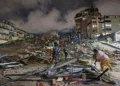
According to the PA’s comprehensive plan, the government will manage the return of displaced Palestinians, provide essential services, oversee border crossings, and lead reconstruction efforts in the war-devastated territory.
Palestinian Prime Minister Mohammad Mustafa revealed a “hundred-day plan” that could be implemented as soon as the ceasefire takes effect.
Israel’s Prime Minister Benjamin Netanyahu has so far rejected both Hamas and PA involvement in Gaza’s future governance, while Hamas sources told AFP they would be willing to hand over the Strip’s civilian affairs to a Palestinian entity.
The United States and several Arab nations favor PA administration, though supporters acknowledge the need for reforms within the authority.
The ceasefire, scheduled to begin Sunday at 8:30 a.m. local time according to Qatar’s foreign ministry spokesperson, was approved by Israel’s cabinet in a 24-8 vote after seven hours of deliberation.
The deal includes three phases, with the first six-week period involving the release of 33 Israeli captives and 735 Palestinian prisoners.
However, Israeli Occupation Forces (IOF) have intensified attacks in the days following the announcement. Gaza’s Civil Defense reported that Israeli strikes have killed more than 120 Palestinians, including 30 children, since the ceasefire deal was announced Wednesday.
The Palestinian Ministry of Health in Gaza stated that Israeli forces have killed more than 46,000 Palestinians and injured over 110,000 during the 15-month assault on the enclave.
Analysts speaking to Al Jazeera warned that the ceasefire might be short-lived. “Israel is very good at breaking ceasefires and making it appear that it wasn’t its fault,” said Mairav Zonszein, an expert at the International Crisis Group.
The deal’s division into three phases creates opportunities for violations, particularly from Israel, which has previously rejected similar agreements.
Diana Buttu, a Palestinian legal scholar, expressed concern about the agreement’s vague terms, particularly regarding Israel’s withdrawal. “The agreement is very vague, and there are a lot of places where Israel can – and will – manoeuvre its way out of it,” she told Al Jazeera.
The ceasefire agreement includes provisions to increase humanitarian aid to 600 trucks daily, a significant rise from the 614 truckloads that entered Gaza in the first two weeks of January.
However, the United Nations warned Thursday that this increase would be “only a start” in addressing Gaza’s humanitarian crisis.
Abbas reiterated his call for “an immediate ceasefire and full Israeli withdrawal from Gaza,” emphasizing that the State of Palestine maintains legal and political jurisdiction over the Strip as part of the occupied Palestinian territory.
He rejected any division of Gaza or forced displacement of Palestinians from their homeland.
Read also: A Three-Phase Deal Explained: What You Need to Know About Israel-Hamas Ceasefire