
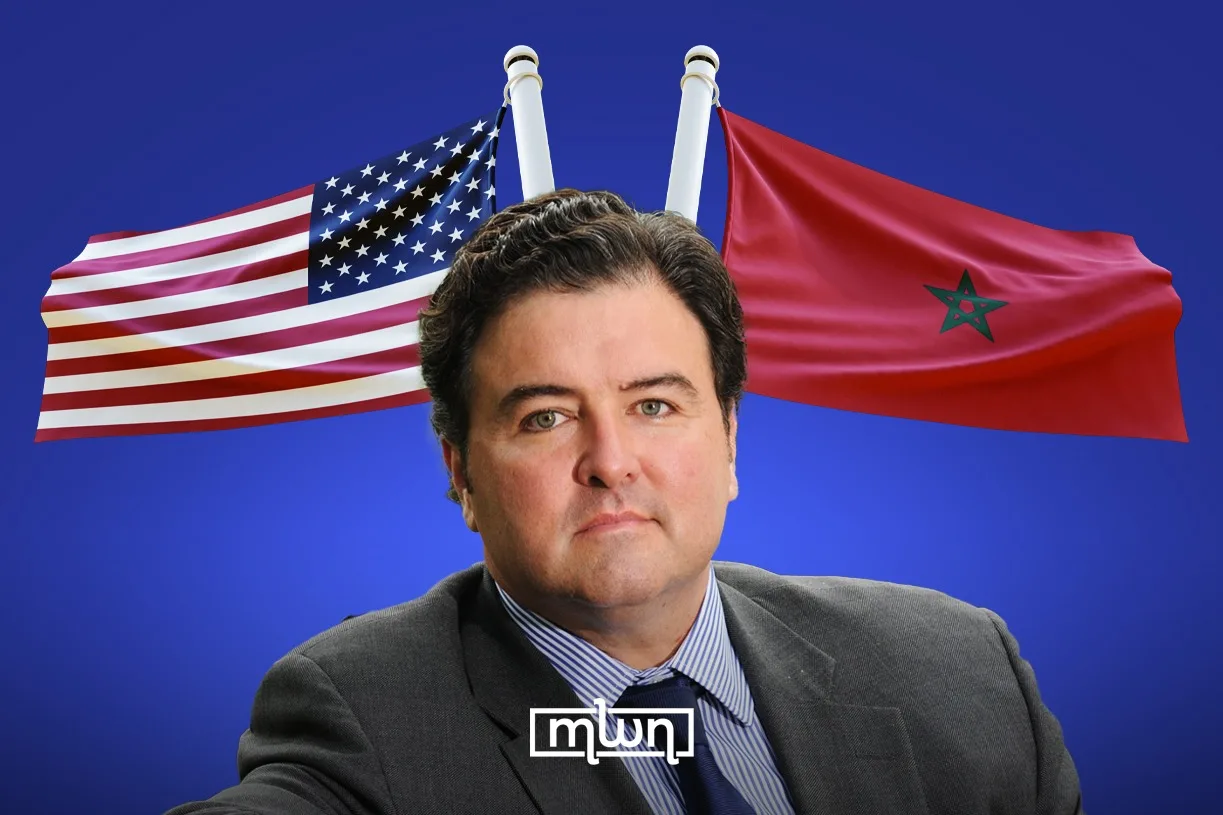
Rabat – US President Donald Trump announced last night the appointment of Richard Duke Buchan III as the new US Ambassador to Morocco, saying he will “play a pivotal role as we strengthen Peace, Freedom, and Prosperity for both of our Countries.”
A rich and varied career
Born in 1963, Duke Buchan is known for his extensive work in both finance and diplomacy. He previously served as the US Ambassador to Spain and Andorra, and made significant contributions in boosting trade and cultural exchanges.
He studied economics and Spanish at the University of North Carolina at Chapel Hill and later earned an MBA from Harvard Business School.
After finishing his studies, Buchan built a successful career in global finance. He began his career at Merrill Lynch, where he gained expertise in global corporate finance and investment banking. He later worked at Maverick Capital, managing investments in banks and financial services.
In 2001, he founded Hunter Global Investors, which grew to manage billions of dollars. His financial background has provided him with a deep understanding of global markets and economic trends.
He later transitioned from finance to diplomacy and served as the US Ambassador to Spain and Andorra from 2017 to 2021. In that role, he focused on boosting trade, resolving tax issues, and promoting cultural exchanges between the US and European countries. His efforts also included strengthening bilateral relations and supporting democratic values.
After that he became the finance chair of the Republican National Committee, the primary committee of the Republican Party responsible for developing and promoting the republican brand.
What’s next in strong US-Morocco ties?
Now, as he takes on his new role in Morocco, Duke is expected to use his financial know-how and diplomatic experience to strengthen US-Morocco ties and build on the strong partnership already in place.
In December 2020, before leaving office, Trump’s administration officially recognized Morocco’s sovereignty over Western Sahara and reaffirmed its support for the country’s serious, credible, and realistic autonomy proposal as the only basis for a just and lasting solution to the dispute.
“Morocco recognized the United States in 1777. It is thus fitting that we recognize their sovereignty over the Western Sahara,” Trump said, referencing strong historical ties between the two countries.
King Mohammed VI described Trump’s recognition as a “historic decision” and a “milestone” in Morocco-US relations. He emphasized that Morocco would be “forever grateful” for this recognition.
The Biden administration did not reverse Trump’s decision but also did not actively implement it and instead maintained a middle ground.
After Trump’s re-election in late 2024, King Mohammed VI congratulated him and highlighted the importance of their bilateral relations. The monarch reaffirmed that Morocco remains a “true friend and faithful ally” of the US and expressed a desire to further strengthen cooperation.
With Trump returning to office, his administration is expected to further reaffirm its recognition of Morocco’s sovereignty over Western Sahara and potentially open a US consulate in the region and promote US investment in the southern provinces. This would further legitimize Morocco’s position, which has been enjoying international momentum in recent years.
Several countries worldwide have expressed support for the country’s territorial integrity and autonomy plan, with many opening diplomatic representations in Morocco’s southern regions.
The latest notable addition is France, which announced last year its official backing of Morocco’s autonomy plan as a legitimate and serious solution to the longstanding dispute.
“The present and future of Western Sahara fall within the framework of Moroccan sovereignty,” said French President Emmanuel Macron.
Trump’s first administration made the US the first major country to unambiguously embrace Morocco’s territorial integrity.
But the Biden years saw a slight dip in American commitment to upholding Moroccan sovereignty over the Sahara. With Trump back in the White House, it remains to be seen whether his second administration will implement all the provisions of the December 2020 deal with Morocco, including the opening of an American consulate in the disputed Moroccan region.