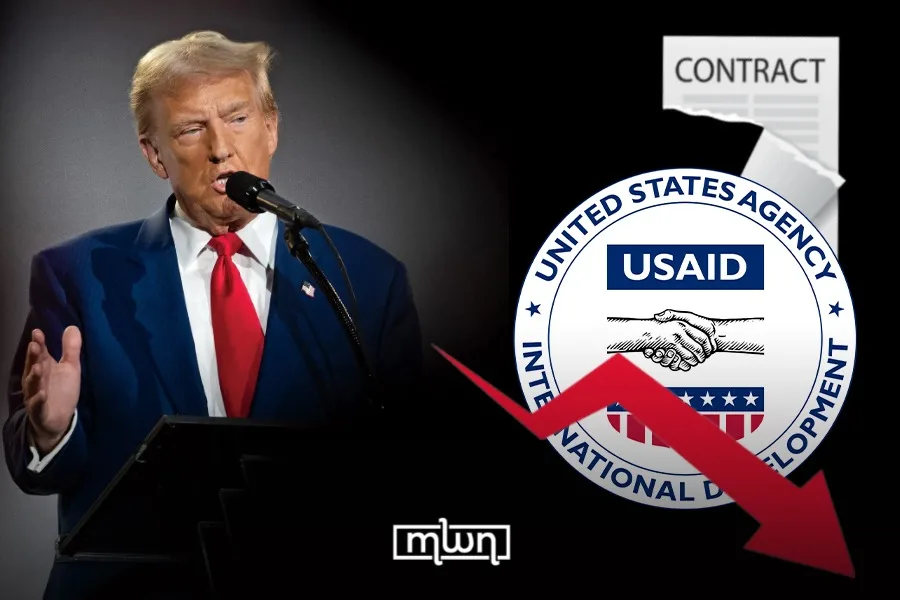
Rabat – The Trump administration is cutting over 90% of USAID’s foreign aid contracts and grants, halting global socio-economic and political development programs, including key human rights and economic initiatives in Morocco.
The elimination of these USAID contracts was announced on February 27 as a part of what President Trump called a cost-cutting initiative that seeks to scrap any “waste” in the federal budget and put “America first” in its foreign policy.
Recipients of federal foreign aid, such as health groups and nongovernmental organizations, have been awaiting this cut since Trump announced a 90-day freeze on federal funding when he took office January 20.
Now, these programs and organizations are grappling with the widespread fallout from the abrupt loss of funding, facing mass layoffs and the dismantling of life-saving initiatives that provide essential care – ranging from food and clean water access to sanitation improvements and HIV/AIDS prevention.
USAID employs over 10,000 people, two thirds of whom are overseas workers, with bases in over 60 countries, according to a Congressional Research Service report.
In 2023, the US government spent $71.9 billion on foreign aid, and most of these funds went to economic development and humanitarian assistance. The Middle East and North Africa (MENA) received the third-largest share, following Europe and Eurasia and sub-Saharan Africa.
That same year, the U.S. government allocated $10.5 billion to the MENA region, with Morocco receiving $45 million. The majority of this funding was allocated to peace and security, along with initiatives supporting democracy, human rights, and governance, with USAID serving as the largest contributor, providing $26.85 million for these efforts.
Nongovernmental organizations in Morocco
The US Department of State issued a stop-work order to the US-based primary organization that funds Mobilising for Rights Associates (MRA), a Rabat-based NGO advocating for women’s legal and human rights. This order suspended funds for one of MRA’s Violence Against Women projects, prompting the organization to pause its activities under that grant.
In an interview with Morocco World News (MWN), founding partner Stephanie Willman Bordat said that the details of the stop-work order were unclear and it has impacted their ability to continue work.
MRA’s research and projects, such as its Violence Against Women Project, seek to boost women’s rights in Morocco through bottom up approaches that support marginalized communities and encourage advocacy. Examples of its work include gender analysis reports for the US government and gender workshops in collaboration with youth-led and legal groups.
Most USAID and federal foreign aid projects are implemented through grants, agreements, or contracts, such as the award given to MRA’s primary organization, and carried out by various foreign and U.S. development partners, including nonprofits, contractors, universities, international organizations, and governments.
Willman Bordat told MWN that while MRA does not receive all of its funding from USAID, it has benefited from close collaboration with the agency.
“USAID, particularly here in Morocco, has been very focused on locally led development,” Willman Bordat said. “They have been very interested in trying to figure out how to make the development initiatives more inclusive…led by the communities we want to serve, and led by Moroccans.”
The impact on economic development
MRA is among several nongovernmental organizations in Morocco that received USAID funding to support humanitarian initiatives aimed at advancing human rights and economic development.
USAID also funds a locally led economic development program in Morocco, known as the Morocco Inclusive Socioeconomic Development in Beni Mellal-Khénifra (ISED-BMK) and Marrakech-Safi (ISED-MS), which focuses on supporting small businesses and boosting local economy.
ISED supports Moroccan small businesses, especially those led by marginalized groups, by promoting transparency, civic engagement, and education-private sector ties, helping them secure and repay loans through program resources.
ISED-BMK completed its work in the start of 2025 as a culmination of its five year implementation plan which began in 2020. ISED-MS began in 2022 and still has three more years to see out its mission which risks being cut short by the elimination of USAID funding.
Willman Bordat said that because economic development programs are designed to help marginalized groups experiencing economic difficulties, it is likely that the elimination of funding for such programs will leave recipients in debt.
“Poor, excluded folks who were going to participate in these activities had to make upfront investments,” Willman Bordat told MWN. “Many of them had to take out loans.”
On March 10, a US federal judge ruled that the government could not go through with any terminations or suspensions of contracts or grants issued before February 13, a decision that had previously been upheld by the US Supreme Court.
This ruling blocks the Trump administration from avoiding payments on work completed before February 13 but does not apply to future work or reinstate contracts canceled after February 13.
Without the funding necessary to continue business education and development programs, Willman Bordat said that many of these cooperatives and small business owners might be unable to repay their loans, causing more harm than good.
“These were people who were already poor, and now they risk having a bad credit history,” William Bordat said. “They invested to make their cooperative, to make their small business, and the US administration cancelled their support. And these are programs that were supposed to alleviate poverty. Instead this has created poverty. And this is not just Morocco, this is worldwide.”