There are some of those expressions that mark you all your life, for better or for worse. In Arlington, Virginia, USA, I had a neighbor whose favorite expression was “It sucks!” He used it to end a sentence regardless of the circumstances. There was another expression: “Madness”!” that I liked, with which I replied for the sake of teasing him. These expressions show to what extent words impact our daily lives.
Nevertheless, my other best expression I used the expression whenever I ran out of arguments, taken from Charles Dickens’s line in his 1854 novel Hard Times: “I want facts.” (…)” Now what I want is facts.” (…) “Facts alone are wanted in life. Plant nothing else and root out everything else.”
These expressions reflect a mental state in a situation where powerlessness is running the show. They attest that the means at one’s disposal are not worth a candle. So, the reaction is often hallucinatory, if not ridiculous.
We witnessed such a behavior a few weeks ago on the occasion of the exchange between US President Donald Trump and Ukrainian President Volodymyr Zelensky. Trump told his interlocutor that he no longer had a card enough strong to get him negotiate a fair solution in the conflict between Ukraine and Russia (H. Hami: L’Europe daltonienne et la phobie d’un Yalta 2, MEDIAS24, March 14, 2025).
Seasoned observers are used to seeing a sample of all these expressions in the behaviors of countries entangled in an exaggerated perception of their political, diplomatic, and strategic assets. One cannot single out Algeria in this respect. Why Algeria once again, some might be tempted to argue, to shut me down? Why am I making of it a fixation while Algeria’s behavior is predictable, readable, and easily translatable?
Walking Barefoot in the Quicksand
Columnists and experts have no better option to fairly assess the Algerian decision-makers’ perceptions of their country’s foreign policy. It would be fair to say that there’s nothing in the world that can satisfy desperate Algerian decision-makers: no tangible facts, no more cards to play, and above all, their mania for displaying a diplomatic behavior that leaves one speechless.
For the record, such a behavior made the late King Hassan II of Morocco say that one could not be fair with swindlers. We had a glaring example of this a few days ago, during a heated exchange within the Security Council between the ambassador permanent representative of Algeria, Amar Bendjama, and the deputy head of mission at the permanent representation of Morocco, Majda Moutchou.
Needless to elaborate on the ungrounded arguments of the Algerian diplomat pertaining to the issue of human rights and MINURSO. And even less on his country’s lamentable position on an issue that will certainly ruin it financially and overwhelm it psychologically. This may even s end up speeding up the fragmentation of the country that inherited large territories belonging to its neighbors thanks to France in 1962.
The scene that took place at the Security Council could not have been more hallucinatory. We witness a septuagenarian challenging a young lady feeling good, who gives him a lesson in diplomatic arguments. He did not know where to turn at the moment when he was practicing the language of Shakespeare in a poor manner.
Because, at the time when Ambassador Bendjama was crossing fire with the Moroccan diplomat, the ambassador representing Morocco at the United Nations, Omar Hilale, was in Rabat. Indeed, the personal representative of the United Nations Secretary-General, Staffan Di Mistura, was in the capital city of Morocco. The UN diplomat was reportedly inaugurating a tour of the region on the issue of the Moroccan Sahara in anticipation of the presentation of a follow-up report to the Security Council next week this April on the evolution of the issue.
This tour will be perhaps the last one, before giving up the apron, unable to convince Algeria to resume its place in the round tables as required by the Security Council since 2020. Algeria participated in Geneva talks in December 2018 and March 2019. Algeria wants the UNSC resume the debate on the issue of the referendum, which has already been dropped from the UNSC agenda since 2003. Algeria remains the only country in the world psychologically frozen on 1991, the date of the signing of the ceasefire agreement.
To make the picture a little more colorful, I will add choruses of three songs that I like and that reflect the Kafkaesque situation in which the Algerian decision-makers are stuck. They keep getting lost in the background of their ideological speculations.
First of all, Willie Nelson, an American icon of country music, who concedes in one of his favorite songs, “If it’s not something you get over, (…) it’s something you get through.” Then, Charles Aznavour swallows his pride and concedes in turn: “You have to know how to leave the table when love is served.” Finally, Julia Boutros, the Lebanese singer who stirs up crowds in her own way, takes her revenge against a fictional partner: تعلم هلا تخسر، تخسر،تخسر ربحت كثير، كثير /// ///خلي عينك تسهر – تعذب شو بصير.
There are signs that describe it all. One is entitled to ask questions about the arguments of some Moroccan columnists (including seasoned diplomats) who cried fire following the interview the Algerian ambassador to Washington, Sabri Boukadoum, gave to the Today Business newspaper last February.
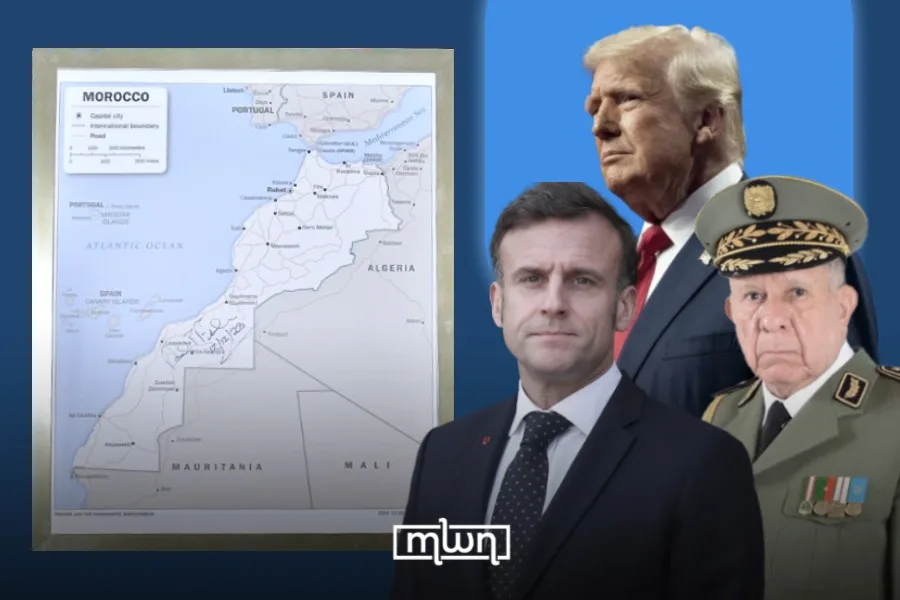
In this commissioned interview, the Algerian diplomat gave the impression that Algeria was willing to sell off all its wealth if the United States went back on its recognition of Moroccan sovereignty over its southern provinces. For the record, President Donald Trump announced this decision in December 2020. Since then it has been registered in the federal register and communicated to the United Nations.
Not only were the apprehensions exaggerated, but they lacked that touch of restraint. Indeed, the above-mentioned columnists have missed the point that strategic foreign policy decisions are shaped by self-respecting countries that have well-structured national security councils. The latter do not fish in troubled waters or change their positions overnight to bow to the capricious partners.
Of course, in politics, only interests matter, yet Algeria has little left to offer. Above all, it has proven to be unreliable in terms of compliance with its commitments, particularly when it comes to security, fight against terrorism, organized crime networks and respect of bilateral trade agreements.
The question remains: should we be alarmed by Algeria’s bellicose behavior and take it seriously when it reiterates its threats to plunge the Maghreb region into instability and insecurity? What importance should be given to the lengthy communiqués that the Ministry of Foreign Affairs makes public all week long? How should we read the meetings of the High Security Council (HCS), which has met tirelessly since 2019 to deal almost exclusively with relations with Morocco and take hostile decisions towards it?
On the Algerian Foreign Ministry’s communiqués, it’s worth noticing that Moroccan officials no longer pay attention to them as their style, tone, and assumptions have become insipid and irrational. As far as the meetings of the HCS are concerned, suffice it to say that it to take a look at its composition and the quality of the members who attend the meetings. Some participate in a meeting the day before, only to find themselves dismissed from their positions or put in jail the next day.
However, let us dig a little deeper to present convincing answers to make our arguments. These responses are at several levels.
YES-1, we have every reason to fear a headlong rush. Algerian decision-makers have lost their compass after losing all their cards. They are ready for anything, including military escalation. Officers who allegedly opposed the outbreak of a blitzkrieg against Morocco in 2020-2022 have been relieved of their duties or placed under house arrest.
YES-2, some influential circles within the Algerian decision-making system might be tempted to push for the remilitarization of the Polisario separatist movement, providing it with sophisticated weapons. They may make a decision regardless of President Tebboune’s commitment not to choose this option. All neutral observers know he has no control on the situation in his own country. Such a decision would undoubtedly be condemned by the major international players who are keen to keep the Maghreb space stable.
However, given the obstacles to world trade in several strategic maritime passages, these major players will never allow the Strait of Gibraltar to become a space of confrontation and chronic instability. This area is a crossroads where the multidimensional triangular dimension is at the center of trade between Europe, Africa, and the two Americas. Yet, some influential players within the Algerian decision-making system, who have no card at their disposal, could be tempted to wage a war for the sake of holding on to their power.
YES-3, the same influential players can use the weapon they wield par excellence, organized crime networks and extremist movements that feed on terrorism. They seem at ease of perpetuating disorder on the borders with Morocco, Libya, Tunisia, Mali, Niger, and Mauritania.
NO-1, Algerian decision-makers cannot dare declare war on Morocco unless they get the approval of their traditional sponsors – at least those who had been a little supportive until recently. The latter no longer seem to trust them.
NO-2, Algerian decision-makers cannot run the risk of giving more power and means to organized crime networks. The reason is that they fear some of them would be compromised with well-known drug traffickers who are likely to denounce them later if they feel they have no say in matters of common interests.
NO-3, the major international players have already decided that they can no longer rely on non-state armed groups in collusion with organized crime networks to indirectly maintain their hegemony in the region.
Then, would it be safer to leave the door open to the future normalization of relations between Morocco and Algeria? BIG question mark. History and the night bring advice, like they say. Let’s take it one step at a time. The story. ONE: Houari Boumediene is credited with having advised Algerians not to open the book of history in order to dispute any historical and political legitimacy with Moroccans. They have no chance to win a single battle in this respect.
TWO, Moroccan-born Algerians who have ruled Algeria since 1962 have a grudge against Morocco. They did everything to ensure that their country of origin suffered unjustified revenge.
THREE, the French who were born in Algeria and the French who were born in Morocco have, with a few exceptions, made common cause against Morocco. They did so in accordance with Charles de Gaulle’s decision not to allow the latter to recover its historical borders.
As a matter of fact, the time has come to deconstruct a narrative that has striven for sixty years to blame Morocco to discredit it on the international diplomatic chessboard.
First of all, the refrain about the 1963 sand wars between Morocco and Algeria. UN: Voices are starting to come out of their reserve. They confirm what Morocco had revealed a long time ago. Indeed, it was the Algerian-Moroccans (Oujda squad) who started this war to win their battle against the true fighters of the National Liberation Front (FLN) dwelling in Kabylia. The elements of the Oujda squad are said to have used in their attacks the first tanks that the same Morocco offered them at the time when they were preparing to build the first Algerian army.
TWO, it was France that forced Morocco to halt its advance in the Eastern Sahara while the Moroccan army was at the gates of Tindouf. France stuck to the provisions of the Evian Accords signed with Algeria, imposing conditional independence aesthetically called self-determination in the framework of cooperation.
The irony of getting nothing for being willing to get everything
Among the clauses of the Evian agreements would be the continuation of nuclear tests in Eastern Sahara and the commitment not to bow to the demands on the delineation of borders that neighboring countries were already formulating at the time. France feared that Morocco’s control of Eastern Sahara would encourage it to move forward with the expression of other territorial claims, including the recovery of Mauritania.
THREE: France and Spain once again joined their efforts as they had done on the occasion of the 1958 Ecouvillon operation against the Moroccan National Liberation Army in the wake of the Ifni war to push Mauritania, which had just gained its independence in 1960, to be a party to the claims to the so-called Spanish Sahara from 1963 onwards. The move was meant to weaken Morocco’s position on this issue.
Spain and France even worked to ensure that Mauritania was the only country to claim this territory by playing with time at a time when Morocco was going through a difficult domestic political situation. Mauritania, for its part, sought to exert pressure on Morocco to recognize its independence. Algeria was in the antechamber and was waiting for its turn to express its request for a part of the territory. It did so as early as 1966 in a note its Permanent Representation sent to the United Nations Secretary-General.
Then, the chapter on the decisions taken on the occasion of the various summits (1968, 1969, 1970, 1972, 1974) between Algeria, Morocco, and Mauritania. The commitments have never been respected by Algiers. Mauritania did so at the beginning and did not change its behavior until the end of 1974. Indeed, President Ould Daddah realized that the political movement created (in connivance with Algeria) to exert pressure on Spain and allow his country to be the only one to claim the Sahara as initiated in 1963 had no intention of attaching the Sahara to Mauritania.
The contradictory ambitions of the three Maghreb countries, to which those of Libya were later added, highlighted a truth that had taken a long time to be understood by Maghreb decision-makers.
The truth is that the three countries have been used, in well-balanced proportions, as guinea pigs by foreign powers who have played on the minds of some of them. The latter have been greedy for power. They also were in favor of maintaining the politico-diplomatic status quo while waiting for the right time to step in (H. Hami, Ambivalence salutaire: éssai sur la logique du conflit et de la coopération au Maghreb, 2003 and 2019).
This highlights a clear truth that is difficult to rule out, the one that has favored the politics of axes rooted in intra-national political ambitions and aspirations for laborious control of the regional strategic game. By being a secondary field of confrontation for intermediary state powers, the Maghreb sub-region has served first as a laboratory for maintaining the hegemony of the former colonial powers and second as a permanent test for the selection of proxy actors who can easily be manipulated because of their propensity to be permanently the nails of the show.
Finally, the close alliance between Algeria and France that has lured observers for five decades is about to crumble or at least to be put on hold. Furthermore, the underside of the cards is no longer so attractive to observers and experts in Maghreb affairs.
Indeed, it turns out that France and Algeria had signed a pact at the time so that France, which apparently left the region, would stay there undercover. The provisions of the Evian Accords and the Franco-Spanish understanding—with the complicity of other powers—have meant that Morocco’s legitimate claims to complete its territorial integrity are undermined.
Needless to go back over the vicissitudes of the secret agreements between Spain and Algeria, Spain and Mauritania, and France and Mauritania, which eventually favored two options. On the one hand, the maintenance of the Sahara under Spanish control in exchange for a staged autonomy. Spain held a hasty referendum on self-determination in 1966 while coordinating its efforts with Mauritania to isolate Morocco. On the other hand, the partition of the territory between Algeria, Mauritania, Morocco, and the Polisario (called Plan Sahara demain, SAD, in 1979) (H. Hami: Géopolitique assimilée pour les uns et saut dans l’inconnu pour les autres, MEDIAS24, 09/01/2025).
This latter option is rejected even before it is presented or put on the table. However, it is worth mentioning the ridiculous performance of Rachid Nekkaz last week in Marrakech. This Algerian opponent, according to his mood of the moment, who, in his usual buffoonery, came to play the role of a historian of the machine that goes back in time.
He, in accordance with the narrative of Algerian decision-makers, made a proposal that some Franco-Maghreb intellectuals (particularly Algerians and Tunisians) already suggested to solve the Saharan issue. They proposed a form of confederation of the territory that would allow Algeria to have access to the Atlantic. Nekkaz went even further.
According to this proposal, the Sahara should be co-administered by Morocco and Algeria for a period of ten years, followed by the organization of a referendum at the end of which the populations would choose to be Moroccan or Algerian.
Enough to tear your hair out and shoot yourself in the head. Nekkaz was pushed by Algerian decision-makers to take up snippets of the Baker II plan, which had fizzled out even before it was presented in 2003. He tried in a ridiculous way to be more creative to please the Algerian military institution, which remained traumatized by the two military defeats they recorded facing the Moroccan Army at Amgala in 1976.
The trauma has been worse and worse since the failure of the remote-controlled operation in El-Guerguerat in 2020 and the opening of new land and sea routes between Morocco and Mauritania and Senegal in 2024 and 2025.
I cannot but ask an ontological question: where is the Polisario in this insipid comedy? Since the jerky recognition of Morocco’s sovereignty over the Sahara by the United States, Spain, and France and the support of more than 108 countries for the Moroccan autonomy plan, Algeria has only been in the spotlight. She no longer defends her narrative on the lack of her interest in the territory. For her, the so-called Western Sahara is a question of national security with existential connotations.
Algerian decision-makers are aware that the institutional structures, even elementary ones that Polisario has established in the Tindouf camps, give thoughts to the separatist movement they envision to permanently stay in the territory. Such an eventuality could calm the ardor of some Moroccan bloggers who are mocking the Algerian military (and bloggers) by evoking from time to time the need to review the provisions of the Moroccan-Algerian border agreement signed in 1972.
Moroccan bloggers tease them, asking why they are not working on the return of Eastern Sahara to Morocco. The latter has a good reason to do so, thanks to the archives that France promised to return to Morocco on the occasion of President Emmanuel Macron’s state visit in October-November 2024.
The underside of the cards one might be tempted to ask! Algeria seems having no cards anymore. The following argument may help getting the idea crystal clear in this respect. UN: The advantage of oil and gas is no longer as tangible and renewable assets as it was in the past, to use an expression dear to Stanley Hoffmann. The country may even no longer be able to meet commitments it made with respect to gas supplying.
By the same token, competition in oil and gas markets has become fiercer, and therefore requesting more efforts from Algeria to adjust. With the projected solution to the crisis between Ukraine and Russia and the lifting of sanctions against Moscow, Russian gas will find its way to the international market, especially to Europe. Europe is certainly agitated to see this scenario happen, but it will eventually calm down.
TWO: The allies who derive their legitimacy from the ideology to which Algeria belonged are no longer so reliable. It turns out that yesterday’s allies have become a burden on each other. This happens when it comes to taking a position on issues vital to their national security.
THREE: The proxy movements on which Algeria and its allies relied are either definitively neutralized, or they lose their capacity for nuisance that sometimes allowed them to dictate the law and survive attempts aimed at terminating them.
FOUR: The bargaining power of Algeria’s allies, namely state actors, has lost much of its impact, especially on the intermediary powers with which Algeria shared vital interests. Some of them are threatened with the fallout from previous geopolitical choices that, over time, have proven wrong.
FIVE: The diaspora card that Algeria has used to exert pressure on countries with a large Algerian community, such as France, no longer seems to produce the desired impact. The Algerian diaspora risks paying for the choices the Algerian decision-makers made. The latter proved to lack inspiration yet, they persist to believe that nothing has changed in regional geopolitics.
SIX: The human rights card that Algeria is reviving with regard to the Moroccan Sahara is being played at the same time as South Africa is doing so with regard to the exploitation of the territory’s wealth. Besides, two days ago South Africa managed to get the South African Development Community (SADC) to sign a memorandum of understanding (MoU) with a phantom entity called SADR to implement the decision adopted by the SADC Summit in Pretoria in 2019. The aim is to keep the latter alive amidst the erosion of its importance in Africa since 2007 and mostly after Morocco resumed its membership in 2017.
The coordination between South Africa and Algeria to undermine Morocco’s territorial integrity is laughable, insofar as, since 2007, the two countries have reaped failure after failure within the Security Council, to which they have been more than other African countries as non-permanent members. South Africa has served in the UNSC three times (2007-2008, 2011-2012, and 2019-2020). Algeria has served four times (1968-1969, 1988-1989, 2004-2005, and 2024-2025).
Attempts to force the African Union to take up the Sahara issue again have been rejected twice. On the one hand, on the occasion of the Nouakchott summit (2018), which confirmed that the Sahara issue is exclusively dealt with by the United Nations Security Council. Thus, the Peace and Security Council of the African Union should no longer take up the issue.
On the other hand, the Accra Summit (2024) decided that only the United Nations member states are entitled to participate in summits between the African Union and its bilateral and multilateral international partners.
SEVEN, the use of European sorcerers’ apprentices to rehearse the same refrain on the issue of human rights has been observed recently on two levels. On the one hand, some left-wing parliamentarians have urged their respective government to step in and give hard time to Morocco. On the other hand, a few left Spanish activists have been dispatched to the southern provinces to challenge the Moroccan authorities.
EIGHT, both strategies didn’t work. However, Algeria has no cards left but to surf on a wave whose only strength is to run aground on beaches that cry desolation and the expiration of diplomatic time. This is verifiable both in relation to Algeria’s rivalry with Morocco on the issue of the southern provinces and on a good part of issues relating to regional and international security and stability. Nothing to do, the die is cast.
NINE, what if diplomacy was on truck in one form or another? That would be a chance to take. However, if this happens, the negotiations between Morocco and Algeria, for example, must then put everything on the table and clarify the ambiguities witnessed first on the eve of Algeria’s independence and second with respect to the game-over strategy implemented the day after the mission assigned to this country as a proxy on the geopolitical chessboard of North Africa and sub-Saharan Africa.
TEN, for now, we are witnessing a scene in which we have a dying proxy ogling a shroud whose blinding color makes him believe that his scheduled funeral is a new engagement reminiscent of the ephemeral glory of the ideological time when he played the role of scarecrow.
The proxy would have lost everything in the end. No doubt he would find in the chorus of Julia Boutros a source of meditation for a hard-to-foresee tomorrow. In fact, this would sound like a reminder to order on the morality of the sprinkler: تعلم هلا تخسر،تخسر – ربحت كثير، كثير ///خلي عينك تسهر -تعذب شو بصير.