Rabat – New reports have recently resurfaced, doubling down on evidence showing Algeria’s interference in the internal affairs of other countries, including Syria.
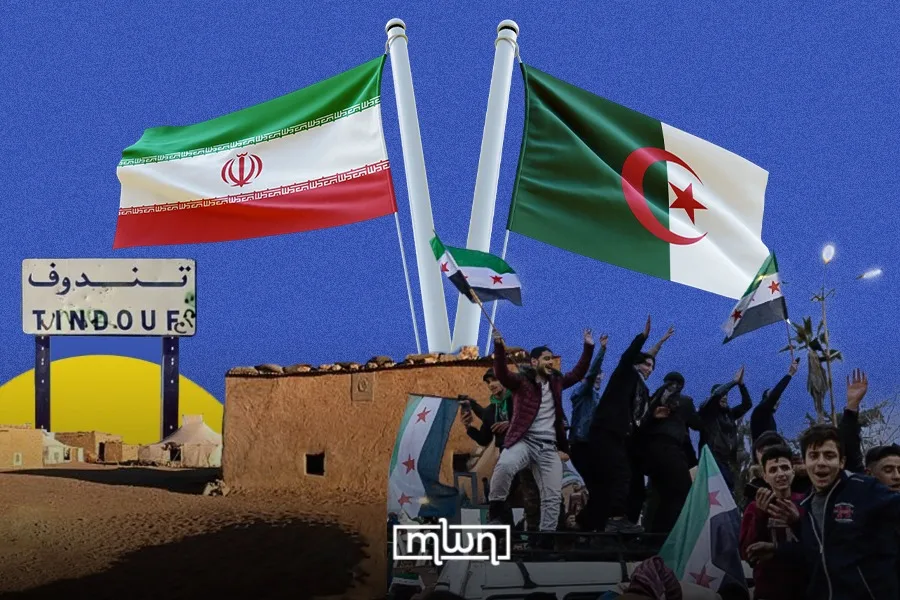
A new report from the Washington Post sheds light on the deeper collaboration between Algiers and Iran-backed Hezbollah, using the Polisario Front to undermine not only Morocco’s territorial integrity and sovereignty over its southern provinces but also meddle in Syria’s domestic affairs.
The Washington Post report quoted sources who confirmed that Hezbollah, an Iranian proxy, has trained Polisario Front separatists to advance its interests.
“Over the years, Iran has fostered a wide array of proxy groups to advance its interests,” the report said, quoting a regional official and a third European official who said Iran trained fighters from the “Algeria-based Polisario Front” that are now detained by Syria’s new security forces.
A brief background on how it started
In 2018, Morocco cut ties with Iran, sharing the same accusations that Tehran has armed and trained the Polisario separatists who undermine Morocco’s territorial integrity through independence claims in Western Sahara.
Morocco also said it presented well-evidenced data and an intelligence report that reveals details on the collusion between Algeria, Iran, and the Polisario Front.
Rabat also sounded the alarm about Algiers’ financing of the Polisario’s acquisition of Iranian military equipment
Polisario and Iran “have gone from training to equipping the Polisario with drones,” he continued, noting that they “are destabilizing our region after having done the same” in Yemen and Syria, Morocco’s permanent ambassador to the UN, Omar Hilale, said in 2022.
Algeria and Iran have both denied Morocco’s accusations, yet Rabat has insisted that it has provided ample evidence.
In 2018, Morocco’s Minister of Foreign Affairs Nasser Bourita said that Morocco provided detailed evidence of the Polisario-Hezbollah collusion.
“The file was carefully prepared, for weeks, on the basis of information collected and cross-checked over several months,” said Bourita, adding that the document summarizes “proven and precise facts: dates of visits by senior officers of Hezbollah in Algeria, dates and venues of meetings with Polisario officials, and a list of names of agents involved in these contacts.”
Well-documented interference
Further weakening Algeria’s arguments of denial, new reports have resurfaced, proving Polisario’s incursion in Syria in a new well-documented interference in the country’s territorial affairs backed by the Algerian regime.
In December last year, a document marked as “highly confidential” under Bashar Al Assad’s collapsed government revealed a secret alliance between the former Syrian regime and the separatist group.
The confidential document, which is reportedly an official correspondence from the Syrian government dating back to January 2012, shows that the Polisario sent militias to undergo military training with the Syrian Arab army.
The document also shows a series of communications between Algeria’s Ministry of Defense, Syria’s Ministry of Defense, and Polisario’s leadership, with fighters divided into four groups.
The document detailed that members of Polisario leadership traveled to Beirut in December 2011 for consultations with Hezbollah to coordinate military training missions in “special operations” in Syria.
These Polisario members were then arrested in Syria in December in Aleppo after being abandoned by the Al-Assad regime forces.
Former Iraqi deputy Omar Abdul Sattar first brought attention to the incident, stating that the militants were found in a camp in rural Aleppo after being transported there by Algeria with Iranian support.
“They were under the supervision of Iranian military advisor Borhashmi, who was killed, and were receiving military training before their planned return to Tindouf to use these experiences in operations against Moroccan territories,” he noted.
In a new revelation in January, converging reports showed how Algeria’s regime received a blow from the new Syrian resident, Ahmed al-Sharaa, who rejected the regime’s request to release Polisario militias who fought under Bashar al-Assad’s rule.
A Monte Carlo Doualiya (MCD) correspondent in Damascus reported that Algerian Foreign Minister Ahmed Attaf traveled to Syria recently to request the Polisario members’ release.
The Syrian president informed the Algerian regime that around 500 members from the Algerian army and the Polisario militias would be under trial along with the remaining Assad forces who were arrested.
Beyond Syria, Algeria’s regime also sparked frustration and backlash in the Sahel region for interfering in countries’ domestic affairs, including Mali.
The Malian government has long warned against Algeria’s interference and hostile acts from the Algerian regime.
The latest accusation came just a week ago, when Mali accused Algeria’s regime of shooting a surveillance drone in its territory. Algeria admitted to shooting down the drone, but claimed that it had crossed into their territory and subsequently closed its airspace with Mali.
Despite their attempted claims to explain the situation, the diplomatic damage was already done. Burkina Faso, in addition to Bamako and Niger, said they will recall their ambassadors from Algiers for consultations over the situation.
As the Algerian regime continues to become more and more isolated on the global stage which more counties affirming their support for Morocco’s Sahara position, these influxes of diplomatic blunders only exacerbate the situation and are not on the horizon to come to a halt.