
 Join on WhatsApp
 Join on Telegram
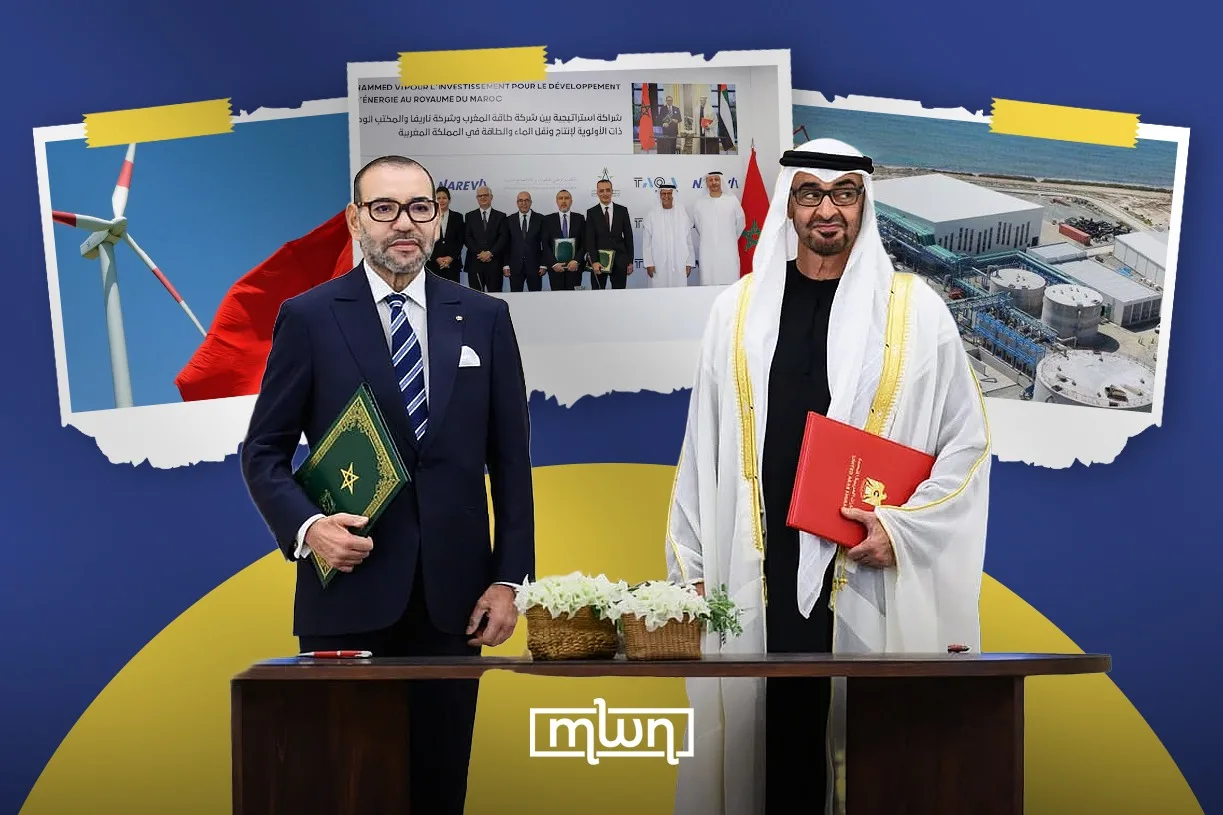
Doha – The largest private investment in Morocco’s modern history has just been inscribed in the country’s economic annals. Yesterday, the country sealed an extraordinary $14 billion accord with the United Arab Emirates – an injection of unprecedented scale that promises to permanently alter the country’s water and energy equation, while fundamentally reshaping its infrastructure landscape for generations to come.
The ceremonial ink still fresh, the agreement binds Morocco’s government and the National Office of Electricity and Drinking Water (ONEE) with a consortium of financial titans: the Mohammed VI Investment Fund, TAQA Morocco (the local subsidiary of Abu Dhabi’s energy colossus), and Nareva (the energy arm of the royal holding Al Mada).
At MAD 130 billion ($14 billion), this collaboration transcends mere commercial arrangement – it heralds a profound reengineering of critical national infrastructure by 2030.
Central to this ambitious blueprint stands a colossal 1,400-kilometer high-voltage transmission corridor stretching from Western Sahara to Casablanca, complemented by a network of sophisticated seawater desalination facilities.
These projects emerge as the culmination of meticulous diplomatic chess moves, coming just five months after King Mohammed VI’s private visit to Abu Dhabi and 18 months following his official state visit to the Emirati capital, where the groundwork for this Moroccan-Emirati renaissance was carefully laid.
Water security: A thirst for innovation
Desert kingdoms understand water’s value. The consortium’s hydric strategy unfolds with architectural precision: a vast network connecting the Sebou and Oum Rabia river basins, engineered to channel 800 million cubic meters annually across thirsty territories.
The first phase of water transfer between the Sebou and Bouregreg basins became operational in August 2023, successfully diverting approximately 350 million cubic meters to the Sidi Mohammed Ben Abdellah dam, critical for supplying drinking water to the Rabat region.
Four jewels in this water crown will rise across Morocco’s map. In Tanger, a 50-million-cubic-meter annual capacity station will quench the industrial thirst of this burgeoning port hub.
Nador’s installation, six times more ambitious at 300 million cubic meters, will transform the eastern region’s hydric calculus. The agricultural heartland of Souss will benefit from Tiznit’s 350-million-cubic-meter facility – the largest of the quartet. Completing this hydraulic network, either Tan-Tan or Guelmim will host a 100-million-cubic-meter operation to serve the arid southern frontier.
These cutting-edge desalination facilities, engineered to operate exclusively on renewable energy, will collectively produce 900 million cubic meters annually.
Notably, they will maintain competitive pricing at or below MAD 4.50 per cubic meter (excluding tax), aligning with national benchmark rates established for ongoing desalination initiatives – all without requiring public subsidies.
The electric heartbeat: Energy sovereignty reimagined
The consortium’s energy infrastructure vision is anchored by a groundbreaking high-voltage direct current (HVDC) transmission network spanning 1,400 kilometers between Morocco’s southern territories and its central economic hub.
This sophisticated “electricity highway” will connect Dakhla to Casablanca with a 3,000 megawatt capacity, dramatically strengthening energy distribution capabilities while catalyzing economic and industrial development throughout the corridor.
This transmission masterpiece will be fed by 1,200 megawatts of fresh renewable capacity, predominantly harvested from the sun-drenched southern provinces. The geographic strategy is to harness the natural abundance of Morocco’s desert regions, translate it into clean energy, and deliver it to industrial centers at competitive rates.
Complementing these renewable ambitions, the Tahaddart complex will undergo a renaissance. This gas-fired installation will see its capacity quadrupled through new combined-cycle units, elevating total output to 1,500 megawatts. This expansion offers crucial ballast to a grid increasingly danced upon by the variable rhythms of wind energy.
The human dividend, capital choreography, and implementation cadence
Beyond pipes and pylons lies perhaps the most valuable yield: people. This grand design promises to spawn over 25,000 employment opportunities through construction and operation, with 10,000 permanent positions taking root after commissioning.
The consortium envisions not merely infrastructure but ecosystem – a fertile soil where technology transfer blooms and local industrial expertise in desalination and renewable energy flourishes. From this terrain will grow new educational pathways and technical specializations, training the standard-bearers of Morocco’s water and energy future.
The financial architecture of this mammoth endeavor will be orchestrated by the consortium, drawing capital from domestic and international financial wellsprings. The urgency is palpable; the project’s partners have pledged to assemble elite technical minds to ensure methodical implementation through 2030.
As with all ventures of this magnitude, regulatory gauntlets must be run, particularly regarding concentration operations. Each project component will be governed by bespoke development agreements between ONEE and the consortium. The first such accord, focusing on Tahaddart’s expansion, has already materialized.
The architects of the alliance
This historic partnership harmonizes complementary strengths. Nareva, Morocco’s private electricity champion, brings 3,200 megawatts of installed capacity producing over 15 terawatt-hours annually. As Africa’s wind energy pioneer, it operates eleven parks totaling 1,810 megawatts alongside the thermal goliath of Safi (1,386 megawatts).
With extensive expertise in electrical transmission infrastructure (exceeding 300 kilometers of high-voltage lines) and advanced water engineering, Nareva currently leads the innovative Amensouss project and is constructing the world’s first exclusively renewable-powered desalination facility in Dakhla.
TAQA Morocco, publicly traded on the Casablanca Stock Exchange since 2013, delivers 34% of Morocco’s national electricity requirements despite representing only 17% of installed capacity.
With a strategic focus on desalination, renewable energy development, low-carbon solutions, and infrastructure networks, the company actively advances national energy transition objectives and water security initiatives.
Its parent organization, Abu Dhabi National Energy Company PJSC (TAQA), operates as a diversified energy and utilities powerhouse with operations spanning 25 countries worldwide.
A diplomatic masterpiece
These accords signal the diplomatic renaissance between Morocco and the Emirates after a period of relative ambiguity. They physically manifest the vision sketched during King Mohammed VI’s December 2023 meeting with Sheikh Mohamed bin Zayed Al Nahyan – a blueprint for collaboration in strategically vital domains.
This official visit established a “renewed partnership” between the Maghreb and Gulf country with announcements of strengthened collaboration in strategic domains including energy and infrastructure development.
The sovereign’s subsequent private voyage proved equally fertile, brokering peace between telecommunications titans Maroc Telecom and Inwi, ending a decade-long legal skirmish and birthing a joint venture to develop 5G infrastructure for international events including the 2025 Africa Cup of Nations and the 2030 World Cup.
For fifteen years, Morocco has methodically invested in renewable energy, which now covers 38% of its electricity needs, with aspirations to reach 52% by 2030. Simultaneously confronting chronic water scarcity, the kingdom has embraced desalination as salvation. This Emirati partnership accelerates both these vital transitions, binding two desert nations in a quest for resource security and sustainable prosperity.